
On the evening of October 15, 2026, an unoccupied Tesla Roadster drove up a steep ramp at SpaceX's test facility in McGregor, Texas, flipped upside down as it went, and stayed glued to the surface. It spun off the ramp, tumbled through the air, fired its thrusters, and landed on its wheels. Then it leapt clean over a line of Tesla vehicles parked together, including the Semi. Tesla CEO Elon Musk told the crowd, "Flying cars are real."
It was the boldest product stunt the auto industry has staged in years, attached to a serious technology claim. The Roadster's headline feature is not just sub-one-second acceleration. It is a propulsion system borrowed from rockets: ten nozzles fed by ultra high-pressure air tanks that let a road car leave the ground, maneuver in the air, and land.
Whether that amounts to a flying car depends on what you mean by flying. What Tesla demonstrated was controlled, short-duration airborne motion, not sustained flight. The distinction sounds like semantics. For aviation engineers, it is the entire problem.
The demo, frame by frame
The centerpiece was the thruster package. According to Tesla, the Roadster uses ten nozzles and what Musk called "ultra high-pressure air tanks." The air is stored in carbon-fiber pressure vessels, and the system is cold gas: compressed air released through nozzles, with no combustion and no rocket propellant. That keeps the system closer to an automotive product than a rocket, with no exotic fuel handling.
The sequence ran through several modes. First, a suction system pulled the car onto the underside of a steep ramp, letting it climb upside down. Then came the airborne work: a flip off the ramp, controlled midair attitude, and a thruster-assisted landing. Finally, the Roadster cleared the parked lineup in a kickflip over the entire range. No driver sat in the car; Tesla ran it remotely, "to make sure we don't kill anyone,"
Tesla vehicle engineering chief Lars Moravy put numbers behind the spectacle: zero to 60 miles per hour in less than a second, a top speed above 230 miles per hour, and more than 300 miles of range on a charge. The acceleration and the flight are separate systems: rear-mounted cold-gas nozzles also shorten straight-line acceleration, a second job for the same hardware.
Three versions, only one that leaves the ground
Enjoying this story?
Get the five most important stories in tech, every morning. Free.
Tesla confirmed three Roadster configurations, according to Drive Tesla Canada. The entry-level Performance seats two and uses active aerodynamics and a suction system for downforce, with a claimed zero to 60 time under 1.6 seconds. The Thrust adds rear-mounted cold-gas thrusters, bringing the claimed time under 0.9 seconds. At the top sits the single-seat Rocket, with additional thrusters rated to lift the car off the ground and control it in flight, and Tesla's headline claim of zero to 60 in under 0.59 seconds.
The pricing signal is telling. US reservation deposits are listed at 50,000 dollars for the Performance and 250,000 dollars for the Thrust. Those are deposits, not final prices, and Tesla announced no target price on stage. The Rocket is invitation-only with no deposit listed, and it is not approved for public road use. The quiet truth inside the spectacle: the version that flies is not a road car, and the road cars are not the ones that fly. Reuters noted that the legality of using the thruster features on public roads remains unclear.
Hopping versus flying: the engineering problem
Tesla Roadster: Three Configurations
Reported lineup after the October 15, 2026 unveiling; prices are reservation deposits, not final figures.
Sources: Drive Tesla Canada, USA Today, CNN. Performance figures are Tesla claims, not independently verified.
"Aircraft are extremely sensitive to weight, whereas with ground vehicles you want them to have bumpers and crumple zones and all that," Roger Conner, the Smithsonian's National Air and Space Museum curator for vertical flight, told CNN. "Inevitably, something that is a hybrid between the two is going to be a poor performing aircraft and a poor performing vehicle, and also quite expensive."
Conner also drew the line that defines this whole story: "We're not talking about sustained flight. We are literally talking about hopping." The Roadster has shown it can push off the ground, orient itself, and land. It has shown nothing about the part of flight aviation actually demands: generating lift continuously, holding altitude, covering distance, with enough energy margin to be safe. Batteries store far less energy per kilogram than jet fuel, which is why purpose-built electric aircraft strip weight to the minimum and still struggle with range.
Jim Dukhovny, CEO of Alef Aeronautics, whose one-seat flying car uses eight propellers and weighs just 254 pounds, named the hardest part: the transition from vertical rise to forward motion. He said it "needs to be extremely careful, making sure you do not lose lift, and making sure it's very stable." His own vehicle shows the compromise: it flies, but it carries one person and has almost none of the structure a road car requires.
Tesla has proven a road car can hop. Sustained flight means generating lift continuously, covering distance, and surviving the tradeoffs between crash structure and weight. That problem is untouched by Thursday's demo.
Nine years of almost
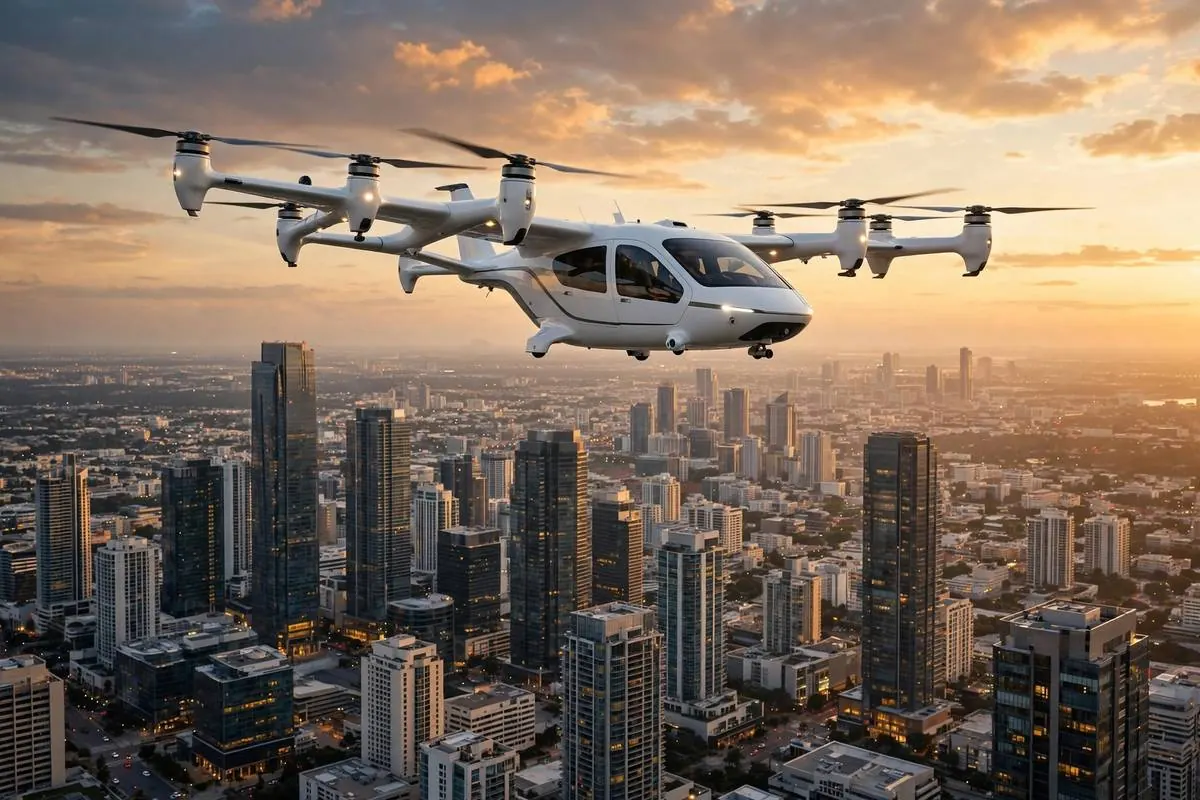
The Roadster's history is inseparable from its credibility. Tesla first revealed the second-generation prototype in November 2017 and said deliveries would begin in 2020. What followed was a ledger of slips: 2021, 2022, 2023, "hopefully" 2024, production in 2025, and by late 2025 a shift to 2027 or 2028. Even the unveiling slid: an October 1 date was postponed two weeks when Tesla said the outdoor show depended on weather. The new target is production in 2028, nearly nine years after the first reveal.
That record does not make the technology fake, but it makes 2028 a claim to weigh rather than a date to trust. The Roadster that left the ground was a prototype, remotely operated, on a closed range, after nearly a decade of development. The distance between that and a certified, road-legal, insurable car runs through aviation-style certification for the airborne functions, automotive safety regulation for the road functions, and the unsolved business of storing enough compressed air in a passenger car to do anything useful in the sky.
Why it matters anyway
Strip away the stunt framing and there is a genuine technology transfer story. Cold-gas thrusters are a spacecraft technology, simple in principle and proven in orbit. Tesla and SpaceX's shared engineering teams have now packaged that capability into an automotive form factor with demonstrated, repeatable results on a full-size vehicle. This is what Musk meant when he called it "the results of what happens when you have a collaboration with the world's best car company and the world's best rocket company."
Electric vertical takeoff and landing aircraft have spent a decade chasing certification for purpose-built air vehicles: lightweight, highly redundant, never intended for roads. Tesla is attacking from the opposite side, taking a road vehicle and bolting on airborne capability. Neither approach has produced a consumer flying car, and Conner's weight paradox explains why: the two design spaces pull in opposite directions. A car that can hold itself upside down with suction, flip through the air, and land on its wheels is not a render. The question is whether hopping is a stepping stone to flight, or the most that road-car physics will ever allow.
0 Comments