
At 10:27 a.m. EDT on October 15, a SpaceX Cargo Dragon nudged itself into the International Space Station's Harmony module and clicked home. Inside its unpressurized trunk: two folded-up solar wings that will be the last major power upgrade the station ever receives. The Dragon, flying the CRS-35 resupply mission, had launched two days earlier from Cape Canaveral's Space Launch Complex 40, the Falcon 9 booster landing back at Landing Zone 40 with a sonic boom on its eighth flight.
The docking was routine in the best possible way, and that is the point. The station is 26 years into a life NASA expects to end with a controlled plunge into the Pacific in the early 2030s. Yet instead of winding down, the ISS is being upgraded to run at its highest power output ever, in service of a research agenda that is busier than at any time in its history. This is not a station in hospice. It is a station being renovated at full capacity, and the reason is worth understanding.
An upgrade, not a repair
The station's original solar arrays entered service between 2000 and 2009, and a quarter century of radiation exposure and thermal cycling has taken its toll. They still work, but they produce significantly less electricity than when they were new. Replacing them outright would be complex and risky, so NASA and Redwire Space took a different approach: the International Space Station Roll-Out Solar Arrays, or iROSAs, flexible roll-up wings that mount directly in front of the aging panels rather than replacing them. Each one restores more than 20 kilowatts of generation capacity without touching the legacy wing behind it. The technology traces back to a demonstration flight on a 2017 resupply mission, and adapting it to the station's original structure, which was never designed for upgrades, required years of engineering: modification kits, new mounting hardware, and preparation work spread across multiple spacewalks.
Six iROSAs are already installed. The two that arrived on CRS-35, the fourth and final pair, will be bolted onto the 2A power channel on the port-side P4 truss segment and the 3B channel on the starboard S6 truss. When all eight are deployed, the station's available power rises from roughly 160 kilowatts to about 215 kilowatts, an increase of up to 30 percent, and each new wing is rated to operate for more than a decade. According to NASA, that margin is what keeps the station's research running through its final years, and it is also what powers the safe and controlled deorbit the agency is planning. A station about to be intentionally destroyed still needs to keep its lights on, and its flight computers up, through the very end.
NASA is spending the station's final years the way cities treat beloved old bridges: reinforce the structure, maximize its capacity, and work it harder than ever, right up to the day it comes down.
Two spacewalks to finish the job
Enjoying this story?
Get the five most important stories in tech, every morning. Free.
The arrays are not installed yet. That happens in the vacuum, by hand, on two spacewalks scheduled for October 29 and November 5. In a milestone for the U.S. space program, these will be the 100th and 101st American spacewalks, and the 285th and 286th spacewalks conducted in support of station assembly, maintenance, and upgrades overall. NASA astronaut Anil Menon and Canadian Space Agency astronaut Joshua Kutryk will exit the Quest airlock for both: on October 29 they will install and deploy the seventh iROSA on the 2A channel, and on November 5 they will complete the power augmentation campaign with the eighth and final wing on the 3B channel. Earlier crews on Expeditions 74 and 75 already did the preparation work, so the channels are waiting, wired and ready.
There is a quiet symbolism in the numbering. The first American spacewalk was Ed White's in 1965, 61 years ago. The 100th is two astronauts unrolling a solar panel on a station that will not exist in five years. Spaceflight has always been a relay race between engineering heritage and obsolescence, and these EVAs are a textbook case: human beings outside a spacecraft, finishing an electrical upgrade conceived before they were selected as astronauts, on infrastructure older than some of the engineers who built the new hardware.
The biotech payload
CRS-35 and the Final iROSA Pair, by the Numbers
Station power before and after the eight-array upgrade campaign.
Sources: NASA station blog (Oct 15, 2026), NASA news release on US spacewalks 100/101, NASASpaceFlight.
Of the roughly 2,867 kilograms CRS-35 hauled up, the unpressurized trunk held the arrays, and the pressurized cabin carried 593 kilograms of science experiments alongside crew supplies, vehicle hardware, spacewalk equipment, and computer resources. The biomedical experiments are the clearest signal of what the station has become: an orbital laboratory that industry treats as manufacturing infrastructure, not a destination.
The headline experiment is LambdaVision-1, hardware to manufacture artificial retinas in microgravity, built layer by layer. Investigators expect the weightless environment to produce more uniform, stable layers than are possible on Earth, which could improve the performance of implants for people with retinal diseases. It travels alongside Stellar Spheroids, 3D heart tissue models intended to advance large-scale drug testing on future missions; ELF-Unconventional Glass 2, studying how a new type of glass forms without gravity; and the MINDS study, brain organoids that could reveal treatment targets for Alzheimer's, Parkinson's, and multiple sclerosis. Dragon will stay at the station until mid-November, then depart with time-critical research samples and failed hardware bound for analysis and refurbishment, splashing down off the coast of California. In a cargo ecosystem now shared with commercial stations on the horizon, Dragon's ability to bring pressurized cargo home remains unmatched, and that downmass capacity is what makes the whole research pipeline commercially legible.
Why a full-power finish matters
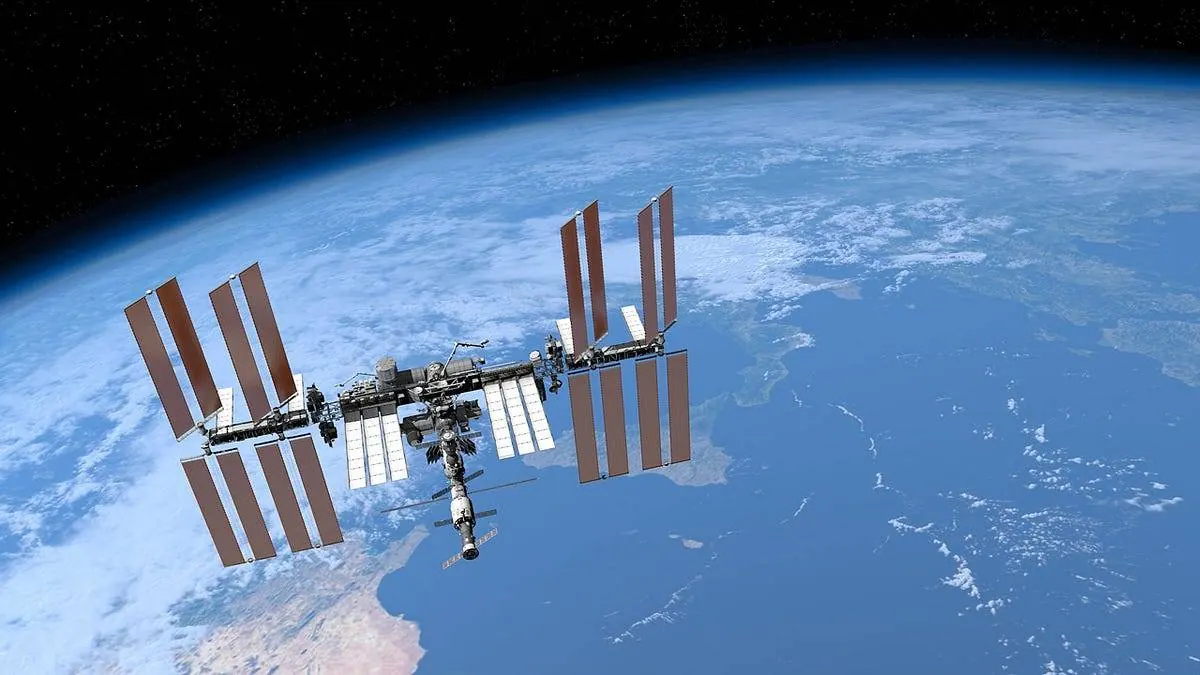
Here is the strategic picture. NASA's commercial low Earth orbit transition assumes the ISS operates until about 2030, with private stations like the ones the agency has been funding taking over research capacity afterward. That handoff only works if the ISS stays productive and safe to the last day, and productive means powered. The extra 55 kilowatts do not just run experiments. They give mission controllers margin: the station can run its full science load, support visiting vehicles, and maintain the systems needed to guide its own deorbit, all at once, without load-shedding tradeoffs. The upgrade also de-risks the commercial transition itself. Companies manufacturing retinas or testing drugs in orbit need reliable power commitments, not degraded legacy performance, to justify their investment in the station's final decade.
There was also a reminder, visible for free, of how routine the extraordinary has become. CRS-35 launched at 6:33 a.m., forty-eight minutes before sunrise, and as the Falcon 9 climbed into sunlight while the ground below stayed dark, its expanding exhaust plume lit up into a glowing space jellyfish, visible from Georgia to New York. It was the 35th commercial resupply flight for NASA, the eighth flight of that booster, and barely a headline. The final solar panels the ISS will ever receive arrived as part of a logistics drumbeat so regular that the spectacle overhead was the only unusual part. That is the real story of CRS-35: not a beginning or an ending, but the moment a 26-year-old space station got its last major upgrade, installed it, and went back to work. The full docking coverage is on NASA's station blog.
0 Comments