
Every vision of future flight eventually has to land somewhere, and somewhere always has neighbors. On October 12, the UK Civil Aviation Authority published its answer to one of the hardest questions in advanced air mobility: what should a drone delivery route or an electric air-taxi corridor be allowed to sound like? The report, Managing Noise from Emerging Aviation Technology (CAP3304), is less a set of rules than a playbook for writing them, and its most striking feature is what it refuses to do. It does not set universal noise limits. Not yet.
The regulator's argument is that the industry has a narrow window to get this right. Get the noise policy wrong now, and air taxis and delivery drones could follow the trajectory of the helicopter: a useful machine that large parts of the public experience mainly as a nuisance overhead. Get it right, and the UK gets a template that other regulators can borrow. The technical publication is dated September 29, 2026; the CAA chose this week to push its findings into the public conversation.
Quieter than a helicopter, harder to live with
The report's central finding sounds like a paradox. Compared with conventional helicopters doing similar work, drones and eVTOL aircraft are expected to be quieter. Yet they may be worse neighbors. The reason is geometry, not decibels. These aircraft fly lower, take off vertically, hover in place, and spread their operations across neighborhoods that have never sat under a flight path. A helicopter passing high over an airport corridor is familiar. An air taxi descending onto a city vertiport, or a delivery drone pausing over a cul-de-sac, is not.
CAP3304 cautions against leaning too hard on the noise measurements built for conventional aviation. A single aircraft's sound level, measured in isolation on a test range, tells you surprisingly little about how a neighborhood will experience that same aircraft flying over homes fifty times a day. The timing, the predictability, the visibility, and above all the frequency of flights shape annoyance as much as the loudness does. The report identifies a real gap in the science: there are not yet robust UK-specific relationships between measured noise exposure and annoyance or sleep disturbance from routine drone and eVTOL operations. Regulators are, in effect, being asked to write the rules before the evidence has fully arrived.
This creates the practical problem that early operators will face first. An aircraft can ace a lab test and still draw complaints when its route repeats over the same houses, or when a landing area wakes people at dawn. The CAA's analysis suggests the pattern of a service, where it flies, how often, and when, deserves as much regulatory attention as the aircraft's engineering.
An air taxi can be quieter than a helicopter on paper and still be a worse neighbor in practice. Altitude, hovering, frequency, and where the route sits decide how the sound lands.
A rulebook with its final pages blank
Enjoying this story?
Get the five most important stories in tech, every morning. Free.
The existing machinery for aviation noise was built for a different sky. Current standards and assessment methods were largely developed for conventional aircraft flying along established flight paths, and the report finds gaps in internationally accepted standards for drones and eVTOLs. The UK's existing regulatory processes give regulators something to stand on, but not a complete or consistent framework for what is coming.
The CAA's recommended fix is deliberately provisional. Rather than locking in definitive, universal drone-specific noise thresholds before the evidence justifies them, CAP3304 proposes a transitional framework: proportionate assessment levels, common data requirements, and periodic reviews that tighten or loosen as operational experience accumulates. The work is meant to feed directly into the Department for Transport's effort to build a national drone-noise policy, with roles for national government, the CAA, and local or devolved authorities within their own responsibilities.
Ed Weston, the CAA's Head of Environmental Research and Consultancy, put the case plainly: "Taking the opportunity to improve our understanding and develop good practice while the sector is still emerging and expanding is vital." A clear and proportionate approach, he argued, protects communities while giving operators something just as valuable: certainty about what they are allowed to build.
The toolbox: routes, hours, and honest data
UK air-taxi noise: the CAP3304 timeline
Note: Figures from the CAA's CAP3304 report and its October 12, 2026 announcement; service dates are UK government policy ambitions, not guarantees.
The report does not stop at philosophy. It names the concrete tools that could manage these impacts. Start with the aircraft itself: reducing sound at the source through quieter design. Then assess each proposed operation in proportion to its likely effects, plan flight routes and operating procedures carefully, and consider restrictions on hours or movement numbers where they are warranted. Land-use planning has a role too, helping decide where vertiports and other fixed facilities go, though planning rules cannot manage aircraft once they are flying across a wider area.
For a proposed airport shuttle, the planning questions would cover the landing site's location, the approach paths, and the number of movements. A medical-supply or delivery-drone network would look different: flights dispersed across many locations rather than concentrated near one airport, raising questions about how many quiet neighborhoods each get a little bit of noise. And throughout, the report stresses something easy to forget in a technical document: communities need clear information about what is flying, where, and when, what it is for, and who is accountable. Accessible complaints channels, consistent record-keeping, and systematic collection of both operational and acoustic data would let regulators and operators judge impacts as trials grow into services.
The clock is already ticking toward 2027 and 2028
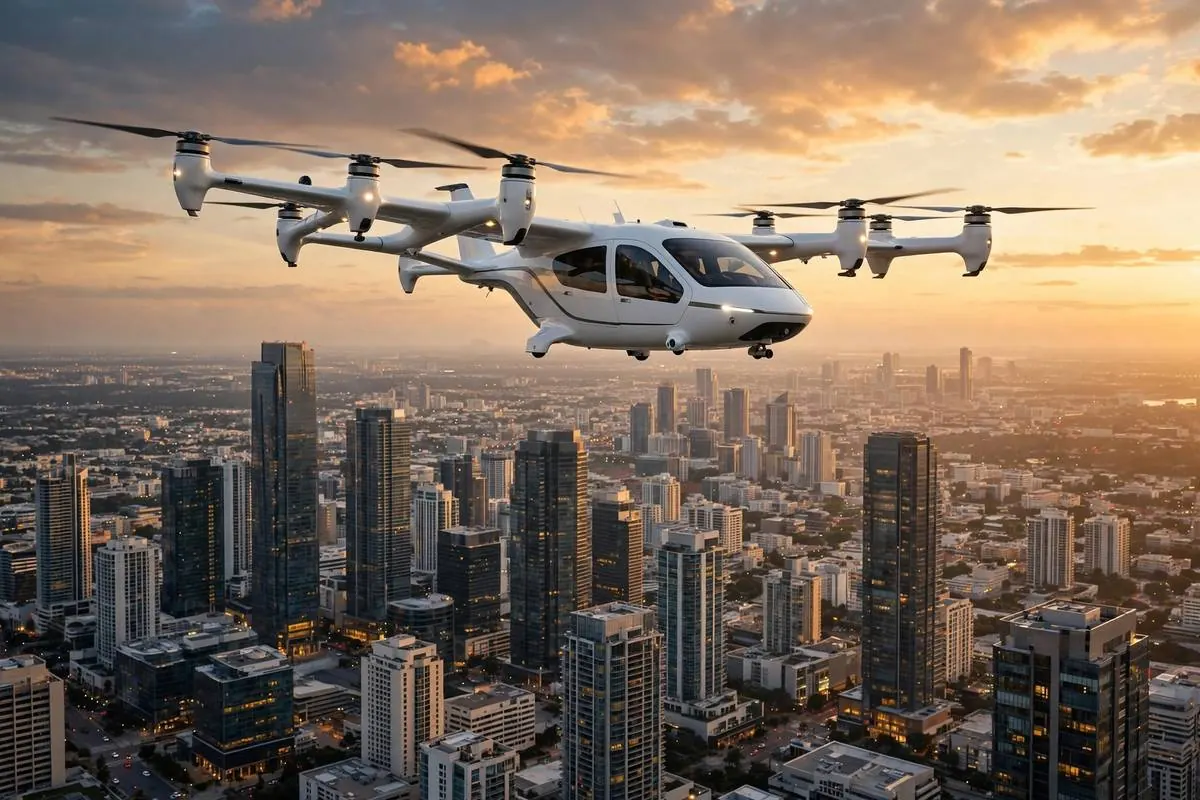
There is a schedule behind all of this. The report cites UK government objectives of routine beyond-visual-line-of-sight drone operations by 2027 and piloted eVTOL passenger services from 2028. Those are policy ambitions(Investors are still divided on who survives the race: Wall Street split the eVTOL industry in three.), not promises that particular routes or networks will open on those dates. But they explain why the noise question is being tackled now, while commercial operations are still small enough to study. This is the logic of the CAA's wider Future of Flight programme, the effort to fit drones and electric air taxis into British airspace without lowering safety or environmental standards.
The commercial stakes are visible in the markets the report singles out. Drones are heading toward infrastructure inspection, emergency work, logistics, and medical deliveries. eVTOLs are being aimed at airport transfers, regional journeys, and possibly emergency services. None of these are established nationwide services yet, and the CAA is careful to describe them as potential uses. But each one implies a different noise footprint, and none of them fits neatly into the categories regulators wrote for the aircraft of the last century.
The honest admission inside CAP3304 is that public acceptance cannot be assessed from aircraft specifications alone. Credible noise evidence, transparent decisions about where flights happen, and a willingness to revise the rules as the data improves may matter more than any single decibel figure. The UK has now said, on the record, that it would rather write those rules carefully than quickly. The rest of the industry is watching, because every air-taxi corridor in the world will eventually have neighbors too.
0 Comments