
On October 12, at the Association of the U.S. Army's annual convention in Washington, D.C., Sikorsky introduced what looks at first glance like a shipping logistics upgrade: a standard 20-foot ISO container. Open the doors and the resemblance ends. Inside are four autonomous vertical takeoff and landing drones, plus the mission-command software, power, communications, and sustainment equipment needed to fly them. Two aircraft can be mission ready in under 15 minutes; the other two follow within four to six hours. No runway is required anywhere in the concept.
The Nomad 100 Fast Pack is being pitched as instant airpower for places that have no airfields: naval vessels, tactical vehicle staging areas, improvised landing zones. The innovation is not really the drone. It is the container. Conventional drone deployments scatter the system across ground control stations, support vehicles, maintenance equipment, and crews. The Fast Pack collapses the whole enterprise into one box that can be shipped, repositioned, and reopened anywhere, then repacked and moved when the mission is done.
What is actually inside the box
The Nomad 100 is an 18-foot-wingspan uncrewed aircraft built around what Sikorsky calls a rotor-blown-wing design: a helicopter's vertical lift and hover paired with the speed, range, and endurance of a fixed-wing aircraft. It flies on the company's MATRIX autonomy software and is classified as a Group 3 drone under Defense Department categories. Depending on how a customer configures it, the aircraft is intended for intelligence, surveillance, reconnaissance and targeting, light attack, or contested logistics.
The numbers that matter are the logistics ones. In its planned configuration (Sikorsky's own qualifier), two aircraft go from boxed to mission ready in under 15 minutes, with the second pair available within four to six hours. The container carries mission-command software, electrical power, communications, and maintenance resources, reducing dependence on permanent aviation infrastructure. After a mission, crews can repack the container, load it onto a compatible vehicle, and move it to a new site.
An airbase is no longer a place you build. It is cargo you move.
Why the Pentagon wants its airpower containerized
Enjoying this story?
Get the five most important stories in tech, every morning. Free.
The Fast Pack arrives as the U.S. military pushes to expand its inventory of uncrewed systems and distribute them across more dispersed operating locations, explicitly in preparation for a potential large-scale conflict in the Indo-Pacific, where fixed runways are long-range targets and forces must keep moving. Military leaders are asking for capability that can deploy worldwide into austere environments, with greater situational awareness, the ability to conduct targeting at range, and the capacity to control multiple assets at once.
This is part of a bigger pattern: the containerization of military capability. The same 20-foot ISO container that moved the global economy is now the standard form factor for missile launchers, radar systems, drone systems, and field hospitals. The reason is mundane and decisive. Every port, ship, truck, and rail car in the world already knows how to move a 20-foot box. When you build a system to container dimensions, you inherit the planet's logistics infrastructure for free, which is a more powerful capability multiplier than most of the technology inside.
The drone behind the box
The Nomad 100 Fast Pack at a Glance
Figures from Sikorsky's AUSA 2026 announcement.
Note: Timing figures describe the planned configuration per Sikorsky. Bar widths scaled for illustration.
The Nomad 100 completed initial ground and flight testing in July 2026 as part of DARPA's EVADE (Early VTOL Aircraft Demonstration) program. It is a larger version of the Nomad 50, which first flew in March 2025. Sikorsky holds a DARPA contract for three Nomad 100 aircraft under the program, and the Marine Corps is buying two more, according to Sikorsky's director of advanced concepts Ramsey Bentley, speaking at AUSA. Nobody has announced a purchase of the Fast Pack itself, and the company has not said whether a physical box has been built yet; the AUSA showing was a concept rendering.
The company has not released the Nomad 100's payload, range, or endurance figures, which makes it hard to judge how much capability the box actually contains. What Sikorsky has disclosed is architectural: distributed, autonomous, and runway-independent. That combination is the trend line. The history of military aviation has been a steady move from few, expensive, exquisite platforms toward many cheaper, more expendable ones, and from basing concentrated on a handful of vulnerable runways toward basing anywhere at all.
The caveats
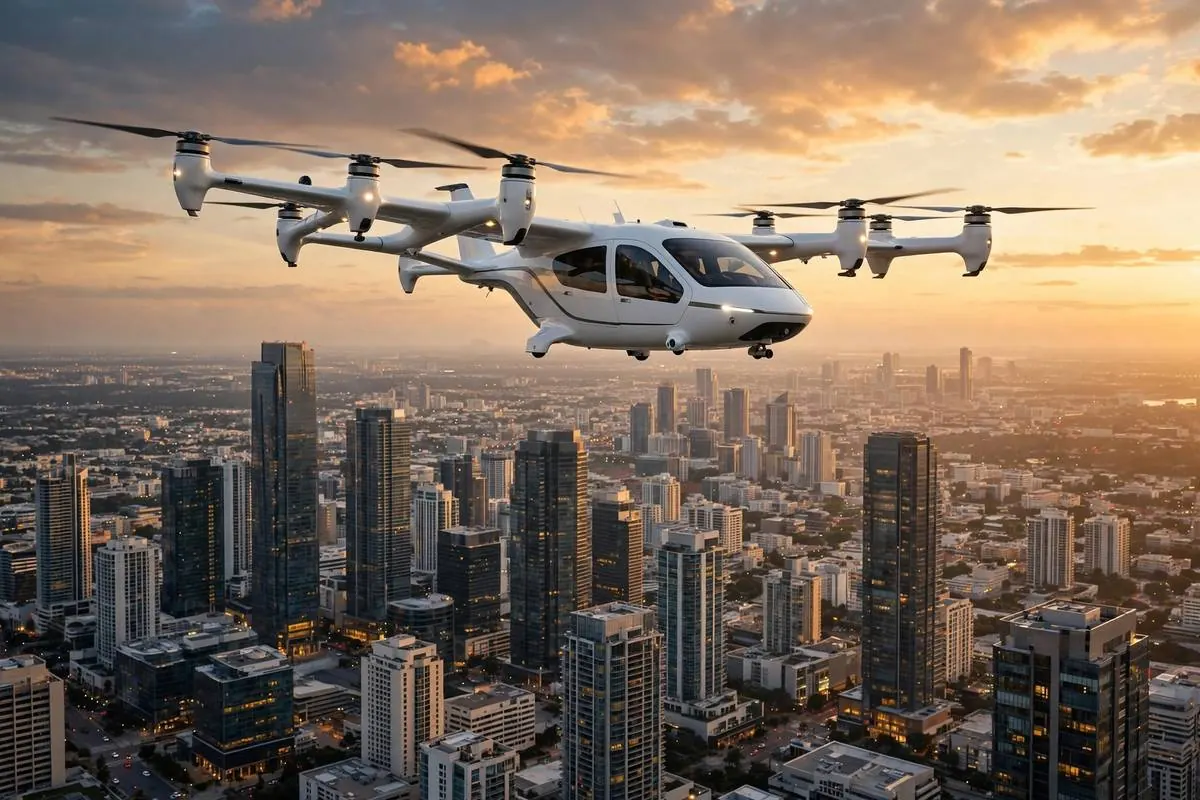
There are reasons to treat the Fast Pack as a pitch rather than a product. The timing claims carry the release's "planned configuration" qualifier, meaning they describe an intent, not a demonstrated capability. Fifteen minutes from container to airborne reconnaissance is a logistics claim about packing, checklists, and crew drills as much as about aircraft technology, and none of that has been publicly demonstrated. And the autonomy story matters more than the container: MATRIX software, which grew out of Sikorsky's work on autonomous Black Hawk flights, is doing the flying, and container or not, autonomous VTOL aircraft were coming.
But the framing is the story. Sikorsky, a Lockheed Martin company, is not really selling four drones. It is selling a different theory of what an airbase is: not infrastructure, but inventory. If the future of airpower is distributed, attritable, and constantly moving, then the most important engineering choice may not be wing shape or propulsion at all. It may be the dimensions of the box everything arrives in.
0 Comments