
At Edwards Air Force Base in late September, NASA's experimental X-59 aircraft did something that would have been unthinkable a decade ago: it flew supersonic six times in a single week and, in the process, reached Mach 1.53, roughly 1,010 miles per hour, the fastest it has ever flown. The jet is not chasing records. Each flight pushes the X-59's flight envelope outward and gathers the data NASA needs to answer a question that has hung over aviation since 1973: can a jet fly faster than sound over a city without anyone below noticing?
NASA announced the milestone in an October 2 update as part of its Quesst mission to demonstrate quiet supersonic flight. The week, with two flights each on September 22, 24, and 25, beat the aircraft's previous single-week record by two flights and brought the program to 38 total test flights. Then the jet earned its rest: NASA put the X-59 into a scheduled maintenance period of about three weeks, followed by a systems review, before the team resumes its fast test cadence.
An airplane shaped by a noise problem
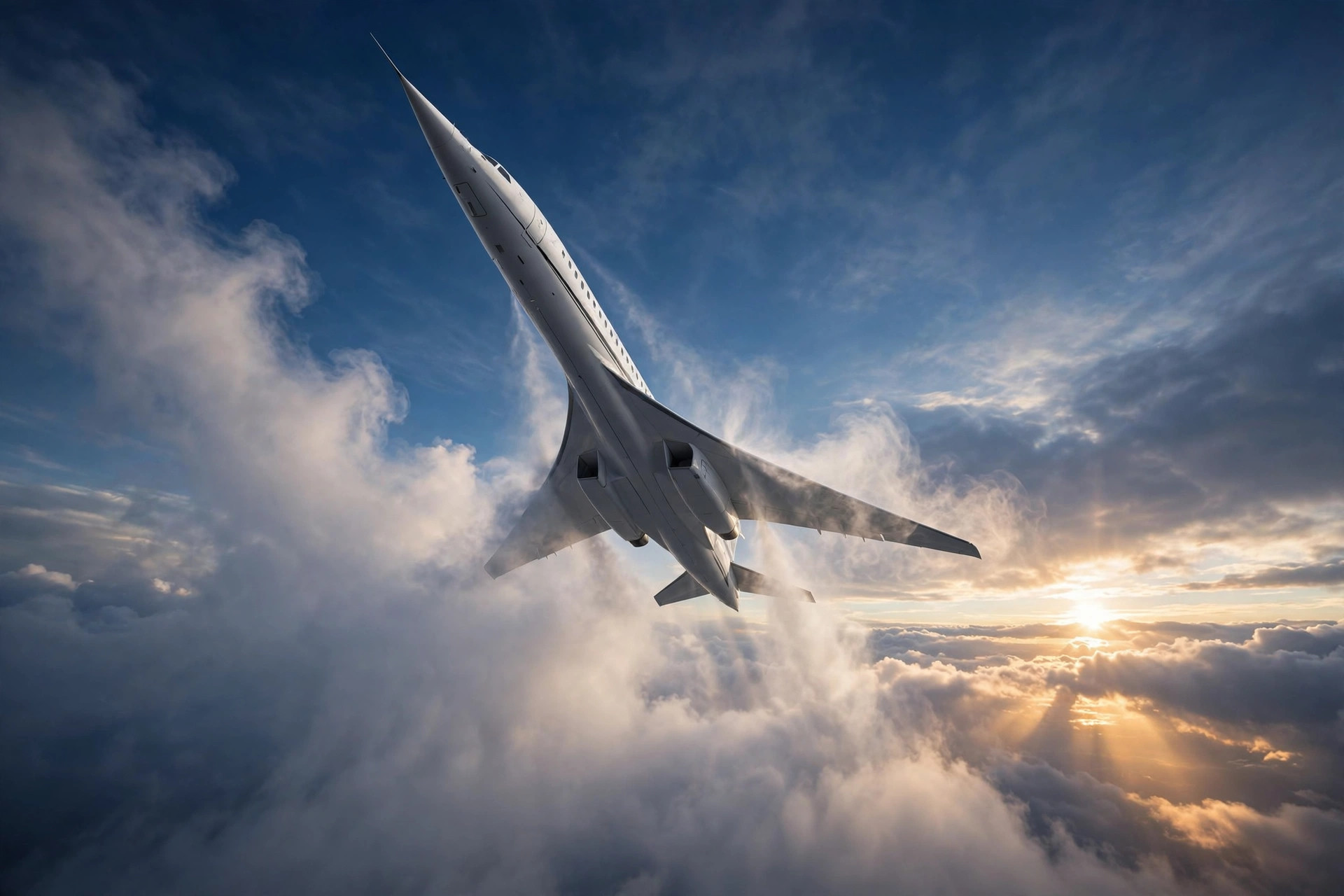
The X-59 looks the way it does because of acoustics. A conventional supersonic aircraft merges its shock waves into a single sharp boom, the double crack that rattled windows during the testing era of the 1960s and 1970s. The X-59, built by Lockheed Martin's Skunk Works, stretches 99.7 feet long with an elongated needle nose, a contoured fuselage, and a top-mounted engine inlet, all designed so the individual shock waves dissipate through the atmosphere instead of reinforcing one another on the way down. The nose is so long there is no room for a forward cockpit window, so the pilot flies with a camera-fed display.
This year the design has been proving itself in the air. The X-59 completed its first supersonic flight on June 5, 2026, reaching Mach 1.077 at 43,400 feet over Edwards. One week later it hit Mach 1.4 at 55,030 feet, the speed and altitude at which it will eventually fly over U.S. communities to measure public response. September's Mach 1.53 run pushed past even that cruise target.
Why six flights in a week matters
Enjoying this story?
Get the five most important stories in tech, every morning. Free.
The rapid schedule is part of flight envelope expansion, the phase where NASA explores how the aircraft performs across speeds, altitudes, and maneuvers. For a program this specialized, pace is itself a milestone: the X-59 went from its first supersonic flight in June to six supersonic sorties in a week by September, a sign that the aircraft and its ground operations are maturing quickly.
The X-59 is not trying to go fast. It is trying to go fast quietly enough that a 53-year-old federal ban finally becomes unnecessary.
What comes next is arguably more important than any speed record. The acoustic validation phase measures the X-59's actual sonic signature using a shock-sensing probe mounted on an F-15 chase aircraft. Then the final phase flies the jet over multiple American cities while NASA places microphones on the ground and surveys residents. That community response data goes to the Federal Aviation Administration and the International Civil Aviation Organization, and it will shape the noise standards that could one day govern supersonic flights over land.
The rulebook is being rewritten in parallel
Supersonic speed check
Top speeds of supersonic aircraft, past, present, and planned.
Sources: NASA, Boom Supersonic, October 2026.
NASA's test campaign is landing in the middle of a regulatory overhaul. On July 2, 2026, the FAA published a notice of proposed rulemaking titled 'Enabling Supersonic Overland Flight' (Docket FAA-2026-6935) that would repeal the 1973 prohibition on civil supersonic flight over land and replace it with a performance standard: supersonic flight would be allowed as long as the sonic boom overpressure at the ground does not exceed 0.11 pounds per square foot.
The proposed threshold is roughly 10 to 20 times lower than the 1.0 to 2.0 pounds per square foot produced by a traditional Concorde-era boom, the kind that rattles windows and sets off car alarms. At 0.11, the acoustic effect at the surface would be a low thump or distant rumble rather than a sharp crack, at least on paper. The comment period closed on August 17, 2026, and the FAA is targeting a final rule by mid-2027.
Not everyone is convinced the number is right. Purdue University researchers argued in comments that a simple pressure threshold does not capture how people perceive sound, and suggested a decibel-based standard might fit better. An Aviation Week analysis of the filings in early October reached a sobering conclusion for optimists: judging by industry comments, there would be no rush to build a high-speed business jet even if the rule is finalized exactly as proposed.
The commercial race behind the test flights
The X-59 will never carry a paying passenger. Its job is to de-risk the regulation so someone else's airplane can. The leading candidate is Boom Supersonic's Overture, designed to carry 64 to 80 passengers at Mach 1.7 with a range of 4,250 nautical miles. Boom's XB-1 demonstrator broke the sound barrier on January 28, 2025, reaching Mach 1.122, and the company holds roughly 130 conditional orders from United Airlines, American Airlines, and Japan Airlines.
Boom's approach does not rely on exotic airframe shaping. Its 'Boomless Cruise' concept uses the Mach cutoff phenomenon: at certain combinations of speed and altitude, shock waves refract upward through the atmosphere rather than reaching the ground. Whether that can consistently keep ground-level overpressure below 0.11 pounds per square foot across seasons and weather is a question only flight testing will answer.
The real test is trust, not speed
All of this engineering converges on one stubbornly human problem: what people are willing to tolerate. In 1964, the FAA and the Air Force ran Operation Bongo II over Oklahoma City, flying military jets supersonic over the city eight times a day for six months and producing 1,253 sonic booms. Residents filed more than 15,000 formal complaints and 9,594 reports of damage; the 4,629 formal damage claims totaled 12,845 dollars in broken glass and cracked plaster, and the FAA rejected 94 percent of them. The fury helped kill funding for the Boeing 2707 supersonic transport in 1971, and the 1973 ban followed two years later.
Concorde lived with the consequences: on U.S. routes it flew subsonic over land and accelerated through Mach 1 only past the Atlantic coast. A theoretical New York to Los Angeles flight at Mach 2 would take about two and a half hours instead of five and a half, but it was never legally possible over land.
That history is why the X-59's 2027 community overflights, not its Mach 1.53 record, will determine whether this revival succeeds. The FAA can write a noise standard, and NASA can fly a remarkably quiet jet, but the standard only becomes durable if the people living under the flight path find the thump acceptable. The six-flight week in September was proof the airplane works. The proof that the idea works is still ahead.
0 Comments