
GlobalFoundries just landed one of the largest chip-factory deals in American history, and the money is coming from Tokyo. On October 14, the chipmaker announced it had been selected to build and operate two new 300mm semiconductor fabs at its Malta, New York campus under a U.S.-Japan initiative that could channel up to $21 billion into American chip manufacturing. The investment will come from Japan, enabled by the trade-and-investment agreement President Trump struck with the country earlier this year.
It is a deal that scrambles the usual logic of chip diplomacy. Japan is not funding its own fabs here. It is paying to build American ones, operated by a company majority-owned by Abu Dhabi's Mubadala Investment Company, with Washington taking an equity stake in the bargain. In the new industrial-policy era, supply chains are negotiated like trade pacts, and this one is among the biggest ever signed.
What was announced
Under the initiative, Japan will provide up to $21 billion to fund two fabrication plants at GlobalFoundries' existing Malta site in Saratoga County, New York. The first $10 billion is earmarked to accelerate construction of the first fab, which the company expects to come online in 2029. A second $10 billion tranche would fund a second fab of similar capacity. Each fab is expected to add about 900,000 300mm wafers of annual U.S. output when fully operational, which would make the expansion one of the largest mature-process additions on American soil in decades.
The scope of the project is substantial even by fab standards. GlobalFoundries says the two plants will support roughly 27,000 construction and ecosystem jobs, plus more than 1,000 high-skilled manufacturing jobs in New York's Capital Region. These are not leading-edge AI accelerators. The fabs will manufacture foundational chips for the automotive, communications, and industrial machinery markets, and Reuters reported that Apple and Japan's Renesas Electronics are among the first customers.
Japan is not funding its own fabs here. It is paying to build American ones, with Washington taking an equity stake in the bargain.
Why Japan is footing the bill
Enjoying this story?
Get the five most important stories in tech, every morning. Free.
The $21 billion flows from a much larger commitment: Japan's agreement to invest $550 billion in the United States in exchange for lower tariffs. The semiconductor fabs are among the first major industrial projects attached to that agreement. Japan is not doing this as charity. The Digital Watch Observatory reported that returns on the investments will be shared equally between Washington and Tokyo up to a defined ceiling, and GlobalFoundries CEO Tim Breen said some of the capital would flow back to Japanese equipment suppliers such as Tokyo Electron.
There is also a strategic logic. Japan needs reliable sources of mature-process chips for its own automotive and industrial giants, including Renesas. Building that capacity in the United States under a formal bilateral framework gives Japanese customers priority access. Breen told reporters the company "definitely would like to give priority to U.S. and Japanese customers."
The Washington twist: government as shareholder
The Malta Expansion at a Glance
Key figures from the October 14, 2026 announcement.
Note: For illustrative purposes only.
The deal is not just foreign money. Under a separate agreement, GlobalFoundries amended its existing award under the CHIPS and Science Act to reallocate $955 million toward silicon photonics, silicon-germanium, and advanced packaging at its facilities in Malta, New York, and Burlington, Vermont. And the U.S. Department of Commerce will take an approximately 4 percent equity stake in the company, according to Dow Jones reporting, tightening the alignment between the company and Washington's industrial policy.
Government ownership stakes in Western chip companies would have been unthinkable a decade ago. They are becoming routine. The Commerce Department's share is small, but the precedent is large: the U.S. government now has direct equity exposure in a company building the country's foundational chip supply. Mubadala remains the majority owner, but the cap table increasingly resembles a diplomatic seating chart.
Why mature chips matter
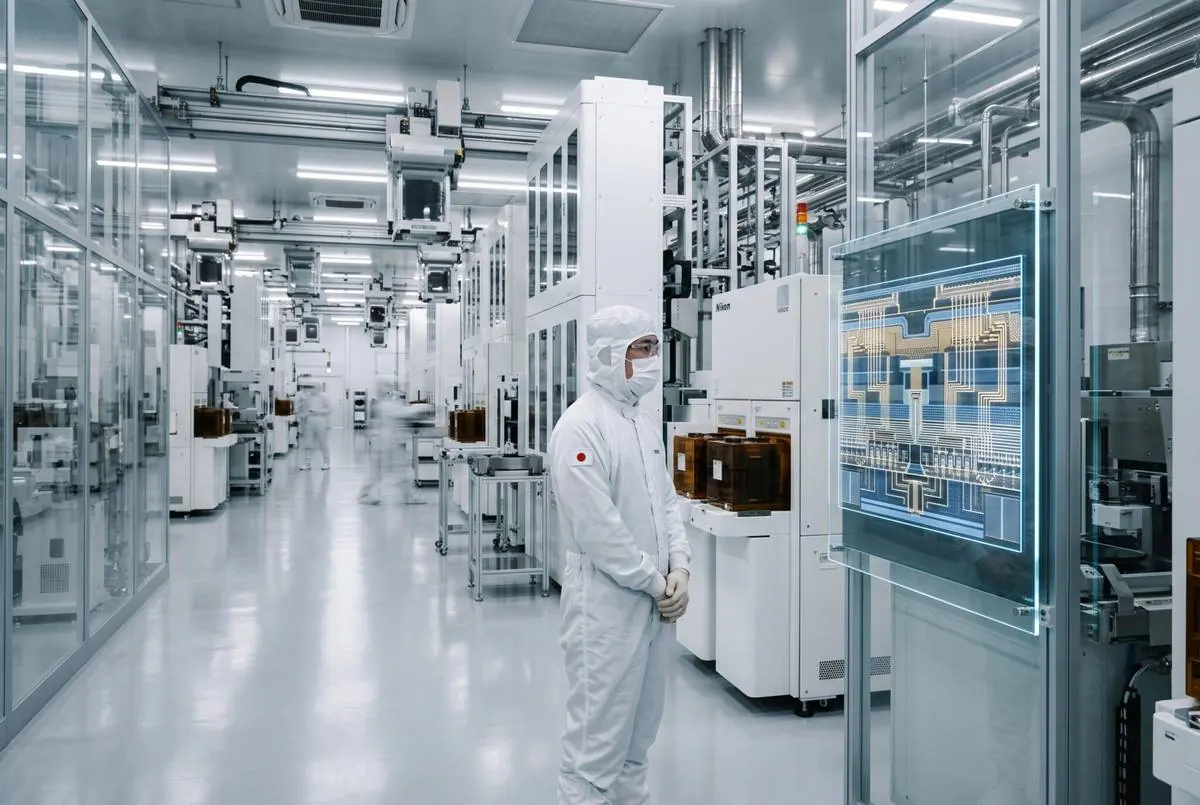
It is easy to be distracted by the AI chip boom, where high-bandwidth memory and advanced packaging dominate the headlines. But the chips that run cars, factory equipment, and telecommunications gear are made on older process nodes, and that market is where the United States remains most dependent on foreign supply. GlobalFoundries is one of the few Western pure-play foundries serving this segment at scale, which is why it was chosen for the role.
The Malta expansion also arrives as Washington pushes to reshore not just fabs but the ecosystem around them. Intel and Micron recently urged Taiwanese suppliers to establish operations in the United States, according to reports from The Elec, and SEMI projects that fab-tool spending in the Americas will roughly double to $40.6 billion by 2029 as TSMC, Intel, Micron, and Samsung expand. Foundries need materials, components, and equipment nearby. The $21 billion buys the fabs. The rest of the supply chain still has to follow.
What to watch
The first real test comes before construction finishes. Groundbreaking on the first fab is expected later this year, but the second $10 billion tranche is described as contingent on further investment, so the full $21 billion is a ceiling, not a check already written. Watch whether the second fab gets firm funding, whether additional customers beyond Apple and Renesas are named, and how the Commerce Department's equity stake evolves. Reuters noted total U.S. government ownership could rise to around 7 percent depending on how related provisions play out.
The bigger question is whether this model, foreign capital funding domestic fabs under a bilateral pact, becomes the template. With leading-edge capacity still concentrated in Taiwan and South Korea, and equipment spending surging across the Americas, the GlobalFoundries deal suggests the next phase of the chip race will be won by whoever stitches together the most durable cross-border partnerships. On October 14, that looked like Tokyo writing a check for upstate New York.
0 Comments