
On October 15, at the Digital Innovation Forum 2026, D-Wave announced that its newest annealing quantum computer has arrived in Lombardy for installation at Villa Saporiti in Como. The machine, an Advantage2 system with more than 4,400 qubits, was funded by Swiss Quantum Technology SA (SQT) and will be known within the Q-Alliance ecosystem as the VoltaB1. It is Italy's first annealing quantum computer, and it will be formally inaugurated on October 16 at Q-Alliance's "Quantum per l'Italia" event, in the run-up to the bicentennial of Alessandro Volta's death. D-Wave CEO Alan Baratz is scheduled to speak.
The announcement matters because this is not a research loaner or a lab prototype. Once installed, the system will be accessible through D-Wave's Leap quantum cloud service, which the company says delivers 99.9 percent availability. The bet being placed in Como is not that quantum computers are about to replace classical ones. It is that there is enough real optimization work in Italian industry, enough researchers who need hands-on time, and enough political will behind digital sovereignty to justify putting a production-grade machine on the floor and letting people book time on it.
The deal behind the machine
The hardware arrived on the back of a 10 million euro agreement between D-Wave and SQT. Under the deal, SQT acquired half of the system's capacity for five years and holds an option to buy the entire machine outright. That structure says a lot about where quantum infrastructure stands in 2026: nobody knows exactly how much quantum compute time they will need, but the parties confident enough to reserve half a machine for half a decade are acting as though the answer is nonzero and growing. SQT's acting CEO, Thomas F. Darden, framed the arrival as putting physical infrastructure behind the company's vision for Italian quantum innovation, connecting researchers and businesses with advanced computing resources instead of slide decks.
Annealing is not what IBM and Google sell
Enjoying this story?
Get the five most important stories in tech, every morning. Free.
Precision matters here, because the phrase "quantum computer" now covers machines that do fundamentally different things. The systems IBM, Google, and IonQ are racing to build are gate-model machines: they apply sequences of quantum gates to qubits, the quantum analogue of logic gates, and in principle they can run any quantum algorithm. That race is being independently stress-tested by programs like DARPA's Quantum Benchmarking Initiative, which is now checking whether the blueprints can actually be built.
D-Wave's annealers take a narrower path. You encode your problem, typically an optimization problem like scheduling, routing, or portfolio selection, as an energy landscape, and the machine physically settles into the lowest-energy configuration it can find. That is a genuinely quantum process, and for the right problems it can be fast, but it is not a universal computer. An annealer will not run Shor's algorithm or break encryption. D-Wave is the rare company building both architectures, which is why it calls itself dual-platform, but the VoltaB1 is an annealer, and it should be judged as one: on optimization, sampling, and materials simulation workloads, not on the gate-model scoreboard.
The VoltaB1 should be judged as an annealer, not as a would-be rival to gate-model machines: its worth will be measured in scheduling, routing, and materials problems solved, not in abstract qubit records.
The 4,400-qubit number, honestly
D-Wave annealing systems by generation
Raw physical qubit count per system. Advantage2 trades some raw count for denser connectivity and lower noise.
Counts are D-Wave's stated physical qubits for its annealing systems. In annealers, qubit connectivity and calibration quality matter more than raw count, which is why the newest system can be more capable with fewer qubits.
More than 4,400 superconducting qubits makes the Advantage2 D-Wave's most advanced annealer, and the number will inevitably be quoted as a record. Treat it with the usual care. Annealer qubits are physical qubits with no error correction, so they cannot be compared one-to-one with the error-corrected logical qubits that gate-model roadmaps talk about. In annealing, what matters at least as much is connectivity, how many other qubits each qubit talks to, and noise, how cleanly the machine holds its quantum behavior during a run. Advantage2 actually has fewer qubits than its predecessor, the 5,000-plus-qubit Advantage, and D-Wave's pitch is that the newer Zephyr topology, with denser connections and lower noise, makes the machine more capable anyway. That is the right way to read the spec sheet: capability per qubit, not qubits per press release.
D-Wave says the Advantage2 has demonstrated the ability to outperform classical computing on a complex materials simulation problem, a result the company describes as one that would have taken a leading classical supercomputer nearly a million years. That is the company's claim, and it sits in a field where classical algorithms keep raising the bar: researchers in Edinburgh recently showed that a clever classical emulator can match or beat some current quantum devices on photonic simulations at a fraction of the energy cost. The honest position is that annealing has credible, specific wins and a long list of problems where classical machines still dominate. The Como installation is a chance to expand the first list with evidence rather than assertions.
Why Italy is deploying quantum in pairs
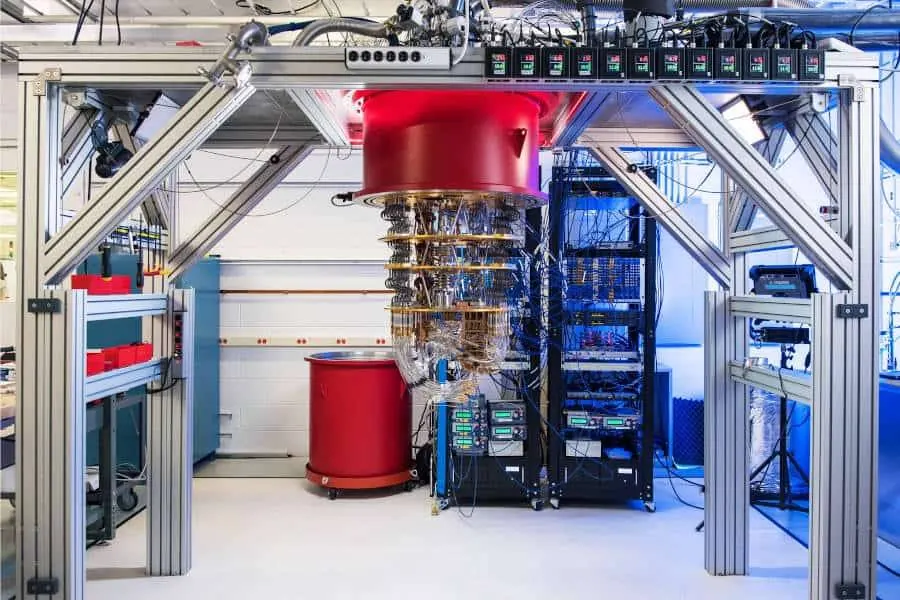
The VoltaB1 is not Italy's first quantum computer, and the pairing is the interesting part. In June 2026, France's Pasqal inaugurated SOL, a 140-qubit neutral-atom system at CINECA in Bologna, integrated with the Leonardo supercomputer under the EuroHPC Joint Undertaking. Neutral-atom machines excel at analog simulation and hybrid supercomputing workflows; annealers excel at optimization. Italy is now hosting both architectures at once, a few hundred kilometers apart, which looks less like duplication and more like a deliberate refusal to bet the country's quantum future on a single technology.
The institutional scaffolding is already in place. Q-Alliance, the consortium behind the Como installation, was founded in October 2025 by D-Wave and IonQ with a memorandum signed in Como and the backing of Italy's digital-transition authorities, including undersecretary Alessio Butti. In June 2026, D-Wave signed the Volta Declaration at the World Tech Conference in Milan, a cooperation framework covering quantum, artificial intelligence, and sovereign computing infrastructure. The alliance's stated program mixes open scientific access with workforce development, scholarships, internships, and training: the unglamorous part of the plan, and arguably the most important, since machines without trained users are museum pieces.
The hard part is the queue, not the qubits
What happens next is commercial, not ceremonial. D-Wave says more than 100 organizations already use its systems across aviation, manufacturing, telecommunications, and health care, and the VoltaB1's capacity is now a bookable resource for European researchers, universities, and businesses. The genuine annealing use cases, flight and crew scheduling, supply-chain optimization, materials discovery, are problems companies already pay classical clusters to solve badly. If the Como machine can solve them measurably better or cheaper, the order book will fill. If it cannot, no inauguration speech will save it.
There is something fitting about the name. Volta invented the battery, the device that turned electricity from a parlor trick into infrastructure, and the grid it enabled took decades to matter. Quantum computing may be on a similar clock. But clocks only matter once the hardware is in the room, and as of this week, in a historic villa on Lake Como, it is.
0 Comments