
On October 14, a team from the University of Edinburgh published a paper with a deliberately provocative title: "A fast and frugal Gaussian Boson Sampling emulator." The claim inside starts arguments. Using a single off-the-shelf CPU or GPU, the researchers built a classical simulation that outperforms 100-mode Gaussian boson sampling experiments on standard benchmark tests. That task, running on light-based quantum hardware, has been one of the showcase examples of quantum advantage for half a decade. And now a conventional computer can do it better, using a fraction of the resources previous simulators needed.
The paper, by Tom Dodd and colleagues in the University of Edinburgh's School of Informatics with collaborators at EPCC, Polytechnique Montreal, and Phasecraft, appeared in Science Advances (DOI: 10.1126/sciadv.aef8431). The results are narrow, technical, and worth taking seriously: not because they mark the end of quantum advantage, but because they show how the verification loop between classical and quantum machines is supposed to work.
The benchmark that started it all
Gaussian boson sampling, or GBS, is about as artificial as a computing problem gets. You fire pulses of squeezed light into a network of beam splitters and mirrors, let the light interfere with itself, and record which photon detectors click. The result is a sample drawn from a probability distribution defined by the mathematics of the light field. Computing that distribution from scratch is believed to be extremely hard for classical computers: the core calculation involves matrix functions called hafnians whose difficulty grows brutally with the size of the system.
That hardness is exactly why GBS became famous. In 2020, a team at the University of Science and Technology of China ran the experiment, Jiuzhang, with 76 detected photons and claimed a quantum computational advantage over supercomputers. A larger successor, Jiuzhang 2.0, followed. For years, these experiments sat near the top of the quantum supremacy scoreboard.
But a crucial fact often gets lost in the retelling. GBS is not a useful computation. Nobody is factoring numbers, simulating molecules, or optimizing portfolios with it. It was designed from the start as a benchmark: a task that is easy for a photonic device and hard for a classical one, chosen precisely to make the comparison clean. When the comparison shifts, so does the headline.
What the Edinburgh team actually built
Enjoying this story?
Get the five most important stories in tech, every morning. Free.
The new emulator targets the threshold-detector version of GBS, where each detector reports only whether at least one photon arrived, not how many. Using a combination of algorithmic refinements, the team reports that a single CPU or GPU can now beat 100-mode GBS experiments on the standard benchmark tests used to check that a device is producing genuine quantum statistics.
The headline efficiency figure comes from the study's own reporting: running these simulations now takes roughly 5 percent of the computing power previously needed with a supercomputer. That puts them within reach of standard machines rather than the handful of facilities worldwide with the necessary supercomputing muscle. And because the method is, in the authors' term, embarrassingly parallel, a small cluster of CPUs or GPUs can match sampling rates that previously required more than 100 GPUs.
The research, led by Raul Garcia-Patron of Edinburgh's School of Informatics, framed the work as democratization: the improvements in memory use, running time, and energy cost make mainstream what was previously available only at a few facilities, he said in the university's announcement. Better, cheaper simulators mean claims about photonic devices can be tested by far more groups than before.
The fastest way to find out what a quantum machine has truly achieved is to keep trying to beat it with a classical one.
Why beating a quantum computer is progress, not defeat
Simulating 100-mode Gaussian boson sampling
Based on Dodd et al., Science Advances (2026), DOI: 10.1126/sciadv.aef8431.
There is a long tradition in quantum computing of classical algorithms chasing down quantum advantage claims, and it is a feature, not a bug. In 2019, Google's Sycamore announcement triggered a wave of classical simulation papers that clawed the claimed advantage down by orders of magnitude. Similar rounds played out over the Jiuzhang experiments. Each round of "the classical computer caught up" did not kill the field; it sharpened the question of what genuine, lasting advantage looks like.
The reason is simple: a quantum advantage claim is only meaningful if it can, in principle, be checked. Simulators are the check. They produce reference samples against which hardware outputs can be compared, they reveal which parts of an experiment are truly hard and which are incidental, and they expose the places where real devices underperform their idealized models. A community that can simulate 100-mode GBS on a laptop is a community that can tell whether the next 1,000-mode machine is doing something classical computers genuinely cannot.
The authors also argue their techniques generalize. Most of the innovations in the emulator apply to generic probability distributions over binary variables, they write, which makes the tools potentially useful for simulating qubit-based sampling problems and for building classical surrogates inside classical-quantum hybrid algorithms. That is a plausible but still speculative extension: the demonstrated results are for threshold-detector GBS at the 100-mode scale.
The 100-mode line, and what sits beyond it
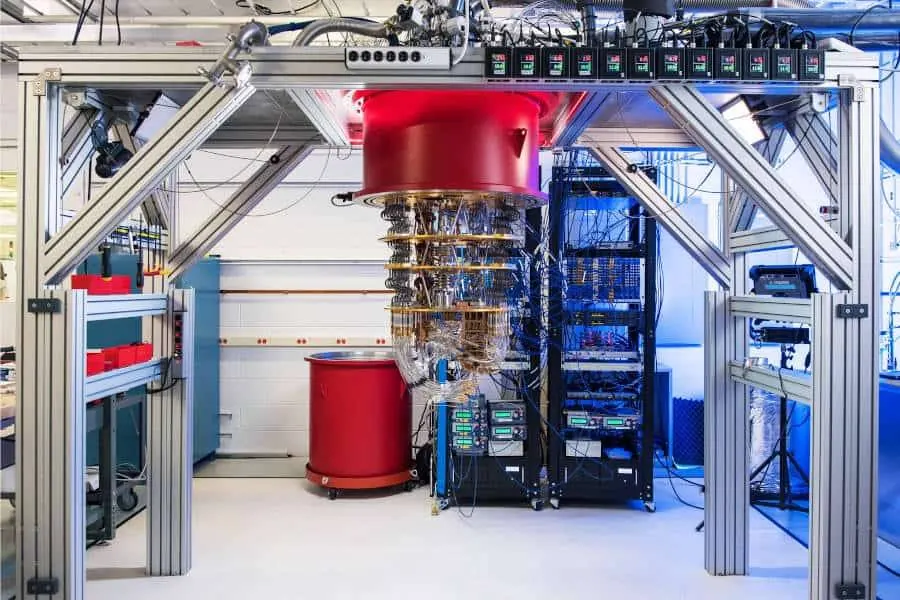
One hundred modes is not an arbitrary number. It sits just above the scale of the flagship GBS experiments of the past few years, which is exactly why it makes an effective benchmark. But the team is explicit that the work is not finished at 100. They expect improvements to extend the approach to photo-counting detectors (which report the actual number of photons per detector, a richer and harder problem), single-photon inputs, and systems beyond 1,000 modes.
Those are projections, not results, and they deserve the standard caveats. Quantum hardware is moving too: photonic platforms keep adding modes and reducing loss. The history of this benchmark is a ratchet, with each side improving in turn. What the Edinburgh paper changes is the cost of playing on the classical side. When verifying a claim costs 5 percent of what it used to, verification happens more often, by more people, and sooner.
There is also a quieter implication for photonic quantum computing itself. Light-based devices are one of several serious approaches to quantum computing, alongside superconducting circuits, trapped ions, and neutral atoms. Simulation of the kind demonstrated here is how engineers test whether their interferometers, squeezers, and detectors behave as designed. Faster simulation means faster design iteration before committing to expensive hardware.
In perspective
It is tempting to read this paper as a reversal of fortune, the moment the classical computer took its crown back. That framing misses the actual dynamic. Gaussian boson sampling was invented to be a measuring stick, and a measuring stick is not diminished when the thing being measured improves. What the Edinburgh emulator demonstrates is something more durable: that the machinery of scientific verification in quantum computing is getting cheaper and more accessible.
The serious question was never whether a classical algorithm could reproduce the statistics of 100 modes of interfering light. It was always whether quantum machines could keep pushing into regimes where classical reproduction stays out of reach, and whether the problems they solve there turn out to matter. This paper does not end the race. It just makes the timing official, and much harder to argue with.
0 Comments