
On October 7, the Defense Advanced Research Projects Agency made one of its most consequential quantum decisions in years. Atom Computing, Diraq, IBM, and IonQ were selected for Stage C of the Quantum Benchmarking Initiative, or QBI, DARPA's program to determine whether any quantum-computing approach can reach utility-scale operation by 2033. They join Microsoft and PsiQuantum, which entered Stage C through the US2QC pilot program that preceded QBI.
The significance is the shift it marks. For two years, DARPA has audited plans: engineering roadmaps, technical risks, proposed mitigations. Now it starts testing reality.
From blueprints to lab benches
QBI is structured in stages, and each stage asks a different question. Stage B put the companies' development plans under the microscope. As QBI managing director Micah Stoutimore put it, Stage B is "about putting the performers' plans under a microscope: understanding the assumptions, identifying the risks, and determining whether the proposed development paths could plausibly get all the way to utility scale."
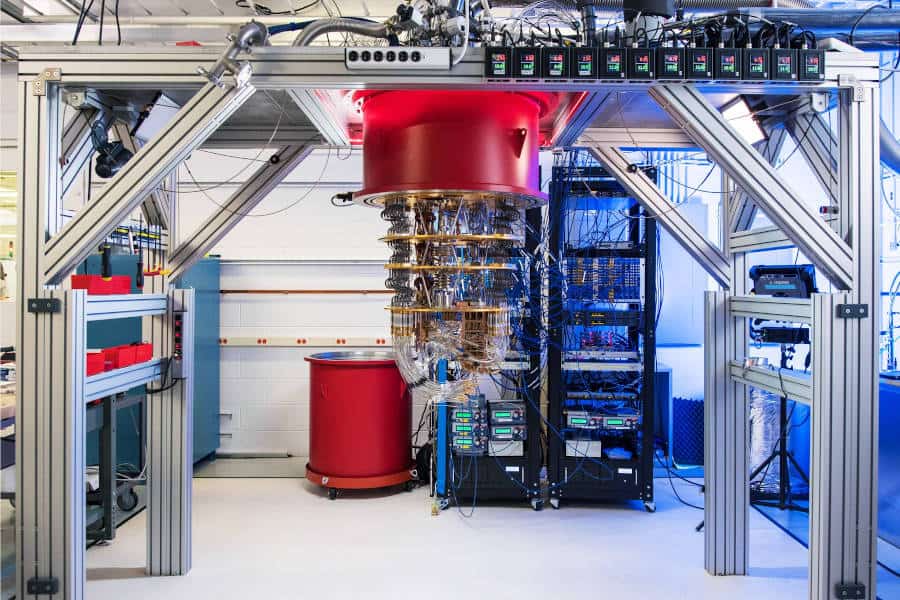
Stage C changes the subject from plausibility to measurability. Participants work with the government's independent verification and validation teams to test whether their proposed systems can be constructed as designed and operated as intended. Direct measurement of hardware, prototypes, and system designs replaces the paper audit.
The bar has a precise definition. QBI defines utility scale as the point where a quantum system's computational value exceeds its total capital and operational costs. That is an economic threshold, not a qubit count. A system with millions of physical qubits that solves nothing worth paying for fails the test. A smaller machine that reliably delivers commercially or scientifically valuable results could pass it.
DARPA is done asking what the machine would do and has started asking what the machine does.
Four machines, four kinds of physics
Enjoying this story?
Get the five most important stories in tech, every morning. Free.
The four newcomers represent fundamentally different hardware philosophies, which is exactly the point. QBI is deliberately not a competition and is not meant to pick a single winner. Each approach is evaluated on its own merits.
IBM is advancing its modular superconducting processors. IBM plans to deliver its first fault-tolerant quantum computer, IBM Quantum Starling, in 2029. In Stage C, DARPA's independent verification team will stress-test the hardware directly, a critical checkpoint for keeping that schedule credible.
IonQ works with trapped ions, and signed a Stage C agreement with DARPA that the company says is worth up to $300 million and runs through 2029. The government will test several generations of IonQ's Superion quantum systems against the company's technical roadmap. That $300 million figure is a ceiling, not a commitment: funding beyond the initial obligation depends on future appropriations and DARPA funding actions.
Atom Computing builds scalable arrays of neutral atoms, and DARPA's evaluation includes a genuine research result. In a June preprint on quantum error correction with the toric code, the team reported running as many as 90 cycles of syndrome extraction while replacing atoms lost mid-computation and reloading from a reservoir. That addresses one of neutral-atom computing's practical weaknesses: atoms escape their traps, and a computation that cannot survive that loss cannot scale. Microsoft has also agreed to provide Atom with algorithmic support and error-correction codes. An honest caveat: the long reloaded runs did not themselves demonstrate lower logical error rates at larger code distance, so the error-correction claim rests on the 90-cycle survival result, not on a full scaling demonstration.
Diraq, based in Sydney, builds silicon spin qubits compatible with standard CMOS chip manufacturing. The strategic argument is industrial: if quantum processors can be made with the same tooling as conventional chips, manufacturing scale follows existing supply chains rather than requiring entirely new ones. DARPA completed a rigorous Stage B evaluation of Diraq's proposed systems before promoting the company.
The money around the announcement
Six Approaches Under DARPA's Stage C Microscope
QBI's final verification phase now covers four distinct qubit technologies.
Note: widths are illustrative; the labels describe each company's primary qubit modality. Microsoft and PsiQuantum entered Stage C via the earlier US2QC pilot.
The selections did not arrive alone. On October 8, the Department of War announced roughly $350 million in quantum computing initiatives: about $200 million in new DARPA funding associated with the Stage C expansion, plus a conditional loan commitment of up to $150 million for PsiQuantum through the Office of Strategic Capital.
The figures need careful reading. DARPA's $200 million describes the new funding tied to the four Stage C advancements, and it builds on more than $650 million of previous DARPA investment in prospective quantum-computing providers. The $300 million ceilings attached to the Atom Computing and IonQ agreements describe possible support over a program of work, not money already committed. And PsiQuantum's loan is conditional: a final commitment requires financial, legal, technical, and regulatory conditions to be met.
The proposed loan would support PsiQuantum's 140,000-square-foot manufacturing and prototyping hub in Milpitas, California, funding component and assembly test equipment, system assembly and integration infrastructure, and advanced cryogenic systems. It follows two earlier, separate PsiQuantum milestones: a $125 million expanded DARPA agreement in July and up to $100 million in CHIPS incentives in September. Those earlier figures are not part of the October 8 package and should not be added to it again.
What DARPA will actually test
The technical evaluation will be paired with an applications effort. DARPA plans to convene application workshops with the Department of Energy's Office of Science, the National Nuclear Security Administration, and the Laboratory for Physical Sciences, beginning before January 2027. The sessions will bring end users together with quantum-algorithm experts, with chemistry, materials science, and physics identified as areas where future quantum capabilities could support the development of weapons and platforms.
A plausible machine is only half the equation. The workshops are meant to produce testable requirements: workloads with explicit assumptions about problem size, precision, runtime, and the best available classical alternative. A quantum advantage measured against an obsolete classical comparison has little value.
The same week, the Department of Energy announced its Quantum Genesis Priority Applications: eight scientific problems across chemistry, materials, subatomic physics, and applied mathematics that will guide research on scientifically relevant fault-tolerant quantum computers. Those priorities will inform DOE's Quantum Genesis Q Competition, its planned $215 million program announced in September, which is separate from the Department of War's $350 million package.
What this does not tell us
Two caveats matter for anyone reading this announcement as a countdown. First, QBI's utility-scale threshold is about economic value, not about cryptanalytic capability. A machine that earns its cost on a chemistry simulation is not necessarily a machine that threatens deployed public-key cryptography. Those are different milestones, and the announcement supplies no new date for a cryptographically relevant quantum computer.
Second, the process is still additive, not eliminative. QBI has assessed more than 20 companies since its mid-2024 launch, and the program expects further entrants from a recent solicitation. Stage C is a vote of confidence in a development path, not a prediction that the path succeeds. The outcomes worth watching are concrete: whether PsiQuantum's conditional loan reaches financial close, what the independent hardware testing actually establishes, and whether the application workshops produce testable requirements that engineers and end users can evaluate together.
The government can finance a facility and convene a room full of experts. The harder result is a calculation that a real user has a compelling reason to run. Stage C is where that case has to start being made with hardware, not slides.
0 Comments