
Veldhoven, Netherlands, is not where you would look for the most important company in the AI boom. Yet on October 14, ASML Holding reported the largest quarter in its history: 11.7 billion euros in net sales and 5.0 billion euros in net income for the three months ending September 30. Sales were up 56 percent from a year earlier, and gross margin hit 57.5 percent, above the company's own forecast.
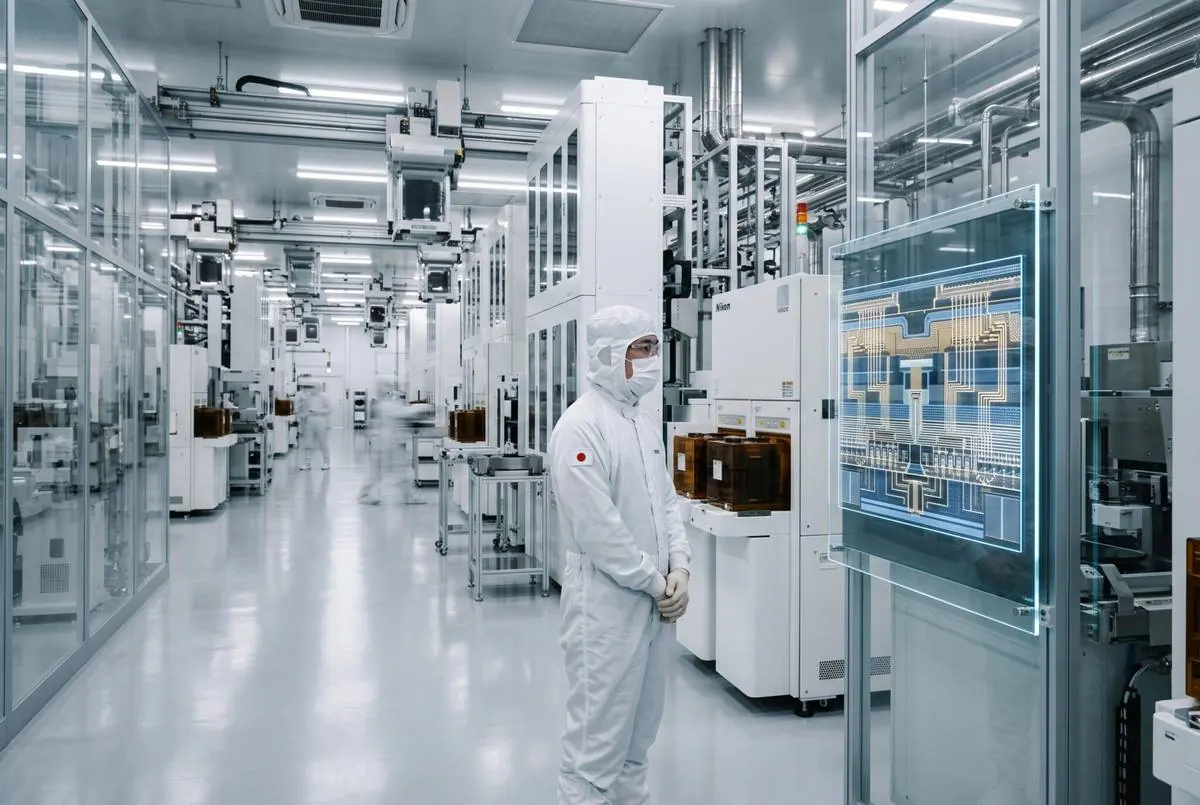
ASML is the only company on Earth that sells extreme ultraviolet (EUV) lithography machines, the equipment that prints the microscopic circuitry of the world's most advanced chips. Every leading AI accelerator, every flagship smartphone processor, and every cutting-edge data-center chip depends on its machines. When ASML's order book swells, it is the semiconductor industry voting with its wallet on how long the AI buildout lasts.
The vote this quarter was emphatic. Customers are not just ordering for next year. Some have begun asking about deliveries in 2029 and 2030. And for 2027 and 2028, ASML told investors its planned output will not fully cover customer demand, even after expanding low-NA EUV and DUV immersion capacity by 30 percent in 2027.
The record quarter, by the numbers
Quarterly sales of 11.7 billion euros beat the top end of ASML's own guidance, and the 56 percent year-over-year jump from 7.5 billion euros in the same quarter of 2025 reflects how violently demand has re-accelerated. The AI buildout, which looked wobbly to some investors as recently as last year, is now pulling equipment orders harder than at any point in the company's history.
Profitability is scaling even faster than revenue. Net income of 5.0 billion euros and a 57.5 percent gross margin point to pricing power that few industrial companies ever achieve. ASML raised its full-year 2026 outlook alongside the results: total net sales between 44 and 45 billion euros, with a gross margin around 56 percent.
The stock has been repriced accordingly. ASML's U.S.-listed shares have gained roughly 60 percent since the start of the year, and the company now trades at a price-to-earnings ratio near 57, a valuation that assumes the boom has years left to run. Options pricing ahead of the release implied a swing of up to 4.6 percent in either direction, a sign of how much was riding on the numbers.
High-NA EUV finally has a timeline
Enjoying this story?
Get the five most important stories in tech, every morning. Free.
Beneath the headline numbers, the earnings call delivered something the industry has wanted for years: a credible schedule for High-NA EUV, the next generation of lithography. High-NA machines use a larger numerical aperture (0.55, up from 0.33) to print finer features in a single exposure, letting chipmakers keep shrinking transistors without resorting to expensive multi-patterning workarounds. Until now, adoption dates were vague.
Intel, the technology's earliest adopter, has now exposed more than one million wafers using High-NA EUV, with performance that meets or exceeds comparable layers patterned with conventional low-NA EUV. The technology is already being used in production. Samsung plans to bring High-NA into high-volume manufacturing in 2028, and TSMC, the world's largest contract chipmaker, is aiming for 2030. Availability across ASML's installed High-NA fleet is approaching 90 percent.
The timeline matters because lithography transitions set the industry's pace. "This quarter we saw meaningful momentum around High-NA EUV," CEO Christophe Fouquet said on the earnings call, describing the technology's move "from development to production." TSMC is also working with ASML on larger EUV photomasks, targeting a 12-inch mask pilot line by 2031 and production in 2033, a sign that both companies expect High-NA to be a multi-decade platform, not a one-node experiment.
CFO Roger Dassen offered the necessary caution: the industry is still in the "very initial ramps" for High-NA, and revenue from the new systems will take time. But the direction is now unambiguous. Fouquet said ASML expects High-NA adoption to increase "node-on-node," meaning every future manufacturing generation will lean on it more heavily.
When the only company that can print the world's most advanced chips says its factory output will not meet demand through 2028, the AI boom stops looking like a cycle and starts looking like a buildout.
Sold out, and struggling to catch up
ASML Q3 2026: the record quarter
Results announced October 14, 2026, for the quarter ending September 30.
Full-year 2026 guidance raised to 44-45B euros in net sales with a gross margin around 56%. High-NA EUV timelines: Intel in production (1M+ wafers), Samsung high-volume 2028, TSMC 2030.
The most striking signal in the quarter may be the capacity crunch. ASML expects to ship about 65 low-NA EUV systems in 2026 and plans to grow low-NA EUV and DUV immersion output by 30 percent in 2027. Even so, management said planned supply for both 2027 and 2028 will fall short of customer demand, and the company is studying further expansion for 2028.
Chipmakers are responding by raising their short- and medium-term equipment demand forecasts, driven by their read on the size and duration of AI-related investment. ASML noted that some customers have inquired about placing orders for delivery as far out as 2029 and 2030. When equipment buyers plan four years ahead, they are telling you they expect the cycle to run that long.
That long-dated demand sits alongside the industry's near-term anxiety. The same week ASML reported, U.S. chip stocks sold off on competition fears around Chinese memory maker CXMT and on jitters about how AI infrastructure spending is financed. ASML's report is the counterweight: the company that builds the bottleneck is booked solid, and its customers are booking further out, not pulling back.
What it means
ASML's quarter is best read as a progress report on the AI hardware cycle itself. Record sales, record income, a raised full-year guide, a credible High-NA adoption schedule, and a backlog that outruns factory output through 2028 all point in the same direction: the industry's capital spending plans extend years into the future.
None of this guarantees the cycle ends well. A price-to-earnings ratio near 57 prices in years of growth, and equipment orders can be deferred or canceled if AI spending stalls. But for now, the company with the clearest window into chipmakers' true plans is reporting the strongest quarter in its history, and the next generation of its technology finally has dates attached. In the semiconductor industry, that is about as close to a verdict as you get.
0 Comments