
Shanghai-based eVTOL developer Volant Aerotech has closed a Series C+ financing round worth nearly 1 billion yuan, about $148 million, marking its second major capital raise within a single month. The money landed almost simultaneously with a new agreement to supply its VE25-100 air taxis to Indonesia, the latest step in an export push that has already stretched from Thailand to Dubai.
The speed of the fundraising tells its own story. Just weeks earlier, Volant closed a separate Series C round worth more than $300 million, described at the time as the largest single-round raise ever recorded in China's manned eVTOL sector. The back-to-back closes bring the company's total funding across 13 rounds to more than 5 billion yuan over five years.
Two raises in a month. 1,900 orders on the books. China's air-taxi race is no longer about prototypes.
The money and who is behind it
The Series C+ round was led by China Life Investment, a state-owned insurance investment platform, with participation from Minjin Investment, a Shanghai Minhang District state-owned vehicle, plus NIO Capital, CoStone Capital, and existing backer China Internet Investment Fund. China Renaissance and CYGNUS EQUITY advised on the transaction.
The investor roster is notable for how little of it is conventional venture capital. Rather than relying on VCs alone, Volant has assembled a base spanning national insurance funds, state-owned capital at multiple levels, strategic industrial partners, and market-driven firms. That structure looks deliberate: airworthiness certification is a slow, expensive process, and the funding matches the extended timelines that regulators demand.
The company says the proceeds will go toward advancing airworthiness certification, accelerating flight test programs, and strengthening supply chain integration as it moves toward full-scale commercial production.
The Indonesia deal
Enjoying this story?
Get the five most important stories in tech, every morning. Free.
On October 9, Volant signed a memorandum of agreement with Indonesian charter operator WhiteSky group covering the supply of VE25-100 eVTOL air taxis, according to Aviation Week's industry briefs. The agreement is a memorandum, not a firm aircraft order, so deliveries and timing remain subject to certification and commercial negotiations.
WhiteSky is one of Indonesia's established helicopter operators, running charter, sightseeing, cargo, and medical evacuation services, with a heliport at Cengkareng near Jakarta's Soekarno-Hatta International Airport. For Volant, Indonesia represents both a congested megacity use case and a tourism market, a combination several Chinese eVTOL makers are targeting across Southeast Asia.
The deal adds to a growing export pipeline. In July 2025, Volant signed a three-party agreement with Thailand's Pan Pacific and AVIC International Engineering covering 500 aircraft valued at $1.75 billion, described then as a record for Chinese passenger eVTOL exports. At the China International Import Expo in November 2025, the company signed a joint order with Dubai-based IC Leasing and Germany's DC Aviation for 30 aircraft.
The aircraft itself
Volant Aerotech, by the Numbers
Note: For illustrative purposes only.
Volant has also retired its X1 technology demonstrator, first flown in 2023, having fully transitioned flight testing to its first development VE25 aircraft, designated AC101. The X1 was the company's learning platform; the VE25 is the product.
The flagship VE25-100 uses a compound wing design intended to balance operational safety with commercial scalability, and offers a flexible six-seat cabin that can be reconfigured across three roles: passenger transport, emergency rescue, and cargo. In October 2025, Volant completed its first piloted test flight. More recently, it conducted a manned conversion flight, transitioning from vertical takeoff to forward flight mode, which the company described as the first such test carried out by a Chinese eVTOL manufacturer.
The company is targeting airworthiness certification and the start of commercial deliveries by 2027. On the commercial side, it reports more than 1,900 domestic orders valued at 47.5 billion yuan, secured through partnerships with operators including China Southern Airlines General Aviation and Asian Express Aviation, along with leasing firm ABC Financial Leasing.
What this signals
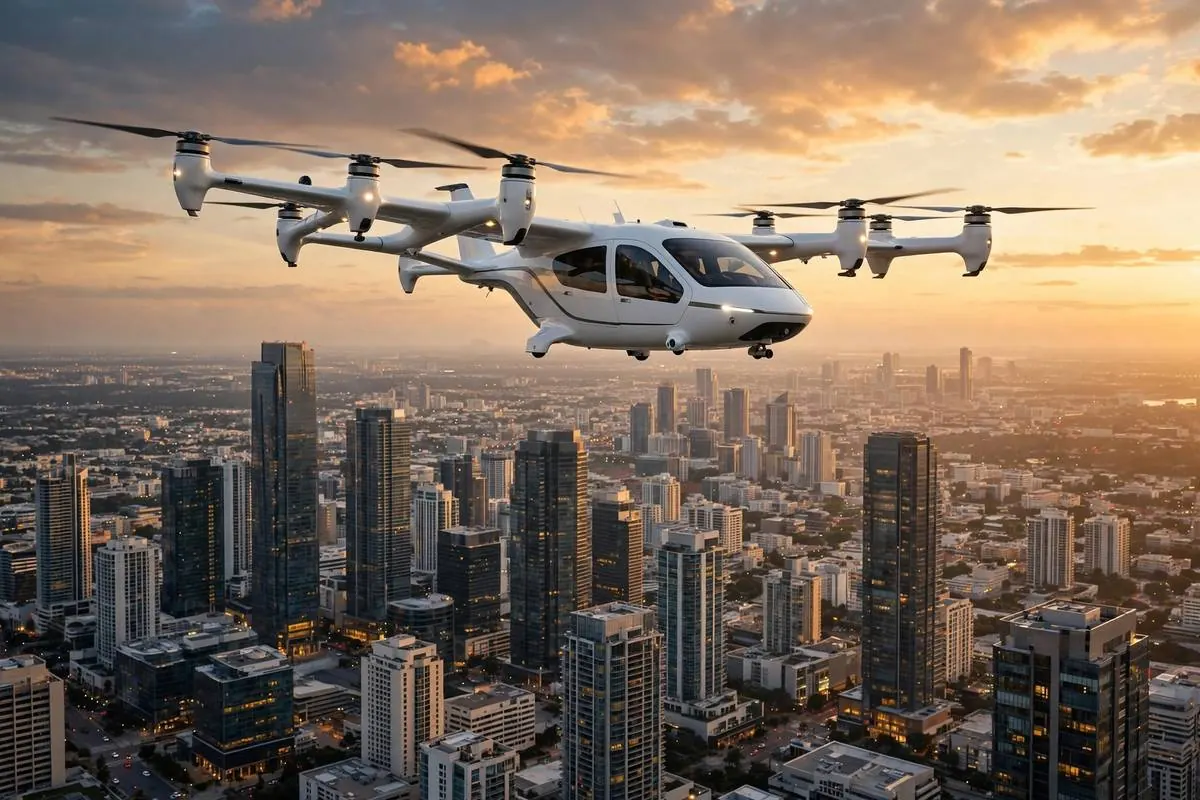
This is analysis, not company guidance: the back-to-back raises suggest Volant is financing the final, hardest stretch of development. Early money built the demonstrators. This money pays for certification paperwork, supply-chain tooling, and the flight-test hours regulators require before a single paying passenger boards.
The pattern is bigger than one company. China's low-altitude economy has drawn sustained capital as eVTOL programs move from technology validation toward certification, with policy support including new airspace management regulations, a dedicated Low-Altitude Economy Department under the National Development and Reform Commission, and six pilot cities for low-altitude initiatives.
Southeast Asia is becoming the export beachhead. Chinese manufacturers are signing agreements across the region faster than Western competitors, pairing aircraft supply deals with leasing structures that lower the barrier for local operators. Indonesia's archipelago geography, with short hops between islands and cities that satellites of road traffic cannot serve well, is an obvious early market.
The risk is the same one every eVTOL maker faces: money can be raised, aircraft can be built, and agreements can be signed, but none of it converts to revenue without a type certificate. Volant's 2027 target puts it in a crowded field. If it hits the date, the Indonesian memorandum could become one of the first real export fleets. If it slips, the $450 million-plus raised this year becomes runway, not proof.
0 Comments