
On October 16, Vertical Aerospace made its least glamorous announcement of the year, and possibly its most important. The Bristol-based air taxi developer signed long-term deals with two suppliers: ANH Structure of South Korea, which will design and build the Valo's seats, and Northrop Grumman LITEF of Germany, which will supply the inertial navigation system. No one flew anywhere. Nothing left the ground. And yet this announcement may matter more than any flight demonstration Vertical has performed.
The air taxi industry has entered the phase where credibility is measured in certification milestones, not airshow applause. The eVTOL startups that survive to 2029 will be the ones with boring, complete supply chains: every system designed, contracted, tested, and documented to aviation standards. A 30G crash seat is that phase made literal. It is a part whose entire job is to save lives on the worst day of the aircraft's existence.
What Vertical actually signed
Under the agreements, ANH Structure will design, develop, certify, and manufacture Valo's bespoke pilot and passenger seating system. The seats will use ANH's proprietary 30G energy-absorption technology on a common platform for pilots, observers, and passengers. ANH already holds EASA design and production organization approvals for aerospace design and manufacturing, though those credentials do not themselves certify the new seats.
The second deal covers Northrop Grumman LITEF's LCR-110, an inertial reference system that feeds position, attitude, and heading data to the aircraft's flight-critical systems. For an eVTOL that must manage vertical takeoffs, the demanding transition to wing-borne flight, and conventional cruise, that data is the sensory backbone of flight control. According to Vertical, the LCR-110 meets applicable EASA and Federal Aviation Administration technical standards for inertial reference equipment, though it still needs integration and certification as part of Valo.
Neither agreement is itself a certification: the seats still need development, crash testing, and approval, and Vertical has not disclosed crash-test results. These deals establish who does the work, not that it is done.
Why the seat is the story
Enjoying this story?
Get the five most important stories in tech, every morning. Free.
Thirty Gs is an arresting number: roughly the peak deceleration a human body can endure in a survivable impact, provided the forces are managed well. Energy-absorbing seats do that managing, deforming in a controlled way during a crash to spread the deceleration over milliseconds and keep spinal loads within survivable limits. It is the same principle behind the crashworthy seats in military helicopters, brought to a civilian air taxi.
Crashworthiness matters for eVTOL certification in a way it never did during the flight-demo era. Regulators certify aircraft against a battery of crash conditions, and the cabin has to demonstrate that occupants can survive impacts the airframe cannot. For a vehicle meant to carry ordinary passengers, this is the core product requirement, not edge-case engineering. A flying taxi whose passengers cannot walk away from a hard landing is not a transportation business, it is a liability business.
Seats are also a brutal engineering tradeoff: every gram of energy absorption is a gram that cannot be payload or battery, and the seat is the most visible thing a passenger touches. A common platform across pilot, observer, and passenger roles, and future four- and six-seat configurations, spreads that engineering cost across the whole aircraft.
The inertial reference system, decoded
Valo's Runway to Certification
Milestones between Vertical's October 16 supplier deals and its 2029 target.
Note: Dates are company targets from public filings and announcements.
An inertial reference system uses gyroscopes and accelerometers to compute the aircraft's orientation and motion independently of GPS, which bounces off buildings and drops out in the urban canyons an air taxi will serve. It keeps the flight control computers honest when the satellite picture goes fuzzy.
That independence matters most during transition, the phase where Valo shifts from vertical lift to forward flight: the most aerodynamically demanding part of an eVTOL flight, where trustworthy attitude and heading data is the difference between a maneuver and a mishap.
Choosing Northrop Grumman LITEF is a signal about Vertical's certification strategy. The LCR-110's existing EASA and FAA approvals mean it starts the conversation with regulators from a position of precedent. Certification is largely an exercise in minimizing the number of novel things a regulator must evaluate, and buying proven subsystems from established suppliers is how you do that.
The air taxi era will not be won by the company with the most impressive demo reel. It will be won by the company that can document every bolt.
The supply chain is the moat
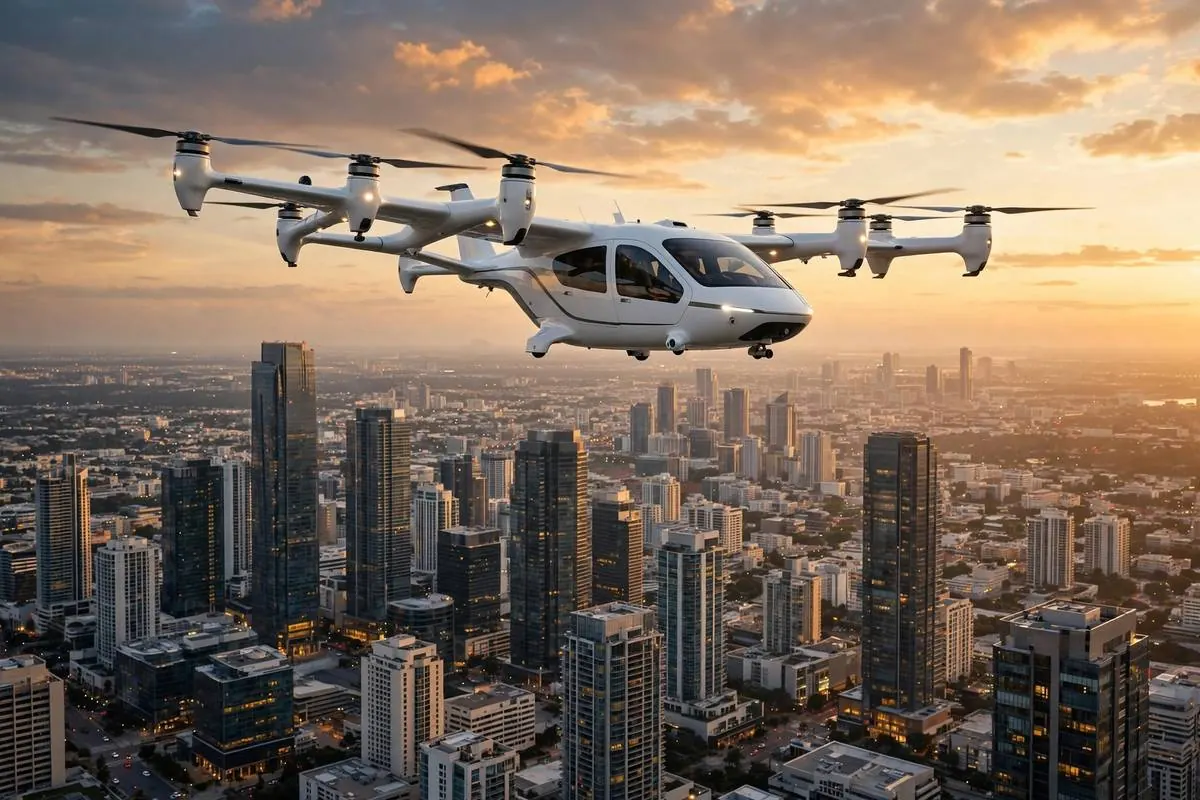
These deals slot into a supplier ecosystem that reads like an aerospace who's who: Honeywell on flight control and aircraft management, Sonaca on airframe structures, Evolito on propulsion, Hyundai WIA, plus Synesqo, Isoclima, and Astronics. It mirrors how modern airliners are built: the integrator owns the certification case while specialists deliver proven subsystems.
Vertical's one-platform strategy spans four- and six-passenger cabins, with electric, hybrid-electric, and autonomous variants for commercial and defense customers, spreading the enormous fixed cost of certification across more airframes built from one set of certified systems. The UK Ministry of Defence has already expressed interest in the hybrid-electric and autonomous capabilities, which is the kind of dual-use validation the whole eVTOL industry is chasing.
On the demand side, Vertical says it holds roughly 1,500 preorders across four continents, including American Airlines, Avolon, and Japan Airlines. Those are commitments, not deliveries, but they are more than most startups can claim.
The shadow over the seats
None of this resolves the tension with Vertical's balance sheet, and honesty requires naming it. On October 2, the company disclosed a New York Stock Exchange notice over its share price; on October 13, the shares fell below 50 cents. An August filing warned of material uncertainty over the company's ability to continue as a going concern, with funding expected to last only through the third quarter of 2027, against a 2029 certification target. Supplier agreements do not extend a cash runway.
But they do sharpen the strategic picture. Vertical's bet is that a technically complete, certification-ready program with a world-class supply chain is a fundable or acquirable asset, while a half-built program is neither. Every contracted subsystem reduces the execution risk for a potential partner or acquirer. In that sense, the 30G seats are not just safety equipment. They are financing equipment.
What to watch next
Three milestones decide whether this reads as progress or press release: the critical design review targeted by the end of 2026, which freezes the design for certification testing; the start of certification-conforming assembly at Cotswold Airport in Q4 2027, with first flight in 2028; and UK CAA type certification in 2029, against a funding runway that ends in Q3 2027.
The eVTOL industry has always sold a vision of flight without friction: quiet electric aircraft lifting commuters above traffic. What the Vertical story now shows is the friction itself, the slow, expensive, unglamorous work of making a novel aircraft safe enough for a regulator to sign and an insurer to touch. Crash seats do not make for thrilling keynote slides. They make for certified aircraft.
0 Comments