
The most interesting flight of 2026 may carry passengers on an aircraft that is not yet certified to fly them. Joby Aviation, the electric air taxi developer that has logged more than 50,000 miles across its test fleet, says it is targeting its first passenger flights before the end of the year, and it plans to get there without waiting for the FAA to finish certifying its aircraft.
This is not a loophole. It is a deliberate policy instrument: the White House-backed eVTOL Integration Pilot Program, known as eIPP, was designed specifically to let a mature electric aircraft design fly in American cities before full type certification is complete. The program starts with professional pilots, expands to invited non-paying passengers, and then, if the data supports it, paying ones. Joby is slated to run its first eIPP flights in Texas, and management has kept the end-of-2026 first-passenger target intact.
The bet behind the bet is that certification, the industry's longest pole in the tent, is a sequencing problem rather than a safety problem. And Joby has spent the past year gathering the evidence to argue it.
A back door built by policy
The eIPP exists because Washington decided it could not afford to watch electric aviation happen elsewhere first. China is already certifying and flying passenger-carrying eVTOLs; EHang recently signed a sandbox testing agreement in Vietnam, making it the second country in its Global Fast Track program after Sri Lanka. The United States, meanwhile, was building test infrastructure, including an $8.3 million FAA test range in Oklahoma, to study aircraft already flying on other continents.
The pilot program is the American answer: real operations, real passengers, real cities, under FAA oversight, while certification runs in parallel. Joby has leased a 45,000-square-foot facility at Fort Worth Alliance Airport as its North Texas operations base, and it is participating in a Texas Department of Transportation project connecting Dallas, Austin, and San Antonio. The company has already demonstrated its aircraft on routes in Texas, California, and New York, and in September it flew its electric air taxi into Dallas-Fort Worth International Airport, one of the most telling flights any eVTOL has made this year.
Why DFW matters: it sits under Class B airspace, the most restrictive category in American aviation, reserved for the busiest airports. An eVTOL operating there generates the air traffic control coordination data the FAA needs to integrate air taxis into existing, high-volume airport environments. If air taxis are eventually going to offer airport connections, the core commercial use case, they have to operate where the airports are, not just in remote test corridors.
The commercial plumbing is being built alongside the regulatory plumbing. Delta Air Lines has put up to $200 million into Joby and is building vertiport infrastructure at New York's JFK and Los Angeles International airports. Joby has also partnered with Atoms, the infrastructure firm founded by former Uber CEO Travis Kalanick, to acquire and develop multimodal transportation hubs across Texas, New York, Florida, and California. Joby acquired Blade's helicopter charter business earlier, which is doing the unglamorous work of keeping the lights on: the company raised its full-year 2026 revenue guidance to $115 to $125 million, primarily from that air charter operation, and it held $2.3 billion in cash and short-term investments as of mid-2026.
What the hardware has actually proved
Enjoying this story?
Get the five most important stories in tech, every morning. Free.
Joby's S4, a five-seat tilt-rotor design carrying four passengers plus a pilot, has been through more piloted flight testing than any other eVTOL program in the United States. The numbers: over 850 flights in 2025 alone, more than 1,000 cumulative test flights by early 2026, and 50,000-plus miles across the fleet. Five aircraft are currently flying, with 12 more in production.
On paper, the certification picture is the most advanced in the American industry. Joby is in the fifth and final stage of FAA type certification, Stage 5, which the FAA calls "Show and Verify": the company must demonstrate compliance with airworthiness rules through FAA-reviewed testing rather than paperwork. Its first fully FAA-conforming S4 has been flying since March 2026 in preparation for that testing.
A successful test flight is not a certification, and a milestone is not the same word as certified. The industry keeps confusing the two.
Why certification still matters more than milestones
Joby's 2026 Certification Scorecard
Test milestones and FAA Stage 5 progress, from company shareholder filings and industry reporting.
Note: For illustrative purposes only.
Here is the uncomfortable math. As of Joby's most recent shareholder update, the company had completed 20 percent of its side of the Stage 5 work, with the FAA having formally accepted 10 percent of it. That is genuine progress, and it is also a long way from done. Independent analysts cited in recent coverage place full commercial service no earlier than mid-2027, with a 20 to 30 percent probability at that date; more conservative estimates run to 2028 or later.
And the industry has a credibility problem on exactly this point. Earlier this year, several outlets reported that Joby had "completed" FAA Stage 4. At least one of those reports was formally corrected in July, after Joby's own May shareholder filing showed Stage 4 work only 15 percent complete on the company's side and 6 percent accepted by the FAA. The confusion came from several real but smaller milestones landing close together: the first flight of a conforming test aircraft, a completed System Review audit, entry into the final phase of testing. None of those individually equals a completed stage. The correction is worth remembering every time an eVTOL headline declares a breakthrough.
This is precisely why the eIPP matters so much. It lets the first passenger flights happen on the strength of the operational safety case, real miles, real coordination data with air traffic control, rather than on the completion of the certification paperwork. The program turns the 2026 first-passenger milestone from an all-or-nothing bet on the FAA's timeline into a staged, evidence-based process. The risk profile is genuinely different. It is also genuinely still risky: the stock, trading around $5 to $6 with a roughly $5 billion market cap as of mid-October, is pricing in the deadline and the doubts together.
The race around them
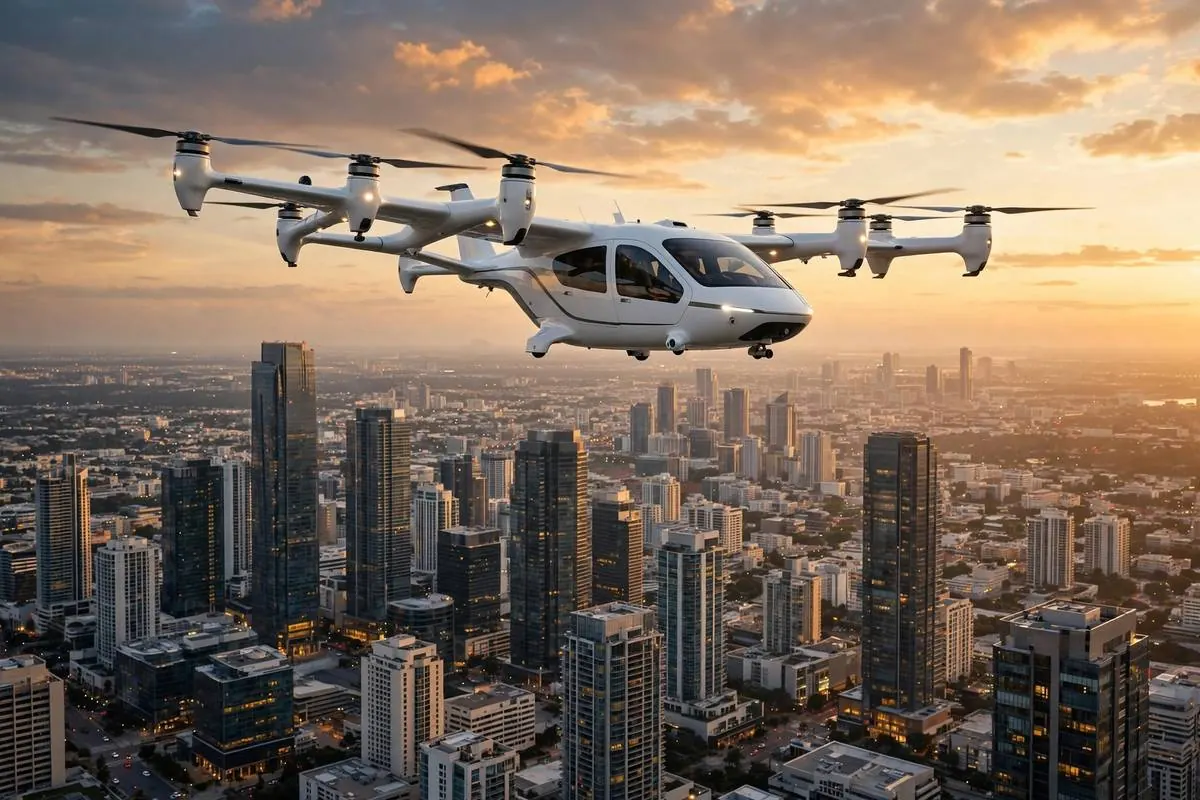
Joby is closest to the finish line, but the field is crowding. Rival Archer Aviation has closed Phase 3 of its certification process, and Phase 4 is where the testing gets hardest. The intellectual property battle is heating up too: on October 6, Vertical Aerospace filed a patent infringement counterclaim against Archer in the U.S. District Court for the Eastern District of Texas, alleging Archer's Midnight eVTOL infringes claims of Vertical's U.S. Patent No. 12,747,027. Vertical is seeking an injunction and monetary damages. In an industry where everyone is burning cash, proprietary technology is the one asset that appreciates, which is why the lawyers are getting involved now.
Meanwhile the supersonic parallel is playing out on its own policy track. Boom Supersonic's Symphony engine program has seen its sprint-core ground tests at the Colorado Air and Space Port slip toward November, per September reporting, and the company's Overture airliner has moved first flight to 2028 with passenger service projected for 2031. But Boom's bet is also partly regulatory: the Supersonic Aviation Modernization Act, which would direct the FAA to legalize civil supersonic flight over U.S. land as long as no sonic boom reaches the ground, cleared the Senate Commerce Committee in July 2026, running alongside the FAA's own proposed overland supersonic rule. Aviation's next decade may be decided as much by rulemaking as by engineering.
What to watch
Forget the stock chart. The number that decides Joby's year is the FAA's acceptance percentage: 10 percent today, and the pace at which that number climbs. The second number is cash burn against the $2.3 billion cushion. The third is the eIPP's first Texas passenger flights, the moment the industry moves from test corridors to actual urban airspace with actual people on board.
If Joby carries its first passengers before year-end, it will not mean the air taxi era has arrived. It will mean something arguably more interesting: that American regulators found a way to let it arrive in stages, with evidence doing the work that a certificate will eventually do. Certification remains the long, expensive gate to full commercial service. But 2026 may be remembered as the year the industry stopped waiting at it, and started flying around it, under supervision, in the open sky.
0 Comments