
On October 15, 2026, ORCA Computing switched on the PT-3, its newest photonic quantum computer, inside Digital Realty's LHR19 data center in London Docklands. The launch is notable less for raw computing muscle than for logistics: the machine runs at room temperature, draws 6 kilowatts across two standard server racks, and was installed in three hours. For a technology long associated with cryogenic freezers and bespoke physics labs, those details matter more than any benchmark.
The PT-3 encodes information in light rather than in superconducting circuits. In the company's own numbers, the system runs 64 photons across 128 qumodes, the continuous-variable channels that play the role of quantum pathways in a photonic machine. Because it does not need cooling to near absolute zero, it weighs about 800 kilograms, occupies ordinary data center floor space, and can be upgraded in the field instead of being shipped back to a lab. ORCA calls it the first quantum computer built to deliver what the company terms "commercial quantum advantage", a phrase worth treating as marketing language until independent benchmarks confirm it.
A quantum machine that plugs into the data center
The PT-3's most important design decision may be its address. The system went live in the Digital Realty Innovation Lab alongside Nvidia accelerated computing, not in a university physics department. James Fletcher, ORCA's head of solutions architecture, told journalists at the launch that co-location is critical because the AI models the system works with do not operate nearly as effectively over a remote link. In this vision, quantum computing is not a distant cloud resource you queue for. It is a rack neighbor of the GPUs.
That framing puts ORCA's hardware in a different category from the superconducting systems built by IBM, Google, and Finland's IQM, all of which need elaborate cryogenic infrastructure. The trade-off is real. Superconducting machines have their own strengths, and ORCA's photonics approach is competing on practicality and integration, not on headline qubit counts. It is a bet that the path to useful quantum computing runs through the data center, not around it.
The results so far
Enjoying this story?
Get the five most important stories in tech, every morning. Free.
The company's headline result is in drug discovery. ORCA built a hybrid quantum-classical extension of Nvidia's Proteina, a generative AI model that designs proteins, the molecules behind most medicines. Trained on 32 Nvidia Hopper GPUs working with the PT-3, the hybrid model produced a ratio of useful proteins 20 percent higher than the classical baseline, and generated a broader mix of protein shapes. ORCA's argument is that quantum hardware can increase the "expressivity" of AI models, their ability to represent complex patterns, helping them learn more from limited scientific data.
The second result is in industrial optimization. On a power-scheduling benchmark with 25,755 variables, run with Japanese software firm JIJ, energy company BP, and the UK's National Quantum Computing Centre, the PT-3 found answers in about an hour. That is more than 12 times faster than its predecessor, at solution quality comparable to commercial mathematical optimization software. Earlier PT-2 results point the same way: working with the Technical University of Denmark, the older system produced roughly twice as many strong peptide binders as classical AI, a result confirmed in physical lab tests, and generated 49 percent more valid molecules on the QM9 chemistry benchmark.
A quantum computer that draws less power than a single Nvidia DGX node and installs in an afternoon is a different proposition from one that needs its own cryogenic lab.
The caveats, stated plainly
PT-3 at a Glance
ORCA Computing's photonic quantum computer, launched October 15, 2026.
Note: Figures from ORCA Computing's launch materials and press coverage.
None of these numbers are independent. The benchmarks are company-run or whitepaper results, the 20 percent protein improvement rests on a single test, and reporting from Computer Weekly notes that the machine's results are competitive with rather than clearly beating classical mathematical solvers. That framing matters, because "commercial quantum advantage" is ORCA's phrase, not the academic definition of quantum advantage. The industry has not built a universal, fault-tolerant quantum computer, and that milestone remains a target for the late 2020s or early 2030s.
What the PT-3 represents is what analysts describe as near-term hybrid advantage: quantum processors acting as specialist accelerators alongside CPUs and GPUs rather than replacing them. Nobody is breaking encryption with this machine. But a machine that can be rolled into an existing facility and put to work on chemistry and scheduling problems within a day is a plausible version of how quantum computing actually reaches users, one upgrade at a time.
The context around the launch
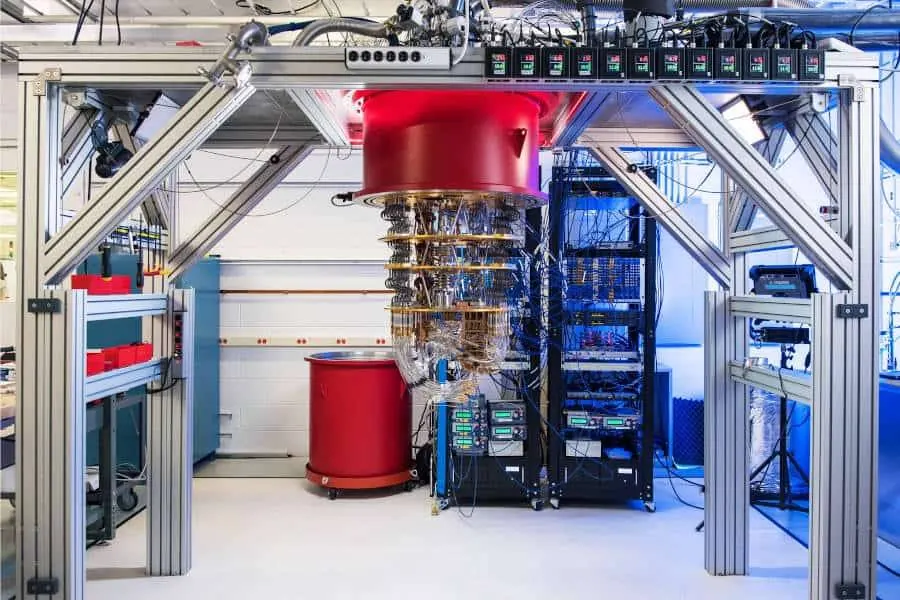
ORCA, spun out of the University of Oxford in 2019, claims it was the first company to place a quantum computer inside a data center back in 2022. It now says it has installed 11 PT Series systems in customer data centers worldwide and works with more than 35 customers and partners, with banks such as NatWest testing the technology for fraud detection. The UK government has made quantum a national priority under its National Quantum Strategy, and recently committed one billion pounds over four years to scaling quantum computing up.
The honest read on the PT-3 is that it changes the installation question, not the physics question. Quantum computers that behave like ordinary data center equipment remove one of the biggest practical barriers to adoption. Whether the hybrid results hold up under independent testing is the next question, and it is the one that will decide whether this launch is remembered as a milestone or as a press release.
0 Comments