
On October 7, Jeff Bezos sat down with Fox News at Blue Origin's Cape Canaveral facilities and gave the company's recovery effort its most specific deadline yet: New Glenn, Blue Origin's orbital heavy-lift rocket, will return to flight in December 2026, carrying the company's Blue Ring spacecraft as its payload. The announcement narrowed an earlier commitment to fly again before the end of the year, and it came with a second headline. Blue Origin has formally asked the Federal Aviation Administration to let it launch New Glenn from 12 times a year to 50.
New Glenn has flown three times. The first flight reached orbit in January 2025 but lost its reusable first stage during descent. The second, in November 2025, deployed NASA's two ESCAPADE spacecraft and landed its booster on the offshore platform Jacklyn. The third, on April 19, 2026, carrying an AST SpaceMobile BlueBird 7 satellite, failed during the upper-stage burn. A month later, a ground test tore through the company's launch complex. December is Blue Origin's promise that the fixes held.
Two failures, five weeks apart
The April failure started well: liftoff and the first-stage ascent went to plan. The trouble came after stage separation, when the upper stage's engines failed to complete the burns needed to deliver the satellite to its assigned orbit. On May 22, the FAA closed its investigation into the flight. The agency said the direct cause was a cryogenic leak that froze a hydraulic line, producing a thrust anomaly during the second-stage engine burn. Blue Origin identified nine corrective actions, and the FAA said the rocket was authorized to return to flight once the agency verified those fixes were implemented.
Six days later, an entirely separate problem struck. On May 28, an integrated-vehicle hotfire test at Launch Complex 36, a ground test where the engines fire while the rocket stays bolted down, produced what Blue Origin described as a significant anomaly. The company reported losing a lightning tower, the transporter-erector used to move the rocket to the pad and raise it upright, and hydraulic cylinders. Facilities including the propellant storage area, the Integration Facility, the vehicle access tower, and the water tower survived, which shaped the recovery plan. In an August 5 update, Blue Origin traced the root cause to the main oxygen valve on one of the seven BE-4 first-stage engines, and said modified valves were being manufactured to fit engines already built.
Three orbital flights and two painful setbacks. December is Blue Origin's chance to prove the recovery actually stuck.
What changed for the return
Enjoying this story?
Get the five most important stories in tech, every morning. Free.
Blue Origin is not just fixing the rocket. It is changing how the rocket gets to the pad. Rather than rebuild the destroyed transporter-erector, the company plans to mate the first and second stages horizontally inside its Integration Facility, move the assembled vehicle to the pad, and raise it upright with a crane onto a refurbished launch table. The payload will be lifted and attached after the rocket is vertical. The workaround removes the need to recreate a custom piece of equipment, though it introduces a new sequence of lifting, connecting, and checking the vehicle at the pad that the company must prove works.
Testing capacity is expanding too. In July, NASA and Blue Origin agreed to use the B-2 test stand at the Stennis Space Center in Mississippi for New Glenn upper-stage hotfire testing, moving some test load off the Cape. In August, Blue Origin began construction of Launch Complex 36B for a future New Glenn 9x4 configuration, with nine engines on the first stage and four on the second, versus the current 7x2. And CEO Dave Limp has repeatedly said the company sees a path to launching this year.
The December payload is Blue Ring, Blue Origin's multipurpose spacecraft platform designed to transport, deploy, and host payloads in different orbital regions, with onboard communications and computing. A smaller Blue Ring Pathfinder flew as a secondary payload on New Glenn's January 2025 inaugural mission. This time the platform itself is the cargo, which makes the flight a demonstration of both the rocket's recovery and a product line Blue Origin wants to sell to government and commercial customers.
Fifty launches a year
New Glenn: The Comeback by the Numbers
Key figures in Blue Origin's return-to-flight push.
Note: Figures from Blue Origin, FAA, and published reports.
The December flight is only the near-term test. The long-term ambition is written into the FAA filing. Blue Origin currently holds a vehicle operator license allowing up to 12 New Glenn launches a year from Launch Complex 36. The draft environmental assessment the FAA posted in September would raise that to 50. The request also covers 50 first-stage landings on an ocean platform downrange, up to 100 static-fire tests, and recovery of the payload fairing, something Blue Origin has not attempted on any of New Glenn's three flights. The FAA is taking written public comments through October 30 and will hold a virtual public meeting on October 22.
It is the second large launch-rate request at the Cape in a month. SpaceX is separately seeking approval for 76 Starship launches a year at Launch Complex 37. The message from both companies is the same: the future of American spaceflight is measured in launches per week, not per year.
Bezos made that ambition personal in the Fox News interview. The company is building three more launch pads, four total under construction, and he described the goal as flying every day, then every hour, then every minute, joking that he loses the team at that point. "Space travel becomes much more routine than it has been to date," he said. Nobody should read "every minute" as a schedule. It is a founder telling his company what scale of ambition he expects.
What the comeback costs
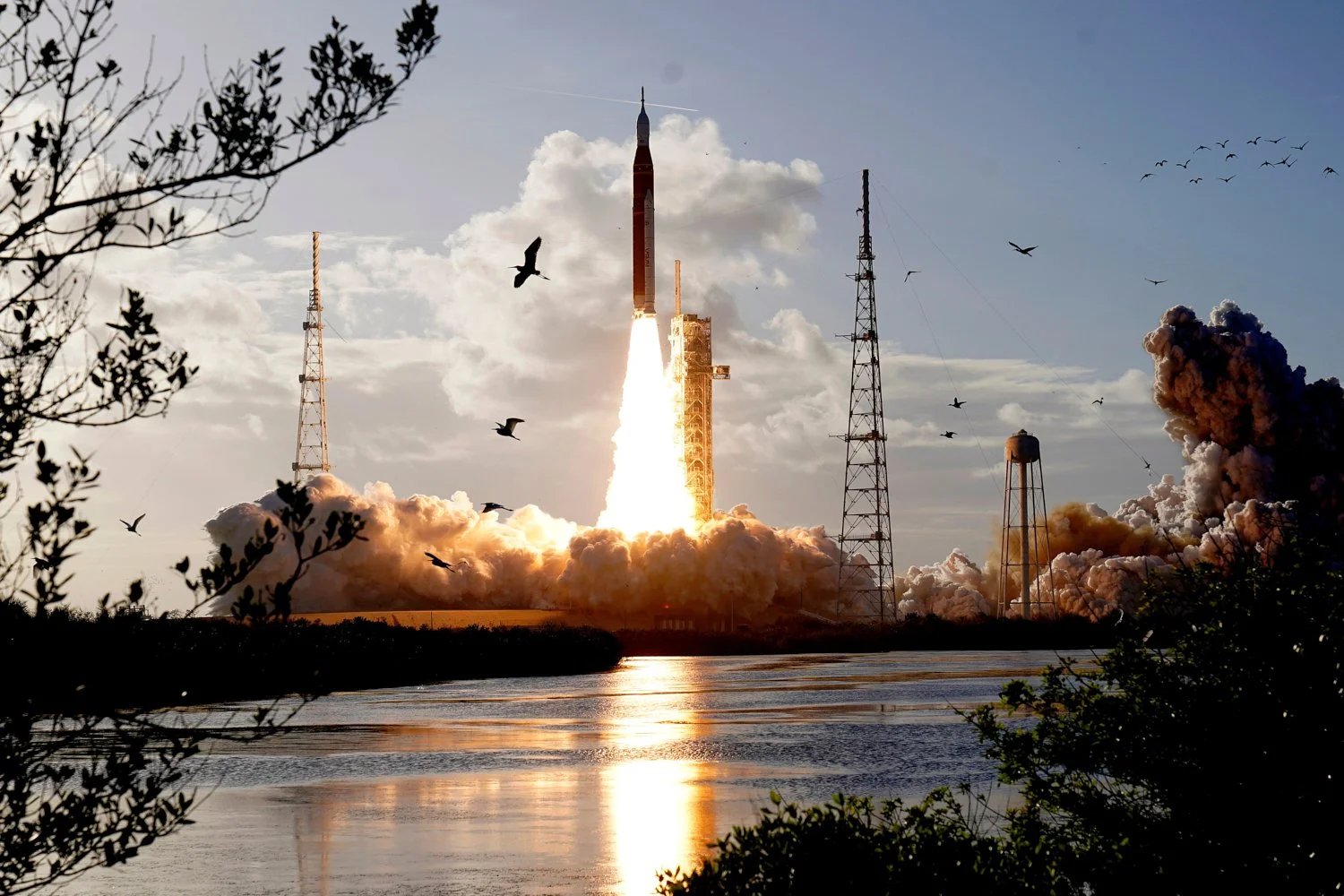
The ambition has a price. In September it emerged that Bezos had personally invested an additional $2 billion in a Blue Origin funding round that reportedly raised $10 billion in total, bringing his cumulative commitment to the company to around $32 billion. Reports now suggest Blue Origin is likely to mount an initial public offering, probably in 2027, once the rocket's reliability is re-established. Reliability is the hinge: capital markets will fund the Cape Canaveral buildout if New Glenn works, and withhold it if it doesn't.
So December is a credibility event, not just a launch. If New Glenn reaches orbit with Blue Ring aboard, Blue Origin answers two years of skepticism in a single mission and starts the climb toward the cadence its FAA filings describe. If it slips, the company still has the pads under construction, the funding, and the test capacity. But the skeptics will have fresh ammunition. "Targeting December" is a promise made from the ground. Keeping it is the only part that counts.
0 Comments