
Japan will put up to $21 billion into two new semiconductor factories in New York State, in what is shaping up as one of the largest single chipmaking investments ever directed at the United States by an allied government. The plants will be built at GlobalFoundries' campus in Malta, New York, and operated by the US chipmaker. The announcement landed on October 14, 2026.
The structure is unusual: Japan supplies the capital, GlobalFoundries supplies the technology and runs the plants, and the US government ends up with a larger ownership stake in the company. It is the first major semiconductor project to take shape under the broader US-Japan investment framework agreed last year, and it arrives at a moment when governments around the world are competing to secure reliable access to chips.
The deal, in plain terms
GlobalFoundries announced it had been selected as the technology provider and operator for two new 300-millimeter fabs at its Malta site, under a US-Japan initiative providing up to $21 billion in funding. Japan will provide the investment, while GlobalFoundries contributes what it calls its differentiated technologies, manufacturing expertise, and operational capabilities.
The first fab carries an initial investment of approximately $10 billion. Construction is scheduled to begin this year, with chip production expected in 2029. A second fab would receive an additional investment of about $10 billion, and the partners expect to decide whether to build it before the end of 2028.
When fully operational, each factory is expected to add about 900,000 300-millimeter wafers of annual US manufacturing capacity, ranking each among the larger semiconductor plants in the country. The first fab alone is expected to create more than 1,000 skilled manufacturing jobs in New York's Capital Region. One industry estimate put total construction and ecosystem roles at roughly 27,000.
The chips will be foundational, not leading edge
Enjoying this story?
Get the five most important stories in tech, every morning. Free.
It is worth being precise about what these fabs will make. GlobalFoundries' announcement describes capacity aimed at automotive, industrial, and connected infrastructure markets. These are foundational chips: the microcontrollers, sensors, power devices, and communications components that go into cars, factory equipment, and networking gear. They are not the leading-edge processors that power AI data centers, and the project does not attempt to be.
GlobalFoundries chief executive Tim Breen told Reuters that initial customers for the New York factories include Japan's Renesas Electronics, a major automotive chip supplier, and iPhone maker Apple. That customer mix fits the foundry's specialty in differentiated, mature-node processes rather than the most advanced nodes, where Taiwan's TSMC and South Korea's Samsung lead.
"Fabs of this scale require more than capital. They require differentiated technology, operational excellence and a proven ability to execute." Tim Breen, CEO of GlobalFoundries
An unusual ownership structure
The Malta fabs, by the numbers
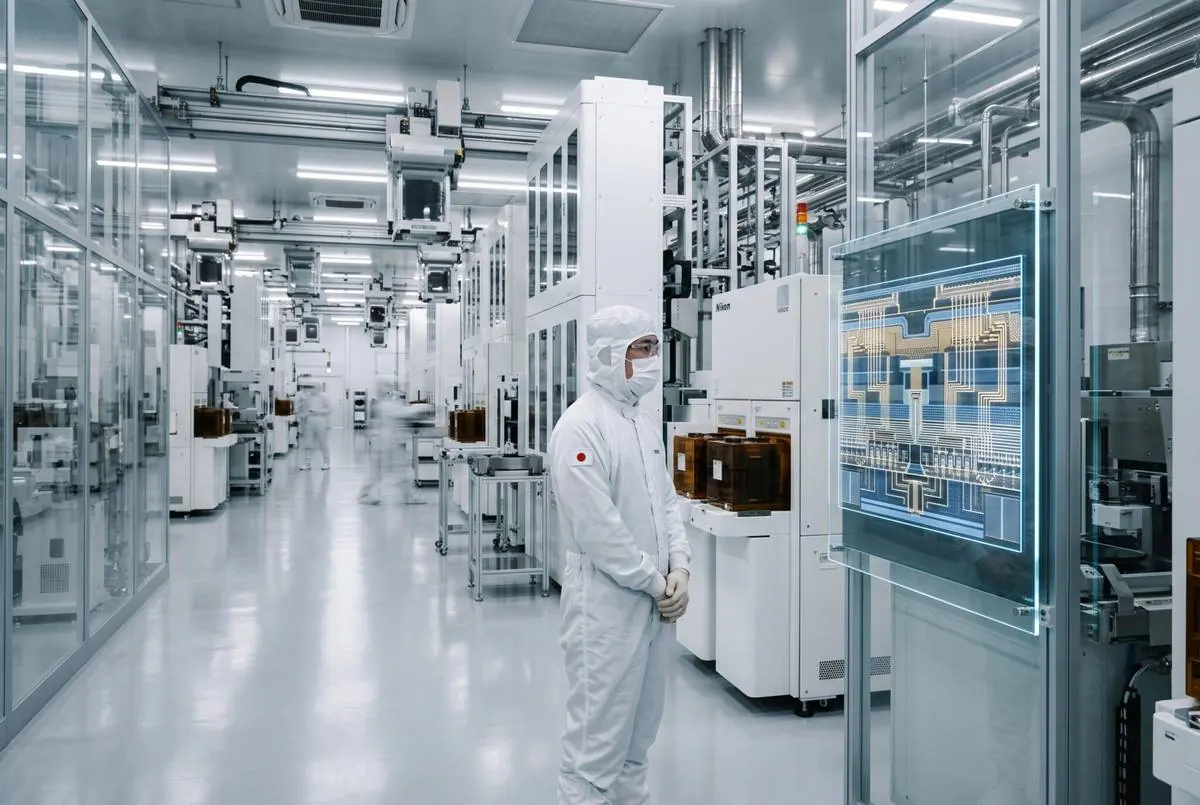
Japan's investment funds two planned 300mm factories at GlobalFoundries' Malta, New York campus.
Sources: GlobalFoundries, Reuters, October 2026.
According to Reuters, the two factories will be jointly owned by the US government and Japanese interests, with GlobalFoundries operating them. Japan will provide all of the investment capital. GlobalFoundries earns fees for building and operating the facilities and licensing its manufacturing technology.
The arrangement also changes Washington's financial relationship with the company. The US government previously held a 3 percent stake in GlobalFoundries, and Breen told Reuters that stake will rise to 7 percent. President Donald Trump said on Truth Social that the US government, which had provided $1.63 billion in grants to the company, values the 7 percent stake at more than $2 billion, adding: "We are the first administration ever to turn grants into money for America."
GlobalFoundries itself is majority-owned by Mubadala Investment Company, Abu Dhabi's sovereign wealth fund. Shares of the company rose more than 4 percent in afternoon trading on the day of the announcement and have gained more than 39 percent this year.
Where it fits in the bigger trade picture
The initiative is part of the Trump administration's deal struck last year under which Japan committed to invest $550 billion in the United States in return for the US lowering tariffs on Japanese cars and other imports from at least 25 percent to 15 percent. The chip project represents about 3.8 percent of that total pledge.
The project also includes a reworking of GlobalFoundries' existing US subsidies. The company and the Department of Commerce agreed to amend its award under the CHIPS and Science Act to reallocate $955 million toward silicon photonics, silicon-germanium, and advanced packaging at its facilities in Malta, New York, and Burlington, Vermont. Those are precisely the technologies that surround advanced chipmaking without being the most advanced logic nodes themselves.
Japanese companies could also benefit on the supply side. GlobalFoundries has indicated that Japanese suppliers, including Tokyo Electron, could participate in the project's supply chain, giving Japanese equipment makers a foothold in an American fab expansion.
The open question: filling the fabs
The largest uncertainty is the one that hangs over every new fab: demand. Each factory's 900,000 annual wafers works out to about 75,000 wafers a month, and that capacity will need firm customers well before production starts in 2029. Renesas and Apple are named as initial customers, but the second fab remains conditional, which suggests the partners themselves want to see demand materialize before committing the second $10 billion.
Still, the timing is deliberate. Automotive electrification, industrial automation, and the buildout of connected infrastructure all depend on exactly the kinds of chips GlobalFoundries makes, and recent years have shown how quickly shortages of those unglamorous components can stall entire industries. The 2021 to 2023 automotive chip shortage, which idled car plants worldwide, remains the industry's cautionary tale.
For now, the agreement stands as a test case for a new model of industrial policy: allied capital, domestic operation, and government equity, aimed at the middle of the chip market rather than its cutting edge. Whether it becomes a template or a footnote will depend on how those fabs fill up.
0 Comments