
The Cavendish Laboratory is where the electron was discovered, where the structure of DNA was worked out, and where a long line of Nobel laureates did the work that rewrote physics. As of October 15, 2026, it is also home to a commercial quantum computer. IonQ and the University of Cambridge have opened the IonQ Quantum Innovation Centre at the Ray Dolby Centre, the Cavendish Laboratory's new home, marking the first university-based IonQ centre anywhere in the world.
The partnership behind it was first announced on March 11, 2026, and the university describes it as its largest corporate research partnership. The centre now has nine funded inaugural research projects, a plan to install IonQ's 256-qubit Superion system on campus, and an entanglement-distribution quantum network to be built alongside it. As part of the deal, Innovate UK, the UK's innovation agency, will provide researchers with access and computing time at the National Quantum Computing Centre (NQCC) over three years.
What is actually being built
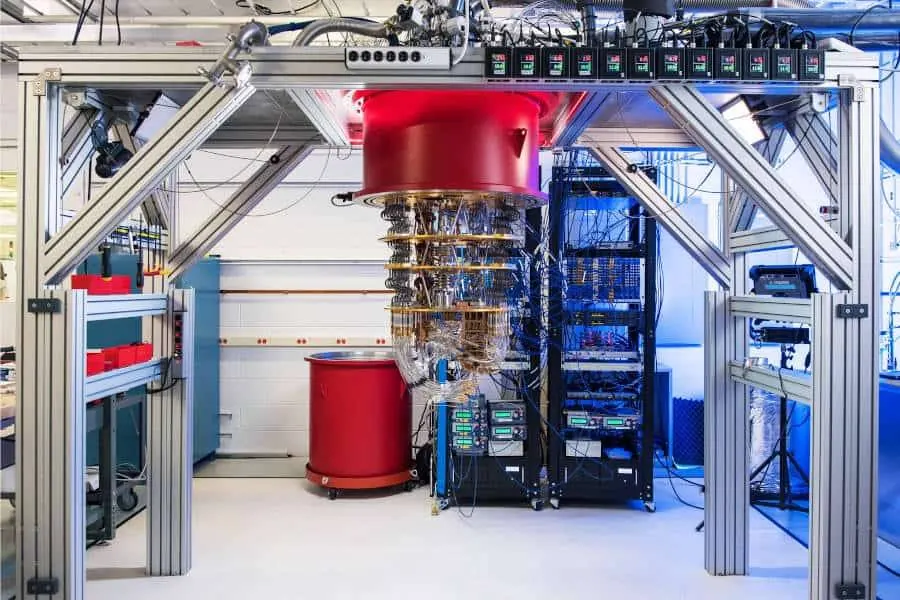
The headline machine is the Superion 256, IonQ's sixth-generation trapped-ion quantum computer, which launched in September 2026. The 256 refers to physical qubits: individual trapped ions whose quantum states are manipulated with lasers. IonQ says the system's quantum processing unit was fabricated by SkyWater, the chipmaker it acquired for $1.8 billion in January 2026, making this the first of its systems with a fully integrated 256-qubit chip from its own fab pipeline.
Worth keeping in perspective: 256 physical qubits is not 256 usable qubits. Practical, error-corrected quantum computation needs many physical qubits to encode each logical qubit, because quantum states are fragile and must be continuously corrected. IonQ's approach, like that of every serious player, is about scaling the physical layer while the error-correction math catches up. The company frames this system as part of its roadmap toward fault-tolerant machines, a path it is also pursuing through DARPA's Quantum Benchmarking Initiative, where IonQ was selected for the final verification stage in early October alongside Microsoft, IBM, Atom Computing and Diraq.
The network installation may matter more than the computer. IonQ plans to deploy an entanglement-distribution quantum network on campus, consisting of two Quantum Networking Data Centres and three Quantum Networking Nodes. The point of such a network is to share quantum correlations (entanglement) between separate processors, which is the mechanism that would let many smaller quantum systems act as one large one. The centre will also strengthen the existing quantum network running between Cambridge and Bristol, and support work on quantum memory chips and frequency-conversion technology, two of the hardest pieces of the interconnect puzzle.
Nine projects, from mirrors to medicine
Enjoying this story?
Get the five most important stories in tech, every morning. Free.
The centre's nine inaugural research projects were selected by a Joint Steering Committee drawn from both organizations, and they are deliberately split between hardware fundamentals and applied algorithms. On the experimental side, one project will develop microscopic mirrors designed to collect light from trapped ions more efficiently. That sounds like an obscure engineering detail, but it is central to the scaling question: ions communicate with the outside world by emitting photons, and capturing those photons reliably is the first step toward optical links between separate quantum processors.
The computational projects read like a catalog of problems where quantum algorithms might eventually earn their keep. Highlighted work includes building investment portfolios that maximize expected returns at a given level of risk, modeling how engineering structures respond to forces, and investigating biological networks to identify potential targets for cancer therapies. Chemistry, materials science, finance, engineering and medicine are all named as target domains.
By bringing quantum computing, networking, sensing, and security research together at Cambridge, we are accelerating the timeline between academic discovery and commercial quantum advantage. This is a long-term commitment to the United Kingdom, built for researchers, start-ups, and industry alike.
That is Niccolo de Masi, IonQ's chairman and CEO, describing the intent. The research draws on Cambridge's Departments of Physics, Engineering, and Computer Science and Technology, plus the Milner Therapeutics Institute and the Cambridge Judge Business School, a mix that suggests the centre is as interested in finding the business case for quantum as it is in the physics. New academic positions, postdoctoral fellowships and PhD places are being funded, which is the part of the announcement most likely to matter on a decades-long timescale.
What this is, and what it is not
The Cambridge Centre, by the Numbers
2 Quantum Networking Data Centres plus 3 Quantum Networking Nodes make up the on-campus network.
It would be easy to file this under quantum hype, but the structure of the deal points somewhere more interesting. Governments and companies have shifted from buying single flagship machines to building ecosystems: hardware, networks, software talent and access schemes bundled together. The Cambridge centre follows that template, combining a machine, a network, NQCC access via Innovate UK, and a training pipeline. It also aligns with the UK National Quantum Strategy, which has been steering public money toward exactly this kind of industry-academic infrastructure.
It is also worth noting what the announcement does not claim. Nobody is saying the Superion 256 will break encryption or solve practical optimization problems tomorrow. The projects are research projects, not product launches, and the most immediately consequential work, the mirrors, the network nodes, the sensing techniques, is infrastructure for a decade of further scaling. The quantum industry spent years selling milestones measured in qubit counts. A centre built around interconnects, networks and training is arguably a sign of a field growing up: the realization that the hard problems are no longer inside a single processor, but in connecting everything around it.
0 Comments