
IonQ wants to sell you the quantum computer, and then sell you the insurance policy for the day it works too well. On Monday, the quantum computing company announced it will acquire the cybersecurity firm Elisity in an all-stock deal valued at up to $1.3 billion, including up to $150 million in payouts tied to Elisity's future performance. It is IonQ's second-largest acquisition after its $1.8 billion purchase of chipmaker SkyWater Technology earlier this year.
The logic is straightforward. IonQ builds the machines that could, eventually, run Shor's algorithm at a scale capable of breaking the public-key encryption that protects most of the internet. Elisity builds the kind of network security those machines would threaten. IonQ's pitch to enterprise and government customers is now a package deal: the quantum future, plus the defenses against it.
"Q-Day is coming much faster than predicted," IonQ CEO Niccolo de Masi said in the announcement, referring to the point when quantum computers could break widely used encryption. In an interview with The Wall Street Journal he added: "The bad guys are going to keep taking advantage of new technology. Unfortunately, we are entering the most dangerous years, vis-a-vis cybersecurity risks."
The deal, by the numbers
The transaction values Elisity at up to $1.3 billion, with the number of IonQ shares issued to be calculated at a price between $33.07 and $49.61 per share. Elisity, founded in 2019 by a team of former Cisco executives, has more than 100 customer deployments worldwide and has doubled its revenue and customer base year over year, according to IonQ's announcement. Its customers include healthcare companies and hospitals, including GSK.
Elisity CEO James Winebrenner will continue to lead the acquired business after the deal closes. The transaction is expected to close in the fourth quarter of 2026, subject to regulatory approval.
Investors did not cheer. IonQ shares sank 9.2% on Monday, closing near $36 after finishing Friday at $39.89, with the company's market value close to $16 billion, according to the Journal. The selloff came partly because the all-stock deal dilutes existing equity, and partly because the broader market was in retreat: peers Rigetti Computing, D-Wave Quantum and Quantinuum all traded lower amid a broad sell-off in artificial intelligence stocks.
A buying spree, not a one-off
Enjoying this story?
Get the five most important stories in tech, every morning. Free.
The Elisity deal is the latest in a string of acquisitions that have turned IonQ from a pure-play quantum hardware company into something closer to a quantum conglomerate. Earlier this year it completed its $1.8 billion acquisition of SkyWater Technology, a chip manufacturer, bringing semiconductor manufacturing in-house. Last year it bought Oxford Ionics, a deal IonQ credits with helping it set a performance record and advance in a federal benchmarking initiative. It has also acquired Vector Atomic, Lightsynq and Capella.
Cantor analyst Troy Jensen said Elisity brings a "high-growth enterprise security business" and an "expert team" to IonQ. StoneX analyst Gary Mobley described the startup's customer base as "expanded channels" for IonQ to deliver its quantum tools to enterprise and federal clients. The rationale is distribution as much as technology: Elisity's relationships with hospitals and large enterprises give IonQ a sales footprint its physics team could never build alone.
IonQ is not waiting for quantum computers to become useful before selling the defenses against them. It is building both businesses in parallel, and betting the market arrives for both at once.
What "Q-Day" actually means
The Elisity deal, by the numbers
Verified figures from IonQ's announcement and Monday's market data
The deal's marketing leans hard on the threat of cryptographically relevant quantum computers, and the technical reality deserves a careful look. Shor's algorithm, published in 1994, can in principle factor large numbers exponentially faster than any classical method, which would let a sufficiently large quantum computer derive private keys from public ones. The operative word is sufficient: no existing machine comes close, and researchers have not demonstrated cryptographically relevant decryption outside controlled research settings.
The immediate danger is not a quantum computer breaking encryption tomorrow. It is "harvest now, decrypt later," the strategy in which attackers intercept and store encrypted traffic today in hopes of decrypting it once quantum hardware matures. That is the threat Elisity's customers, hospitals and enterprises with data that stays sensitive for decades, are paying to defend against right now.
It is also the threat driving government action. A Government Accountability Office report released this month found that zero of the 24 major federal agencies had fully implemented the practices needed to migrate to post-quantum cryptography. In June, the White House signed Executive Order 14412 directing federal systems to move toward NIST-standardized post-quantum algorithms, with targets of 2030 for key establishment and 2031 for digital signatures. The October 22 deadline for agency migration plans is nine days away.
The QKD caveat
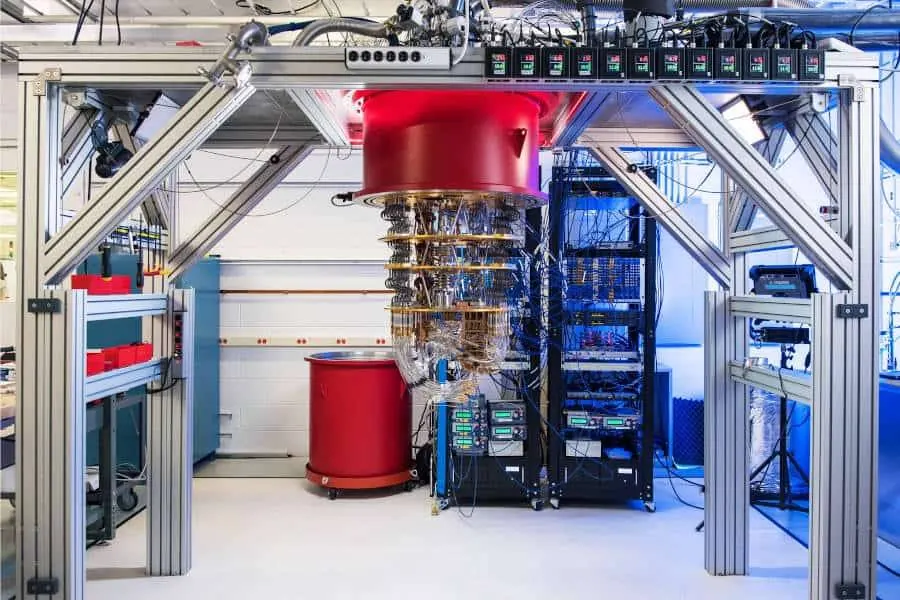
IonQ's existing cybersecurity portfolio is built around quantum key distribution, headlined by its Clavis XG line, including the Clavis XG Multiplex launched in June for protecting data across fiber networks. QKD uses quantum physics to generate encryption keys whose interception is, in principle, detectable. Here a note of caution is warranted: the National Security Agency and other oversight bodies advise against adopting QKD until several technical limitations, including the difficulty of authenticating endpoints and scaling beyond point-to-point links, are resolved.
Elisity's technology is different. It is a microsegmentation-style network security platform that limits how far an attacker, or ransomware, can move inside an organization once inside. That is conventional cybersecurity, not quantum magic, and that is arguably the point: IonQ is buying revenue and customers in the security market as it exists today, not only in the quantum-threatened future.
Why this fits the pattern
The acquisition lands in a month where quantum computing has become a national-security priority as much as a research program. The Department of War announced roughly $350 million in quantum initiatives in early October, including about $200 million in new DARPA funding and a conditional loan commitment of up to $150 million for PsiQuantum's California manufacturing hub. DARPA selected Atom Computing, Diraq, IBM and IonQ for Stage C of its Quantum Benchmarking Initiative, which asks whether any approach can reach utility-scale operation by 2033. IonQ also announced last month that its Superion 256 system will be the first deployed in Nvidia's quantum research center, where it will operate as a specialized coprocessor alongside Nvidia's graphics processors.
Put together, the picture is of an industry shifting from proof-of-concept to procurement. IonQ, which went public via a SPAC in 2021 and has seen its stock run up on the administration's enthusiasm for quantum technology, is using that currency to assemble a full-stack business before the hardware is finished: chips from SkyWater, processors from its own trapped-ion labs, networks from Lightsynq and Capella, and now security software and customers from Elisity.
Whether that breadth becomes an advantage or a distraction is the open question. Running a quantum hardware program and a conventional cybersecurity business are very different disciplines, and investors clearly harbor doubts, as Monday's 9.2% drop shows. But the underlying bet is a coherent one. If Q-Day ever arrives, the companies that built both the machines and the defenses will own the whole conversation. IonQ just paid up to $1.3 billion to make sure it is one of them.
0 Comments