
Quantum Computing Inc. (Nasdaq: QUBT) announced on October 14 that it has signed its first commercial customer in the pharmaceutical market: INmune Bio (Nasdaq: INMB), a late-stage biotech developing XPro (XPro1595), an investigational treatment for Alzheimer's disease and other neuroinflammatory conditions. The collaboration will apply QCi's Dirac-3S quantum optimization machine, alongside AI and conventional data analytics, to INmune Bio's datasets spanning pre-clinical research through four clinical trials, looking for new treatment indications and biomarkers that predict patient response.
On its face, this is a press release of a familiar genre: a quantum hardware company announcing a real-world use case, a biotech company announcing a new analytical tool. What makes this one worth a closer read is not the promise that quantum computing will cure Alzheimer's. Neither company made that claim. What they did commit to, in writing, is more interesting: the two companies plan to compare results from the Dirac-3S against conventional statistical and machine-learning methods, explicitly testing where quantum optimization adds value and which approaches suit which parts of the analysis.
A deal built around an honest experiment
Benchmarking quantum hardware against classical baselines is the question that has dogged every commercial quantum deployment for the past decade. Most partnership announcements quietly skip it, framing the quantum system as one more tool in the stack. Here the comparison is presented as a central deliverable of the Stage 1 engagement. That framing matters, because quantum optimization machines occupy a specific and often misunderstood corner of the field.
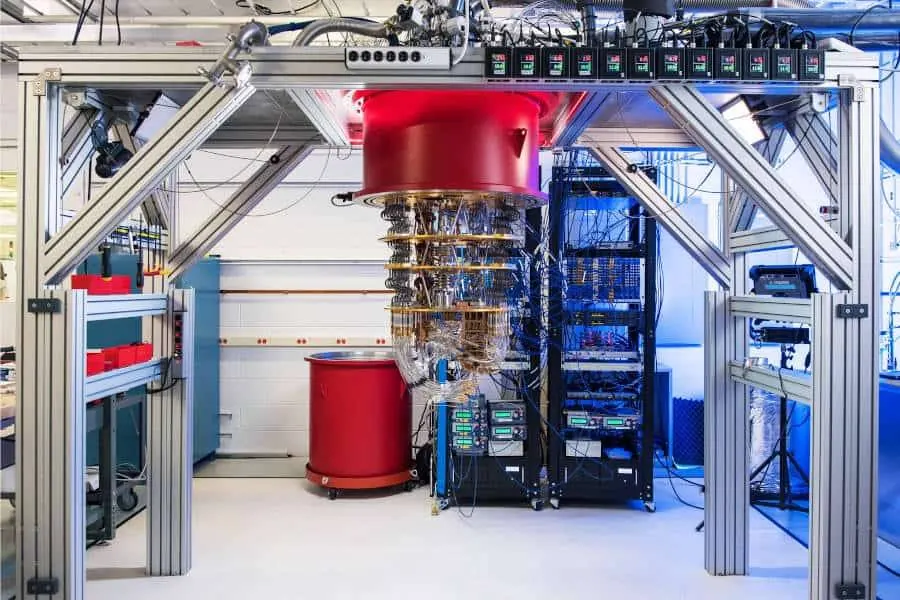
The Dirac-3S is not a universal, gate-model quantum computer. It is an entropy quantum computer built on photonic hardware, designed for one task: solving large optimization problems, problems where you must find the best combination of variables out of an enormous space of possibilities. QCi describes the system as running at room temperature and low power, without the dilution refrigerators that superconducting qubit systems require. On October 1, QCi announced that Dirac-3S scales to problems involving up to 9,980 variables, a roughly tenfold increase over the previous Dirac-3 generation's 1,000-variable limit, with first customer shipments expected in November 2026. The 5U rack-mountable base unit can be paired with expansion modules, and QCi says one module was enough to reach the 9,980-variable demonstrations.
The variable count on an optimization machine is not a qubit count, and it tells you nothing on its own about speed or solution quality against a tuned classical solver.
That distinction is where technical accuracy matters most. Ten thousand variables sounds comparable to the kind of scale numbers quoted for gate-model machines, but the numbers measure different things. An optimization machine encodes a combinatorial problem across its variables and searches for minima; it does not run quantum circuits. Whether it outperforms a well-configured classical heuristic on a given problem depends on problem structure, constraint density, precision, runtime, power consumption, and the baseline it is measured against. QCi has published a technical review covering synthetic problems, graph problems, and standard DIMACS maximum-clique benchmarks, with comparisons against projected gradient descent and the commercial classical solver Hexaly, reporting optimal solutions on selected synthetic tests from 2,000 to 9,980 variables. Independent replication, however, is still the missing piece, and the INmune Bio work could provide the first public look at how the system performs on a messy, real biomedical dataset rather than curated benchmarks.
Why a drug company wants optimization, not simulation
Enjoying this story?
Get the five most important stories in tech, every morning. Free.
The popular image of quantum computing in pharma is molecular simulation: a future fault-tolerant machine modeling drug-target interactions atom by atom. That future is still distant. What INmune Bio is buying is nearer term and less glamorous. The task is essentially a prioritization problem: given years of clinical and biological data on XPro, which patient populations and which diseases are most worth pursuing?
XPro is designed to selectively inhibit soluble tumor necrosis factor (sTNF), a protein involved in inflammation, while preserving other TNF functions the immune system needs. INmune Bio's stated strategy starts with rare diseases, where trials can be smaller, faster, and more capital-efficient, and where a qualifying pediatric approval may earn a Priority Review Voucher. Finding the diseases whose underlying biology matches what XPro has already shown in earlier work means searching across large clinical and publicly available biomedical datasets for relationships between biomarkers, disease biology, and treatment response. That is a high-dimensional pattern-matching and prioritization problem, exactly the kind of workload an optimization machine is built to attack.
INmune Bio also brings serious pipeline stakes to the table. Its second platform, CORDStrom, is transitioning toward regulatory filings with a UK marketing authorization application planned for 2026 and an EU filing in 2027, and XPro1595 has FDA Fast Track designation with an integrated Phase 2b/3 seamless adaptive program planned in early Alzheimer's. The company has no approved products and notes in its own forward-looking statements that there is no assurance of regulatory approval or of any specific outcome from the collaboration. That candor sets the right baseline for reading the quantum claims: this is an exploratory Stage 1 engagement with options for additional work, not a validated discovery platform.
What to watch next
Dirac-3S by the numbers
Variable counts on optimization machines measure problem size, not qubits. QCi announced Dirac-3S on October 1, 2026.
The most telling details in the announcement are the operational ones. First, the companies say the work is intended to establish a repeatable discovery process that INmune Bio can reuse on additional datasets and indications. Second, the head-to-head evaluation against conventional methods is an explicit program component, which means any future results announcement will be judged, correctly, against those baselines rather than against hype. Third, QCi has staked this as the opening of a new market vertical, so the commercial terms, timeline, and any follow-on stages will be scrutinized by investors watching whether quantum optimization has found a genuine recurring workload or another one-off pilot.
"This is a great example of what practical quantum computing can look like today," said Yuping Huang, QCi's chairman and CEO, framing the collaboration as a test of new computing capabilities on a substantial clinical dataset. INmune Bio CEO David Moss framed it as a search for the diseases with the greatest potential for success, starting with rare diseases where trial economics are favorable. Both framings are, notably, modest.
The broader signal is one of maturation. A decade ago, quantum computing partnerships in life sciences were almost entirely about future molecular simulation on hardware that did not yet exist. The INmune Bio deal is about today's hardware, a photonic optimization machine you can rack-mount, applied to the kind of noisy, high-dimensional data problem that drug development actually generates. The honest experiment at the center of the deal, quantum versus classical on the same data, is precisely the test the industry should be running. If Dirac-3S wins on some subproblems and loses on others, that is still a meaningful result. What the field needs now is fewer superlatives and more scoreboards.
0 Comments