
On paper, a quantum computer that corrects its own mistakes sounds simple: notice something went wrong, fix it, keep going. In practice, it is one of the hardest engineering problems in computing. Quantum information cannot be copied, measuring it disturbs it, and errors arrive constantly, from stray heat, imperfect control pulses, and tiny hardware flaws. Until recently, watching a quantum processor police itself in real time, at meaningful scale, was mostly aspiration. A new experiment from Rutgers University and IBM shows it can be done: on a chain of up to 100 superconducting qubits, researchers repeatedly measured and reset qubits while the rest of the processor kept running, steering the system out of chaos and back into control.
The result, published in Nature Physics on October 12, 2026, is among the largest demonstrations of real-time quantum feedback control ever attempted. It is not a fault-tolerant quantum computer. Nobody has built one of those yet. But it is a convincing proof that present-day hardware can do the thing a fault-tolerant machine will need to do billions of times a day: check its work and respond, without stopping.
Scramble versus reset
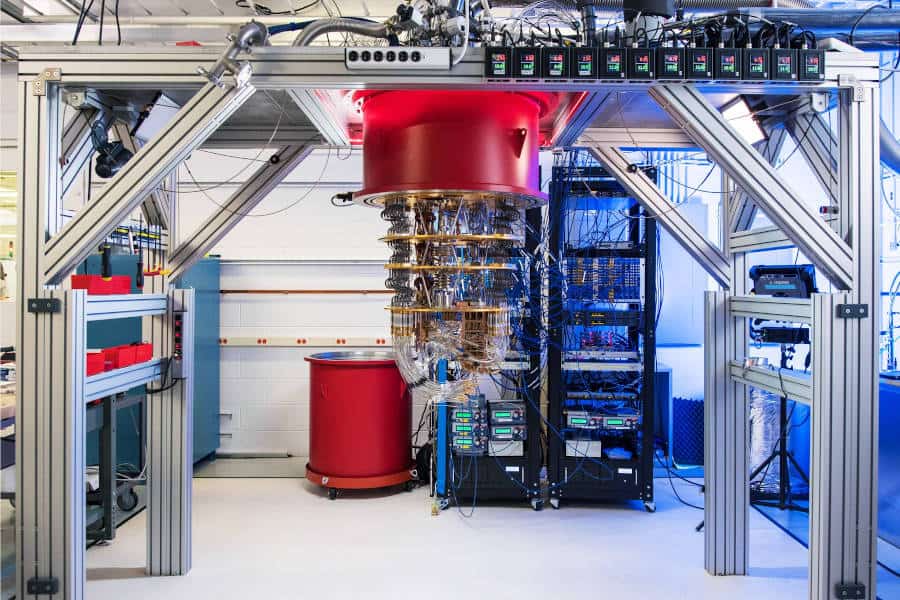
The experiment ran on an IBM Quantum Heron processor, a 156-qubit machine, from which the team selected a connected chain of as many as 100 qubits. They then set two processes against each other in a kind of controlled tug of war.
The first process scrambled. It entangled neighboring qubits, spreading information across the chain in a way that quickly made the system unrecognizable from its starting point, a process the researchers compared to shuffling a deck of cards. Each shuffle erases a little more of the original order. Left to itself, scrambling drives the system toward chaos.
The second process intervened. The machine measured individual qubits and reset them toward a predetermined orderly state, while the rest of the chain kept evolving. Measurement in quantum mechanics is destructive: it collapses the delicate superposition the qubit was holding. But the resets were strategic, applied often enough that they pushed the whole system toward the simple state the researchers had chosen.
Across the full run, the team coordinated nearly 5,000 two-qubit operations alongside nearly 5,000 measurement-and-reset cycles. As IBM principal research scientist Maika Takita described it, the challenge was never measuring a single qubit. It was doing it thousands of times across a large system while everything else kept running.
The tipping point
Enjoying this story?
Get the five most important stories in tech, every morning. Free.
The researchers could dial the relative frequency of scrambling and resetting, and they watched which force won. When scrambling happened more than half the time, chaos won. When resets came more often, control won. And at almost exactly the 50-50 point, the system flipped: a tiny change in the balance shifted the entire 100-qubit chain from chaotic to controllable, the way water freezes into ice when the temperature nudges past zero.
Physicists call such a sudden, collective shift a phase transition. The striking part was that the transition survived in a quantum system at all. There was no guarantee it would. Quantum noise is relentless, and many delicate theoretical effects wash out when they meet real hardware. Here the opposite happened: the transition became sharper as the team scaled up to larger qubit chains, which is the signature of genuine collective behavior rather than an artifact of a small circuit.
The machine had to notice trouble, act on it, and keep calculating, all at once. That is the rehearsal every future fault-tolerant quantum computer will run.
Why feedback control is the whole game
The Feedback Experiment, by the Numbers
IBM Heron ran alternating scrambling and measurement-reset cycles across a 100-qubit chain.
Note: For illustrative purposes only.
It helps to separate two ideas that often get blurred in quantum coverage. Error correction is the full framework: encoding one sturdy logical qubit across many fragile physical ones, constantly checking for errors, and fixing them without destroying the encoded information. Feedback control is the machinery underneath it: the ability to measure something mid-calculation and change what the circuit does next, in real time.
Every serious roadmap to fault-tolerant quantum computing depends on both. The problem that makes feedback hard is speed and scale. The classical electronics steering the quantum chip must decide and act before errors snowball, and it must do this for hundreds or thousands of qubits at once. Demonstrations at a dozen qubits are suggestive but not dispositive, because the interesting question is whether the machinery survives at sizes no classical computer can simulate for comparison.
This experiment pushed into that territory. Conventional simulations maxed out at roughly two dozen qubits for this kind of system, yet the experiment ran cleanly at up to 100. The agreement between the theoretical prediction and the hardware at those scales is what turned a curiosity into a result: the theory said order would emerge past a threshold, and the hardware agreed.
What this is not
Precision matters here, because quantum results are routinely overread. This experiment did not demonstrate a logical qubit, did not run an error-corrected algorithm, and did not move the timeline for breaking encryption or simulating new drugs. The resets pushed qubits toward a simple known state, which is easier than the real task: detecting an unknown error and correcting it while preserving an unknown quantum state you are not allowed to look at directly.
What it did show is narrower and arguably more important. The supporting machinery of error correction, measuring and resetting repeatedly, in the middle of a running computation, at a scale of 100 qubits, works on hardware that exists today. That is a necessary condition for fault tolerance, and until this result, it was an open question at this scale.
From a birthday bet to Nature Physics
The result has an unlikely origin story. In 2021, at a birthday party, Rutgers physicist Jedediah Pixley and his longtime collaborator Sriram Ganeshan made a friendly wager about a puzzling quantum effect, which led the group to develop a new theory of controlling quantum chaos. A chance conversation with IBM physicist Barbara Jones turned the theory into a plan. Pixley lost the bet and paid up in blueberry ice cream, but the theory survived the party and, five years later, matched experiment at a scale no supercomputer could check.
The collaboration ultimately spanned Rutgers, IBM, the City College of New York, the CUNY Graduate Center, Iowa State University, Ames National Laboratory, Pennsylvania State University, and Louisiana State University. Co-first author Haining Pan, a Rutgers postdoctoral researcher at the time, noted that the agreement between theory and experiment at 100 qubits was the tell: this was collective behavior emerging across the system, not a quirk of a small circuit.
The era of treating quantum processors as delicate instruments you set running and hope for the best is ending. The next era will be built on machines that watch themselves, thousands of times a second, and act on what they see. This experiment showed that, at least for 100 qubits at a time, the watching part already works.
0 Comments