
For 53 years, one of the simplest rules in American aviation was this: do not go supersonic over land. The prohibition, written into regulation 14 CFR 91.817 in 1973, made no exceptions for altitude, aircraft design, or how quiet your jet happened to be. Exceed Mach 1 over the continental United States and you were breaking the law. That era is ending, and the replacement is a single number: 0.11 pounds per square foot.
The number comes from a Notice of Proposed Rulemaking the FAA published on July 2, 2026, titled "Enabling Supersonic Overland Flight" and filed under Docket FAA-2026-6935. If finalized, it would repeal the speed-based ban and substitute a performance-based standard: supersonic flight over land becomes legal so long as the boom overpressure reaching the ground stays at or below 0.11 pounds per square foot. Comments closed on August 17, 2026, and the agency targets a final rule by mid-2027.
Why a ban, and why it lasted 53 years
The ban was born in Oklahoma City in 1964. In an experiment called Operation Bongo II, the FAA and the Air Force flew military jets supersonic over the city eight times a day for six months, producing 1,253 sonic booms. The booms rattled windows and cracked plaster. The FAA received more than 15,000 formal complaints from a city of about 500,000, plus 4,629 damage claims. The agency rejected 94 percent of them.
The fallout was decisive. In May 1971, the House voted 215 to 204 to kill funding for the Boeing 2707 supersonic transport. In 1973 the FAA formalized the prohibition. Concorde, which entered service in 1976 and cruised at Mach 2.02, could never fly supersonic over the United States: it flew subsonic over land and accelerated past Mach 1 only past the Atlantic coast.
The ban worked because it was brutally simple: a speed limit, not a noise limit. That simplicity is exactly what the new rule trades away.
What the FAA proposed
Enjoying this story?
Get the five most important stories in tech, every morning. Free.
The proposed framework replaces the categorical prohibition with an interim noise-based standard. An operator must demonstrate to the FAA, before beginning operations, that its operation keeps ground-level overpressure within the ceiling, and must comply with agency-imposed conditions afterward, including periodic reviews.
The ceiling covers primary booms and secondary booms that reach the ground after refracting or reflecting through the atmosphere. The FAA cited NASA's FaINT research and a Volpe Center study in choosing the threshold, along with advances in atmospheric modeling and Mach cutoff operations, in which shock waves refract upward and never reach the ground.
A traditional boom registers 1.0 to 2.0 pounds per square foot at the surface, the sharp double crack that defined the 1960s backlash. The proposed threshold is roughly 10 to 20 times lower, more like a low thump. Whether that is perceptible or objectionable to people on the ground is one of the central questions the rulemaking is meant to answer.
The ban is repealed in principle. The rulebook does not exist yet.
That sentence, from one industry analyst's reading of the saga, captures the situation precisely. Executive Order 14304, signed in June 2025, told the FAA to repeal the ban. But until the rule is final, overland supersonic flight remains effectively off-limits, and no aircraft program has published verified numbers showing routine cruise booms under the threshold.
The case against the number
The overland supersonic rulebook, by the numbers
What the FAA's proposal would replace, and what it would require
Note: For illustrative purposes only.
The sharpest criticism came from Purdue University researchers, who told the FAA that a simple pressure threshold does not necessarily match perceived noise, because human hearing responds differently to different frequencies.
Aviation Week's October 6 analysis of the comments reached a related conclusion: there will be no rush to build a supersonic business jet even if the rule becomes final as proposed. The rule opens the sky but leaves noise on takeoff and landing for a later Part 36 rulemaking. The FAA does not expect airliner type certificate applications until that rule exists.
The gap is structural: a cruise boom limit does not solve takeoff noise, landing noise, fuel economics, or emissions.
The three-legged race
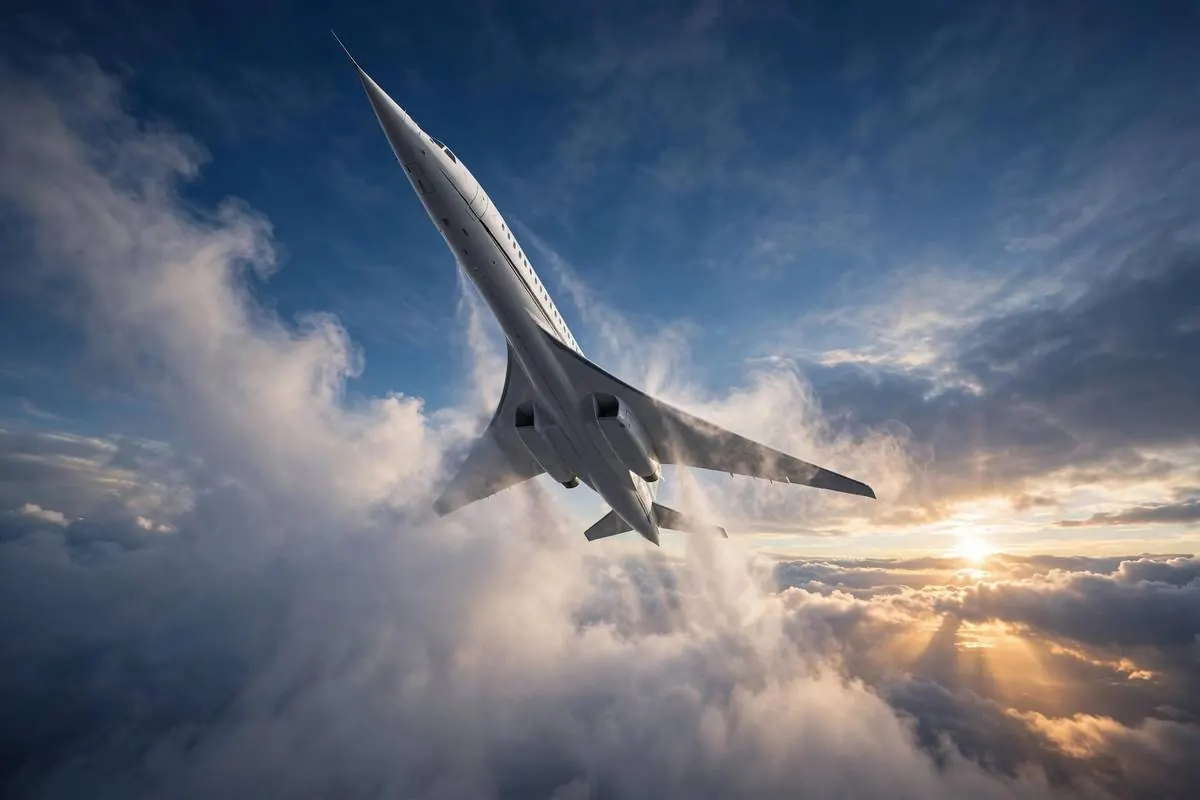
The rulemaking is only one of three parallel tracks. The first is the executive order, which sets June 6, 2027 as the deadline for finalizing noise certification standards. The second is Congress: the bipartisan Supersonic Aviation Modernization Act passed the House in March 2026 as H.R. 3410 and awaits Senate action, with statutory deadlines as a backstop. The FAA already missed the order's original December 2025 deadline by about seven months.
The third track is the one producing actual data. NASA's X-59, built by Lockheed Martin's Skunk Works, is the low-boom demonstrator designed to prove the rule's acoustic assumption. Its elongated nose and top-mounted engine inlet are shaped so shock waves dissipate rather than coalescing into a single boom. It first went supersonic on June 5, 2026, and hit Mach 1.4 at 55,030 feet a week later, targeting about 75 PLdB of perceived noise against Concorde's 105 to 110.
The critical phase comes next: flying the X-59 over American cities while ground microphones and resident surveys measure public perception of the thump. NASA will share the data with the FAA and ICAO, which is not expected to adopt an international standard until 2031. The data may or may not support the 0.11 number.
The physics that will not negotiate
Whatever the rule says, supersonic flight has a fuel problem that no regulation can repeal. Supersonic aircraft burn 6.1 to 8.5 times more fuel per passenger than twin-aisle jets, according to an ICAO study from December 2025. In its mid-demand 2050 scenario, about 1,190 supersonic business jets and 1,037 airliners would raise global fuel burn and CO2 by about 8 percent, wiping out roughly a third of subsonic efficiency gains. In the highest-demand case, the increase reaches 19 percent.
Concorde is the cautionary baseline. At full load it delivered 15.8 passenger miles per gallon; a Boeing 747 delivered 46.4. It died of economics in 2003: maintenance costs, low passenger numbers, and the post-9/11 travel slump. Boom Supersonic, the furthest-along commercial program, holds roughly 130 conditional orders from United, American, and Japan Airlines for its Mach 1.7 Overture, but its clean-sheet Symphony engine has yet to complete core testing. Its 2029 target is optimistic; 2031 to 2032 is the more conservative reading.
The upshot: supersonic service returns only where a premium fare covers a fuel burn multiple of 6.1 to 8.5. The rule change opens the sky. It does not fill the fuel tanks.
What happens next
The sequence from here is fixed: a final rule by mid-2027, X-59 community overflight data feeding FAA and ICAO deliberations through 2027, and a separate Part 36 rulemaking for takeoff and landing noise before any airliner can be certified. Only then does the industry learn whether Mach cutoff techniques can hold a boom under 0.11 pounds per square foot across seasons, terrain, and atmospheric conditions.
The 53-year ban was a speed limit. What replaces it is a noise budget. That is the right trade, and also the one that reveals how much work is left. The boom is the easy problem to measure. Building an airplane that beats it, certifies it, and makes money doing it, that is the hard problem.
0 Comments