
For forty years, the flying DeLorean has been a punchline and a promise. The stainless-steel time machine from the 1980s film series taught an entire generation to picture a car lifting off the road, gullwing doors and all, while the real DeLorean Motor Company collapsed years before the first movie even premiered. On October 13, 2026, the revived American automaker decided the joke had run long enough. At TechCrunch Disrupt 2026 in San Francisco, DeLorean Motor Company announced it is entering the Airspeeder International Series, the world's first racing series for electric flying cars, as constructor of the United States team.
The team will race as the DeLorean Airspeeder Team and make its debut when the 2026-27 season opens in November 2026, lining up against national teams in the series' first international season. DeLorean is the first American constructor in flying car racing.
What the team is racing
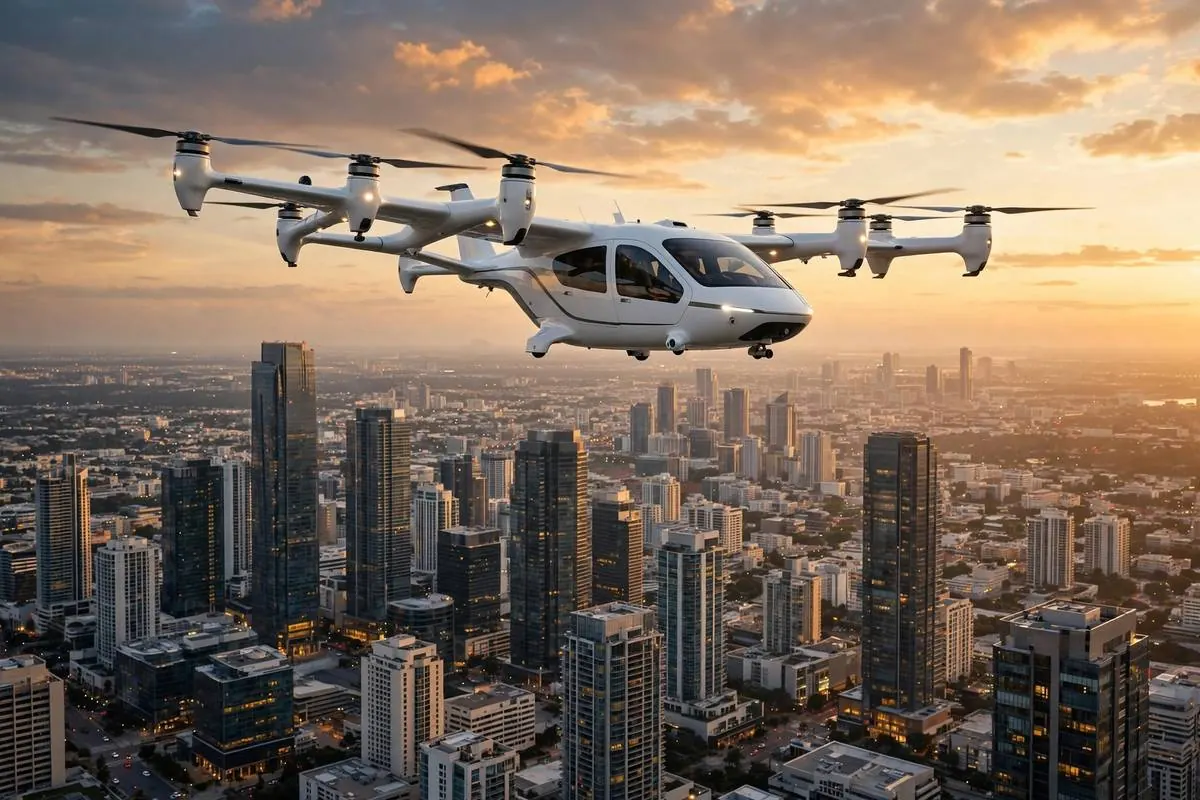
In the Airspeeder International Series, national teams race electric vertical take-off and landing (eVTOL) aircraft in three dimensions through augmented reality-defined courses, rather than around a conventional circuit. The sport is built on electric propulsion, advanced flight control, and AI-enabled safety systems, and the technology is meant to be tested under competitive pressure, the same way motorsport has refined the automobile for a century.
For the debut season, every team, including DeLorean, will fly a standardized electric race platform: the Airspeeder Mk3C, built by Alauda Aeronautics. DeLorean will lead the design identity of its own Mk3C entry. The Mk3C's power-to-weight ratio is reported to exceed that of a fighter jet or a Formula 1 car, which gives you a rough idea of what three-dimensional racing actually demands.
The long-term plan is more ambitious. For the 2027-28 season, DeLorean intends to race a bespoke eVTOL racer of its own design, developed in collaboration with student engineering teams at UC Berkeley and Georgia Tech. The aircraft design, pilot lineup, and sporting program for the debut season have not been revealed yet; the company says they will be disclosed ahead of the season opener.
The flying DeLorean stopped being a movie prop. It is now a constructor entry on a real racing grid.
Why racing matters for electric flight
Enjoying this story?
Get the five most important stories in tech, every morning. Free.
Airspeeder's founding argument is a simple one: electric flying cars should be developed the way the automobile was, through the pressure, scrutiny, and spectacle of racing. Competition compresses development cycles. Flight control software, battery management, collision avoidance, and lightweight structures all improve faster when rival engineering teams are chasing each other through a course than when a single company's prototypes fly carefully scheduled demonstration routes.
This is not a new playbook. Early aviation records were set by racers. The automobile industry spent decades using Grand Prix circuits as rolling laboratories. The question is whether the same dynamic applies to eVTOL aircraft, which face challenges that go beyond speed: certification rules, noise limits, airspace integration, and the physics of carrying a battery-heavy aircraft plus a pilot through demanding maneuvers.
Racing sidesteps some of those constraints on purpose. Airspeeders race on closed courses, not over cities, so they can push airframes and control systems harder than any certified air taxi would be allowed to in service. The bet is that lessons learned at the edge, in battery thermal management, in redundant flight control, in high-agility maneuvering, migrate inward to the mainstream of advanced air mobility.
Brand, spectacle, and a fair bit of skepticism
The DeLorean Airspeeder Team, By the Numbers
From announcement to grid, the key facts.
Note: Figures are illustrative. The 2027-28 bespoke racer is a stated plan, not a delivered aircraft.
There is no pretending the branding angle is incidental. "DeLorean has always stood for the courage to imagine transportation differently," said Cameron Wynne, the company's Chief Brand Officer. "People have pictured a DeLorean in the sky for forty years. We decided it was time to stop picturing it." Airspeeder founder and CEO Matt Pearson, the Australian entrepreneur who created the series, called DeLorean "the original flying car brand," noting that long before anyone built one, the world already knew what a flying DeLorean looked like.
And skepticism is warranted. Some coverage of the announcement has asked, reasonably, whether the team will be much more than a PR stunt. The series is young, the first international season has not yet begun, and DeLorean's modern incarnation, founded in 1995 by UK-born businessman Stephen Wynne to supply parts and refurbishment for original DMC-12s, has teased production models for years without shipping one. A racing team that has not yet revealed its aircraft, its pilot, or its sporting program is, for now, mostly an announcement.
But announcements have a way of becoming infrastructure when they arrive at the right moment. The eVTOL industry is racing toward certification and commercialization on multiple fronts at once, from Southeast Asia to the Middle East, and public demonstrations of electric flight keep pulling the concept closer to the mainstream. If Airspeeder's first international season delivers genuine competition, DeLorean's grid slot will have bought the company something money rarely buys in transportation: a front-row seat in the proving ground for electric flight. Where it goes, it no longer needs roads.
0 Comments