
On October 8, the U.S. government made its biggest coordinated push yet toward practical quantum computing. The Pentagon announced roughly $350 million in new quantum initiatives, and the Department of Energy pressed forward with its Quantum Genesis Q Competition, a program with up to $215 million in planned funding. Taken together, the federal quantum pipeline now exceeds half a billion dollars in new money, all aimed at one milestone: a fault-tolerant quantum computer with at least 100 logical qubits.
That number matters more than the dollar figures. A logical qubit is the thing you can actually compute with. Today's processors have physical qubits, individual quantum bits that are noisy and lose their quantum state within microseconds. Error correction stitches hundreds or thousands of physical qubits together into a single logical qubit that behaves reliably. The largest machines on the market field thousands of physical qubits but only a handful of high-quality logical ones. Reaching 100 is where machines start doing scientifically useful work that classical computers cannot.
The catch, and there is always a catch, is that much of the announced money is conditional, planned, or spread across multiple years. Washington is buying an attempt, not a result.
The Pentagon's $350 million package
The Defense Department announcement breaks into two pieces. Roughly $200 million in new DARPA funding is tied to the October 7 selection of Atom Computing, Diraq, IBM, and IonQ for Stage C of the Quantum Benchmarking Initiative (QBI). Those four join Microsoft and PsiQuantum in the program's final verification phase.
QBI's stated objective is unusually concrete for government research: determine whether a quantum-computing approach can reach utility-scale operation by 2033, meaning computational value that exceeds the cost of running it. Stage C is a credibility test, with companies working alongside the government to verify whether their proposed machines can actually be constructed as designed and operated as intended. The new money builds on more than $650 million of previous DARPA investment in prospective quantum-computing providers.
The second piece is a conditional loan commitment of up to $150 million from the Office of Strategic Capital for PsiQuantum's 140,000-square-foot manufacturing and prototyping hub in Milpitas, California. The financing would fund component and assembly test equipment, system assembly and integration infrastructure, and advanced cryogenic systems, alongside company co-investment. Final commitment remains subject to financial, legal, technical, and regulatory review. PsiQuantum previously reached a $125 million expanded DARPA agreement in July and an agreement for up to $100 million in CHIPS incentives in September.
DARPA will also convene application workshops with the DOE Office of Science, the National Nuclear Security Administration, and the Laboratory for Physical Sciences, beginning before January 2027. The agenda is to bring end users together with quantum-algorithm experts and identify chemistry, materials science, and physics problems where future quantum capabilities could matter for national security.
Washington is buying an attempt, not a result. The money is real, but much of it is conditional on the machines actually working.
The $215 million competition
Enjoying this story?
Get the five most important stories in tech, every morning. Free.
The DOE's Quantum Genesis Q Competition, launched September 17, sets the clearest technical bar of any federal program to date. Teams must demonstrate machines with at least 100 logical qubits capable of hundreds of millions of fault-tolerant operations. The department identified eight priority applications spanning chemistry, materials science, subatomic physics, and applied mathematics.
The funding is structured as a ladder. Companies meeting early milestones can receive awards of up to $1.5 million each. A $100 million incentive pool is reserved for teams demonstrating machines with at least 100 logical qubits, with two additional $50 million pools for systems reaching 150 and 200 logical qubits. A separate $45 million laboratory program will support testing and verification of the hardware and software.
Two caveats deserve emphasis. Applications close October 19, 2026, so the field of competitors is about to lock in. And the DOE says the awards will depend partly on future congressional appropriations, meaning the full $215 million has been planned, not guaranteed. The competition follows a June 2026 executive order on quantum innovation directing federal agencies to support advanced quantum technologies.
Why 100 logical qubits is the real story
The Federal Quantum Funding Push
New money announced in October 2026, by program.
Figures as announced Oct 2026; several commitments are conditional or subject to appropriations.
To understand why both programs orbit the same number, consider the arithmetic of error correction. A single reliable logical qubit typically requires hundreds to thousands of physical qubits, depending on hardware quality and the error-correction code. A 100-logical-qubit machine therefore implies hundreds of thousands of physical qubits operating in concert, or a breakthrough that slashes the overhead.
That scale is where quantum computers could start outperforming classical supercomputers on specific chemistry and materials problems, such as simulating molecules too complex for brute-force classical methods. Nobody has demonstrated this at scale yet, and classical methods keep improving, which is why the DOE's plan to benchmark quantum systems against advanced classical supercomputing matters. A quantum advantage measured against an obsolete classical baseline is a marketing claim, not a scientific result.
The crypto footnote, kept in proportion
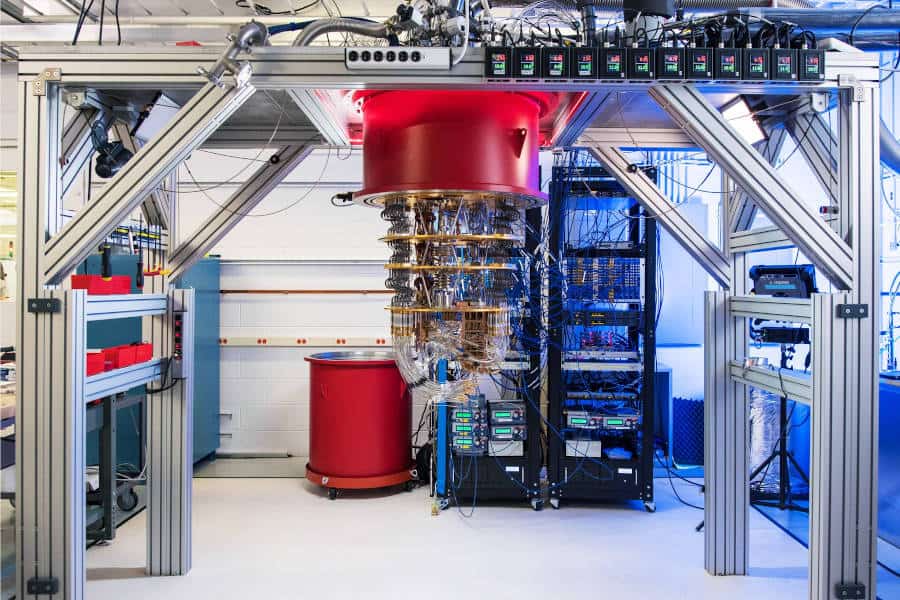
The announcements arrived the same week that Europol published two reports (October 7) on how future quantum capabilities could affect cryptocurrencies and encrypted information. The agency warned that sufficiently powerful quantum computers could derive private keys from exposed public keys. It did not claim that existing machines can do this, and it described the timing as uncertain.
The gap between the two stories is worth stating plainly. Breaking Bitcoin's elliptic-curve cryptography with Shor's algorithm is estimated to require on the order of 1,200 to 1,450 logical qubits. The federal programs are targeting 100. That is progress toward scientific computing, not an encryption crisis. Developers are already preparing regardless: the first quantum-resistant Bitcoin transaction was completed in August 2026, and custody providers are testing quantum-resistant signing technology.
What to watch next
The developments worth tracking from here are concrete. Whether PsiQuantum's loan reaches financial close. What DARPA's Stage C verification actually establishes about each company's design. Whether the application workshops produce testable workloads with explicit problem sizes and classical baselines, or just slide decks. And whether Congress appropriates the funds the Quantum Genesis competition is counting on.
The federal government has decided that the quantum industry's next phase should be evaluated, not just funded. That is the right instinct. The companies now have to show that their machines can be built as designed, operated as intended, and aimed at problems that matter. The money is real enough to get attention. The machines still have to earn it.
0 Comments