
Shopping malls are not traditional venues for aviation debuts, but IOI City Mall in Putrajaya became one on October 9, 2026, when Chinese eVTOL developer TCab Tech opened a month-long public showcase of its five-seat E20 electric aircraft. The mall debut carried a business payload: a memorandum of understanding with the Selangor Information Technology and Digital Economy Corporation (SIDEC) to explore commercialising the E20 in Malaysia and anchoring the company's expansion across Southeast Asia.
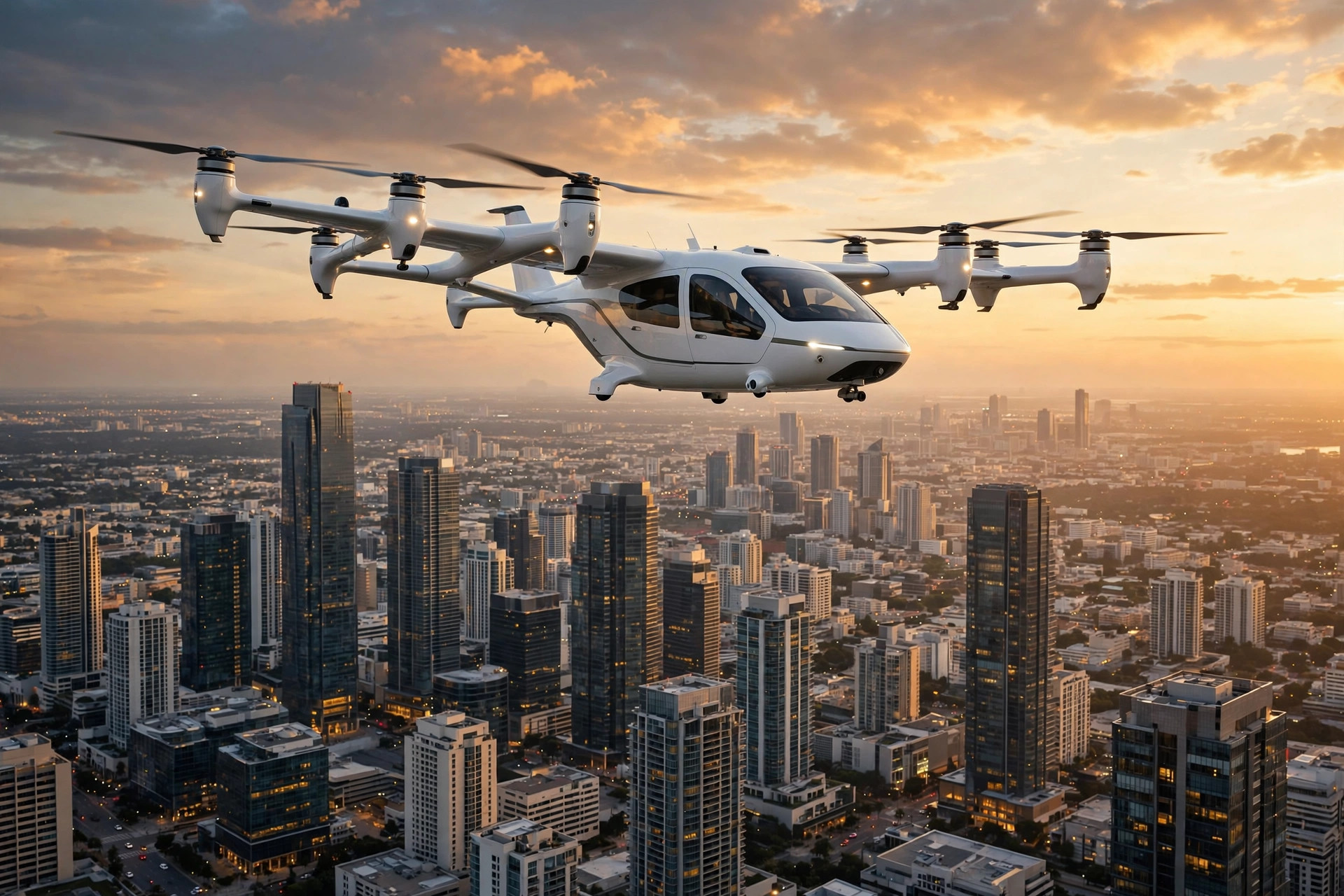
The E20 is a tilt-rotor machine built for regional air mobility, not short urban hops. One pilot, four passengers, a cruise speed of 260 km/h, a top speed of 320 km/h, and a range of 200 kilometres put it in the intercity class: airport transfers, tourist routes, and connections between Malaysian cities that today require a helicopter or a long drive. That positioning explains the choice of Malaysia as a beachhead, a country whose aviation regulator is actively writing the rulebook for advanced air mobility and whose geography, dense cities separated by water and terrain, suits exactly the kind of missions the E20 was designed for.
What the MOU actually commits to
The agreement is deliberately modest about what it promises. It commits the two sides to cooperate on certification preparations, industry engagement, and potential commercial applications. It confirms no aircraft order and sets no timetable for service entry. What it does commit to is harder to quantify but arguably more valuable: SIDEC will use its local industry network to coordinate engagement with Malaysian government agencies, the Civil Aviation Authority of Malaysia (CAAM), and other stakeholders, while TCab Tech plans to establish a regional business centre in the country.
TCab Tech founder and chief executive Ng Yon Wui has also been appointed an industry adviser to SIDEC, with a remit covering aerospace, advanced air mobility, and other emerging technology sectors. That is a seat at the policy table rather than a purchase contract, and it signals how the company intends to enter the market: by helping shape the local ecosystem before selling aircraft into it.
The aircraft behind the showcase
Enjoying this story?
Get the five most important stories in tech, every morning. Free.
The E20's tilt-rotor configuration is the same broad architecture pursued by Joby and Archer, and for good reason. Four tilting propellers provide lift in vertical flight and tilt forward for efficient wing-borne cruise, while two additional double-stacked rotors are dedicated to vertical takeoff and landing. Six electric motors distribute propulsion, so the loss of one motor does not compromise the flight, and the company says the aircraft can glide to a landing even in a complete propeller failure. An 800-volt ultra-fast charging system is designed for rapid turnaround between flights.
The test record is substantial for a five-year-old startup. TCab Tech reports more than 1,000 test flights, including a multi-passenger flight with the chief executive on board, and it completed transition flight tests in December 2025. Certification is further along than many Western eVTOL programmes are publicly admitting, but it is not done: the company says it has agreed the certification basis, means of compliance, and certification plan with the Civil Aviation Administration of China (CAAC), while type certification itself remains unachieved.
A showcase in a shopping mall is marketing. A regional business centre and a seat at the regulator's table are strategy.
Why Malaysia, and why now
The TCab E20 at a Glance
Specifications reported by TCab Tech and independent references.
Note: Specifications are company-reported. CAAC type certification has not yet been achieved.
The regulatory groundwork is falling into place at both ends of the relationship. On September 21, 2026, the CAAC and Malaysia's CAAM signed an aviation safety cooperation MOU covering airworthiness, organisational certification, personnel licensing, and operational oversight. That framework does not approve the E20 for Malaysian operation by itself, but it creates the authority-to-authority channel through which a Chinese-certified aircraft could eventually be recognised. Malaysia's own regulator has begun work on an advanced air mobility technical working group, a concept of operations, and a national roadmap, alongside consideration of regulatory sandbox arrangements.
The MOU is also the third plank in a visible Southeast Asia strategy. In November 2025, TCab Tech launched its Air Silk Road Global Pioneer Partnership and signed an agreement with Singapore-based NexAvian to support expansion into Southeast Asia. In July 2026, it appointed PT Intercrus Aero Indonesia as its authorised partner in Indonesia, with regulatory engagement and feasibility studies for potential E20 deployment. Malaysia now completes a Singapore, Indonesia, Malaysia triangle of commercial groundwork, all three before the aircraft is certified in its home country.
The money already on the table
The Malaysian engagement rides on a commercial pipeline that gives TCab Tech something most eVTOL startups lack: stated demand. In July 2025, the UAE's Autocraft signed an MOU to purchase 350 E20 aircraft worth $1 billion, described as China's largest single intent order for eVTOLs. Provisional orders reportedly exceed 200 aircraft in total, and Chinese media has put the aircraft's expected price at around 7 million yuan. In November 2025, the company raised RMB 300 million (about $43 million) in a Series B++ round led by Meridian Capital, HuaHan Capital, and Puhua Capital, taking total funding past RMB 1 billion. The company is targeting CAAC airworthiness certification in 2027.
The applications named for Malaysia, tourism, intercity connections, and urban transport, are the standard eVTOL playbook, and the standard caveats apply. No eVTOL in the world has yet entered commercial passenger service at scale, CAAC certification is the gating event, and MOUs are worth exactly the effort both sides put into them afterwards. But the structure of this particular MOU is more serious than the average handshake photo. A regulator relationship, a policy adviser role, a regional headquarters plan, and a bilateral airworthiness cooperation agreement between the two countries' aviation authorities are the unglamorous infrastructure on which air taxi markets will either be built or fail to materialise.
The month-long showcase at IOI City Mall, meanwhile, does the other job: it puts a real aircraft in front of thousands of Malaysians who have never stood next to one. In a sector where public acceptance is as uncertain as certification timelines, that is not a vanity exercise. The air taxi industry has spent a decade flying for investors and regulators. TCab Tech just spent a month flying for shoppers, and in the long game of advanced air mobility, the shoppers may matter more.
0 Comments