
Three months of dealmaking just rewrote the economics of the private space industry. Space startups raised a record $20.8 billion in the third quarter of 2026, according to a quarterly report from global investment firm Seraphim released on October 14, nearly triple the $7.4 billion raised in the second quarter and more than double the previous all-time peak. The quarter also set a deal-count record: 216 transactions, up from 140 in the prior three months.
Strip out the single largest deal, Blue Origin's $10 billion financing, and the story barely changes. The remaining $10.8 billion would still be the biggest quarter in the industry's history. This is not one outlier deal pulling up an average. It is a broad-based capital wave.
Where the money actually went
The capital did not flow evenly. Infrastructure-related businesses captured the bulk of the funding, and the split reveals where investors think the real value is accumulating. Companies involved in launch and broader space access pulled in $16.4 billion across 120 deals, while satellite communications, Earth observation, and other space-service companies raised $4 billion.
That is a deliberate shift in emphasis. For years, space investing was dominated by application-layer bets: constellations promising global internet, satellite imagery companies selling data. Now the check sizes are going to the picks and shovels: launch vehicles, manufacturing, orbital infrastructure. The quarter's largest rounds tell the same story. Hadrian, which builds factories for aerospace and defense hardware, raised $1.37 billion. Stoke Space, developing a fully reusable rocket, took in $1 billion. K2 Space, which is building high-power satellite buses, closed $500 million.
This is not one outlier deal pulling up an average. It is a broad-based capital wave moving into launch pads, factories, and orbital infrastructure.
Demand is doing the talking
Enjoying this story?
Get the five most important stories in tech, every morning. Free.
Seraphim Space vice president Lucas Bishop summed up the mood: capital is now following evidence of commercial and institutional demand, not residual enthusiasm left over from the IPO boom. In other words, investors are no longer buying the dream of space. They are buying its order books.
That demand comes from two directions at once. Commercial orders are growing, as constellations multiply and companies need more launch capacity, more satellite platforms, and more ground systems to support them. At the same time, government-backed programs are expanding. Defense and sovereign demand are increasingly underpinning investment in launch, manufacturing, and orbital infrastructure, as governments prioritize building domestic space capabilities rather than depending on foreign providers.
This dual engine matters because it makes space investing look less like venture gambling and more like industrial policy with returns. A launch company with multi-year defense contracts and a queue of commercial payloads is a fundamentally different investment than a satellite constellation hoping to find subscribers. The money is following that difference.
The strange split in space stocks
Space Startup Funding, Q3 2026
Record quarter for private space investment, per Seraphim.
Note: Figures from Seraphim's Q3 2026 report, released October 14, 2026. Deal count hit a record 216, up from 140 in Q2.
Here is the puzzle in the data: while private markets were on fire, publicly traded space companies had a noticeably weaker quarter. Many listed space firms remain loss-making, and Seraphim notes that SpaceX's scale and visibility may have drawn investor attention away from smaller publicly listed peers.
The divergence is worth understanding. Public markets price what exists today, with all its quarterly losses and cash burn on display. Private markets price what could exist tomorrow, discounted for risk but not yet punished by earnings reports. When the two disagree this sharply, either private investors are too optimistic or public investors are too cautious. Historically in space, the truth has usually landed somewhere in between, with corrections arriving eventually on one side or the other.
There is also a concentration effect. The mega-rounds skew toward companies that look increasingly like strategic infrastructure: Hadrian's aerospace factories, Stoke's reusable rockets, Blue Origin's heavy lift. These are businesses where scale itself is the moat, and where governments are effectively co-investors through contracts. Smaller listed companies selling commodity services face a tougher story.
What $20.8 billion actually buys
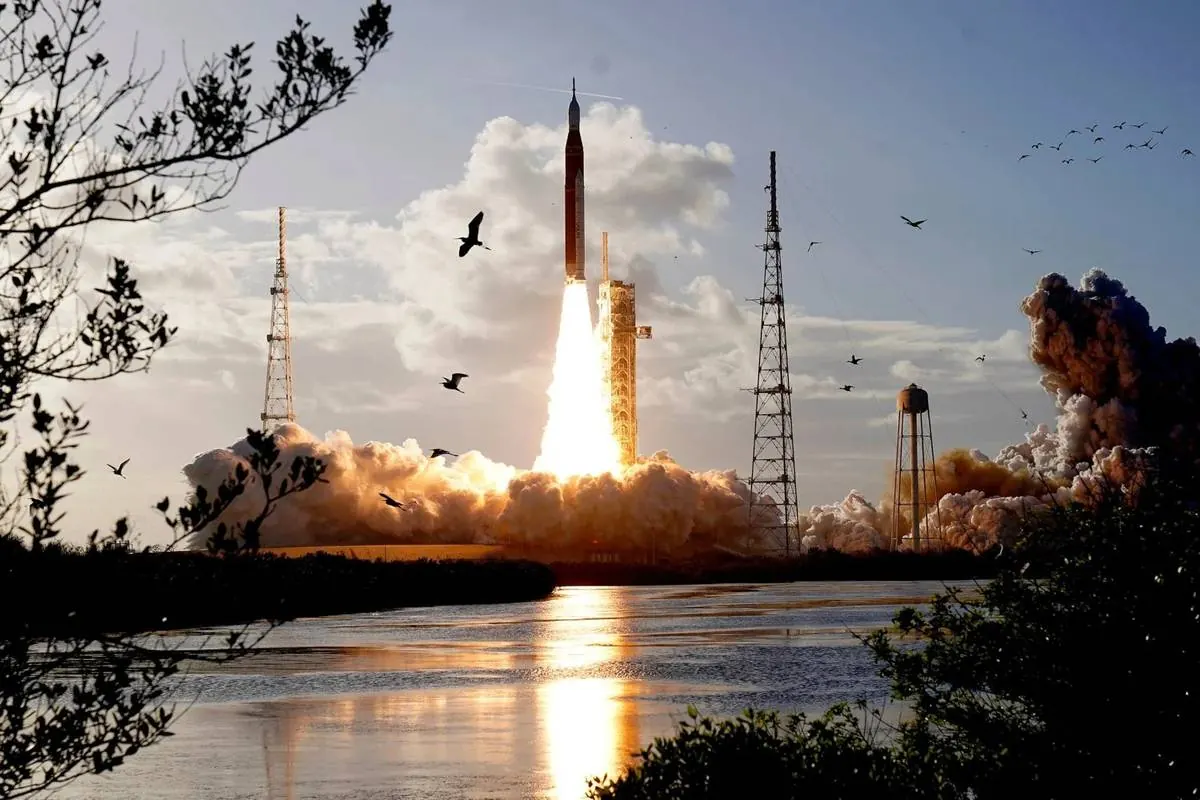
Money at this scale stops being a headline and starts being a landscape. Ten billion dollars built out a full factory-to-launch pipeline at Blue Origin. A billion dollars funds a reusable rocket program from design through test flights. The $16.4 billion that went into launch and space access this quarter represents, in practical terms, years of manufacturing capacity, engine testing, launch sites, and the skilled workforce to run them.
It also buys speed. Space programs are measured in decades when funded by annual government budgets. Private capital compresses that. The reason 216 deals closed in three months is that investors believe the capacity being built now will be worth more soon, once the commercial orders and defense contracts flow through.
What to watch
Three questions will decide whether this quarter was a peak or a plateau. First, does the defense and sovereign demand that underwrote much of this funding keep growing, or was it front-loaded by one-time procurement decisions? Second, do the mega-round recipients hit their technical milestones, since a missed test flight or delayed factory can cool a whole sector? Third, does the public-market weakness spread to private valuations, or do private investors keep pricing space infrastructure as a growth asset while public markets treat it as a value trap?
For now, though, the signal from the third quarter is unambiguous. The space industry has moved past the phase where its main product was excitement. The money is going to the companies that make things fly, and to the factories, launch sites, and supply chains behind them. The romance of space has been replaced by something more durable: revenue.
0 Comments