
Two announcements in five days put Osaka at the center of Japan's air taxi push. On October 1, 2026, SkyDrive unveiled a feasibility study to convert 146 rooftop emergency helipads across Osaka City into vertiports. On October 6, the company announced a joint initiative with MUFG Bank and other Kansai enterprises to build the commercial case for eVTOL service across Western Japan, under the banner of the "Kansai Air Transportation Network Concept."
The pairing matters. Most eVTOL pitches start with the aircraft and hope the infrastructure arrives later. SkyDrive is doing it the other way around: nail down where the aircraft would land, and who would pay for the whole thing, before anyone buys a ticket. Whether that discipline survives contact with Japanese aviation regulators is the real question.
A vertiport network without new construction
Osaka City has 146 rooftop emergency landing sites, marked with the familiar "H," mostly atop buildings taller than 100 meters. They were built for disaster response, not commerce: reinforced flooring, fire suppression systems, lighting, and a legal status that keeps them reserved exclusively for emergency use. Securing commercial passenger transport permits for them, as SkyDrive itself notes, remains a significant regulatory challenge.
The feasibility study, run under the Cabinet Office's Super City research program, asks whether these sites could serve as alternate vertiports for eVTOL operations: backup landing points for aircraft that cannot reach their planned destination, and potentially nodes in a daily intra-city network. SkyDrive is conducting the study with Osaka Metro, Kansai Electric Power, Chodai Co., and the Organization of Airport Facilitation, with administrative support from Osaka Prefecture and Osaka City.
The study's checklist is revealing. It covers airspace compliance with Civil Aeronautics Act standards, mapped district by district; analysis of building-induced winds to set safe weather and operational limits; noise simulation for takeoff, landing, and flight; structural floor-load capacity for repeated aircraft landings; passenger movement flows during diversions; charging infrastructure feasibility and power equipment upgrades; cost estimates; and logistics for transporting an aircraft down from a rooftop after a mechanical failure. SkyDrive will also consult the Osaka Municipal Fire Department on how to preserve the sites' disaster response function while adding commercial operations.
The attraction is obvious. In a dense city where land is scarce and new ground-level heliports are expensive, the rooftops already exist. Reusing them is the pragmatic path around the infrastructure costs and zoning fights that have stalled air taxi projects elsewhere. The counterpoint: these pads were never designed for daily commercial operations, and the operational guidelines and regulatory framework for converting them are, by SkyDrive's own admission, still being developed.
From Expo demonstration to bank-backed business case
Enjoying this story?
Get the five most important stories in tech, every morning. Free.
The second announcement moves from infrastructure to money. The October 6 initiative brings together MUFG Bank and industry leaders from transportation, aviation, infrastructure, energy, tourism, finance, and insurance to push commercialization. The six work areas are flight networks and routes, infrastructure and maintenance facilities, operations and safety management, demand generation and service integration with regional transport and tourism, commercial feasibility and business models, and public engagement with national and local government.
The pairing is deliberate: one study asks where the aircraft would land, the other asks who would pay for the whole thing.
MUFG is not a neutral observer. The bank led SkyDrive's ¥8.3 billion Pre-Series D funding round in July 2025, the capital meant to carry the company from prototype testing to commercial planning. Having the lead investor now organize the commercialization study suggests a bank trying to de-risk its own bet, which is arguably more useful to SkyDrive than a cheerleader.
The company has recent proof points. SkyDrive flew demonstration flights of its SKYDRIVE (SD-05) aircraft during Expo 2025 Osaka, Kansai, over a one-month period witnessed by thousands of visitors. Production began in March 2024 at a Suzuki Motor plant, SkyDrive's official production partner. The company says it is working with civil aviation authorities in Japan and the United States toward certification, with service aimed for 2028. On October 1 it restructured its executive leadership to focus on global commercialization. The October 6 announcement was presented at the MUFG booth during Global Startup EXPO 2026 in Osaka, with former prime minister Fumio Kishida and Osaka governor Hirofumi Yoshimura on stage.
The aircraft, in concrete terms
The Osaka eVTOL push, in numbers
SkyDrive's SD-05 aircraft and the two October 2026 initiatives
Note: funding round closed July 2025; service launch targeted for 2028, pending certification.
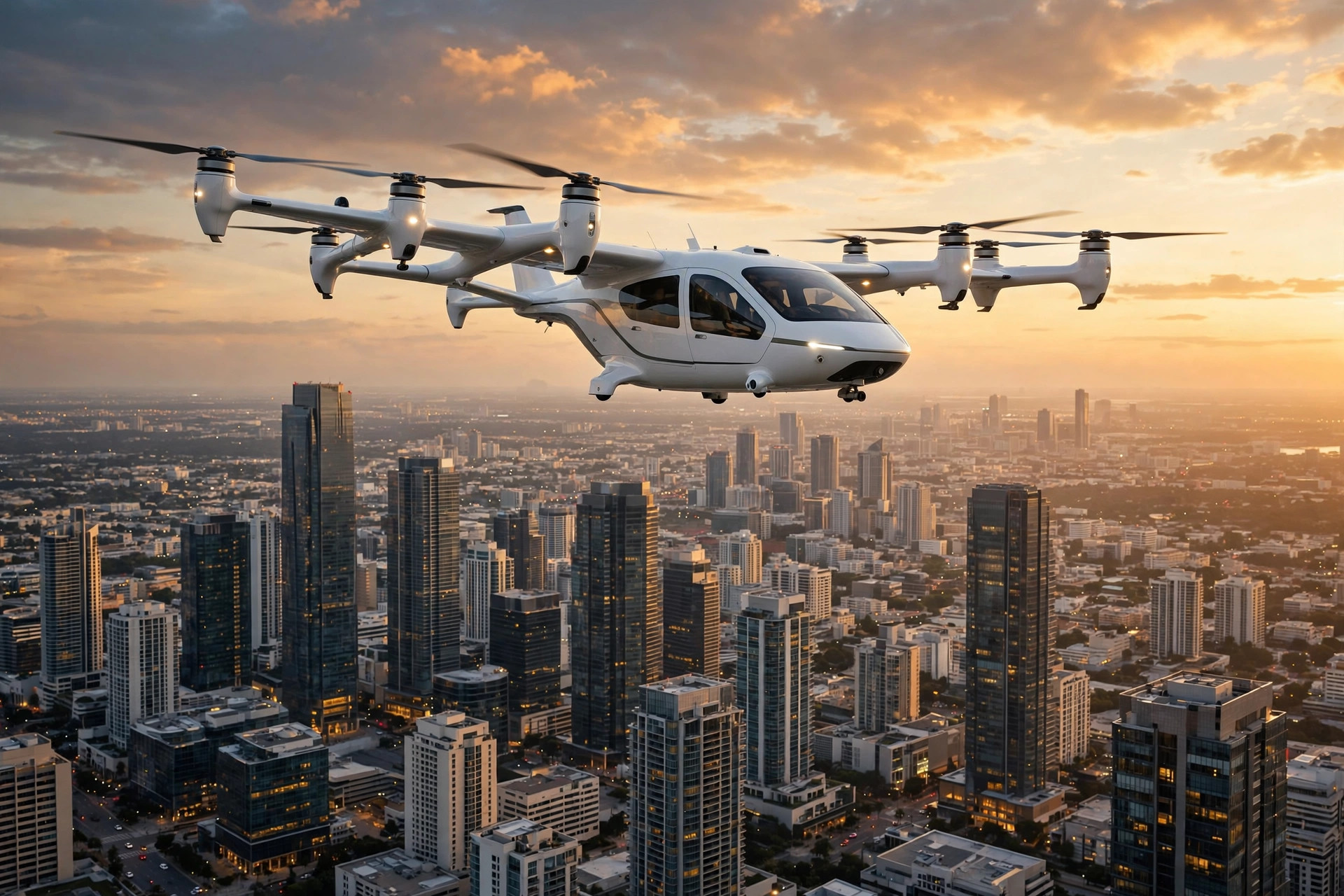
The SD-05 is a compact three-seater: one pilot, two passengers. Twelve motor rotors lift a maximum takeoff weight of 1,400 kilograms, with a cruising speed around 100 km/h and a range of 15 to 40 kilometers. SkyDrive, founded in 2018 in Toyota City and led by CEO Tomohiro Fukuzawa, began eVTOL prototype testing in 2014 and became the first company to fly a crewed eVTOL in Japan in 2019.
Those numbers define the business. Forty kilometers at 100 km/h is not regional aviation; it is cross-town travel. That is why the rooftop network and the Osaka focus matter so much. SkyDrive says its approach differs from most global eVTOL projects, which target airport-to-suburb hops, by aiming at daily intra-city mobility with a compact aircraft. The honest reading: the aircraft's short legs make a dense, centrally located landing network a necessity, not a flourish.
What 2028 would actually require
Two hurdles stand between these studies and a 2028 service launch. The first is certification of the aircraft itself, still in progress with regulators in two countries. The second is harder: writing the rules that let a disaster-response helipad operate as a commercial vertiport, getting the fire department comfortable with dual use, upgrading power infrastructure on dozens of buildings, and proving that enough Osaka residents would pay air-taxi prices to fill the seats.
On paper, the sequence is right: infrastructure study first, commercial framework second, certification in parallel. In practice, each step depends on the others. The vertiport economics assume an aircraft that is certified, the aircraft's business case assumes vertiports that exist, and both assume demand that no one has measured yet. The six work areas of the Kansai network concept read like an admission that the company knows this. Feasibility studies are not launches, and SkyDrive's October announcements are more valuable as a map of what has to go right than as a promise that it will.
Still, few eVTOL companies anywhere are this far along at connecting the dots. A bank organizing the business case, a metro operator planning the pads, a power utility in the room from day one: that is what a serious commercialization attempt looks like in a country that does not approve aircraft quickly or casually. Whether Osaka gets air taxis in 2028 depends less on the rotors and more on the paperwork, the power lines, and the fire department. SkyDrive seems to have figured that out. Now it has to execute.
0 Comments