
Everyone in aviation is chasing the same shiny future: vertical takeoff, battery packs, rooftop vertiports, a Jetsons commute over Manhattan. Meanwhile, one of the oldest aircraft types in existence is quietly being rebuilt around the same technology. This week, European aviation company EVIA AERO signed a memorandum of understanding with US developer Tidal Flight to introduce up to 20 Polaris amphibians to Europe, a hybrid-electric seaplane that takes off from water and runways alike.
The deal, signed October 14, covers ten firm positions and ten options on an aircraft that does not yet exist at full scale. EVIA AERO wants to be among the first operators to fly it once it enters service, subject to EASA validation and a definitive purchase agreement. Early routes being modelled include Valletta to Gozo in Malta, flown fully electric; Helsinki to Stockholm, about 215 nautical miles; Amsterdam to London, roughly 200 nautical miles; and a lake-to-Riviera hop from Lake Zurich to Monaco.
What just happened
Strip away the romance of seaplanes and this is a procurement story with a twist: a European operator is buying a future aircraft type before it flies, and the first candidate market is a five-minute inter-island hop. The Valletta-Gozo connection is the centerpiece because it is the shortest, and per the companies' operational study it could be flown fully electric. Longer routes would use the hybrid system, with onboard generators extending range.
EVIA AERO is not the first customer to sign up. India's Mehair, the country's pioneering seaplane operator, signed for ten Polaris aircraft at the Singapore Airshow in February 2026. Tropic Ocean Airways in Florida, one of the largest seaplane operators in the Americas, has partnered with Tidal Flight to introduce the aircraft across Florida and the Bahamas. The pattern is consistent: established water-based operators see a better version of the aircraft they already fly.
Why the seaplane works again now
Enjoying this story?
Get the five most important stories in tech, every morning. Free.
The case for electric seaplanes rests on an underappreciated truth: water infrastructure already exists. Every lake, harbor, and coastline is a runway that needs no construction, no land acquisition, and no planning permission. While eVTOL developers budget billions for vertiports and negotiate rooftop access with cities, seaplane operators can land anywhere the water is calm and deep enough.
There is also the noise problem, the single biggest political obstacle to urban air mobility. Tidal claims the Polaris's hybrid powertrain cuts takeoff noise by approximately 20 decibels compared to conventional aircraft. Twenty decibels is not a tweak; it is roughly a fourfold reduction in perceived loudness, and it comes from low-tip-speed propellers, and it explains the entire sales pitch. For operators that have spent decades fighting noise complaints from waterfront neighborhoods, that figure matters more than any battery spec.
The eVTOL industry is building a new network from scratch. The seaplane industry is electrifying one that already exists.
How the Polaris actually flies
The Tidal Polaris, By the Numbers
Company design targets for the hybrid-electric amphibian.
Note: Efficiency and noise figures are company claims, not independently audited results.
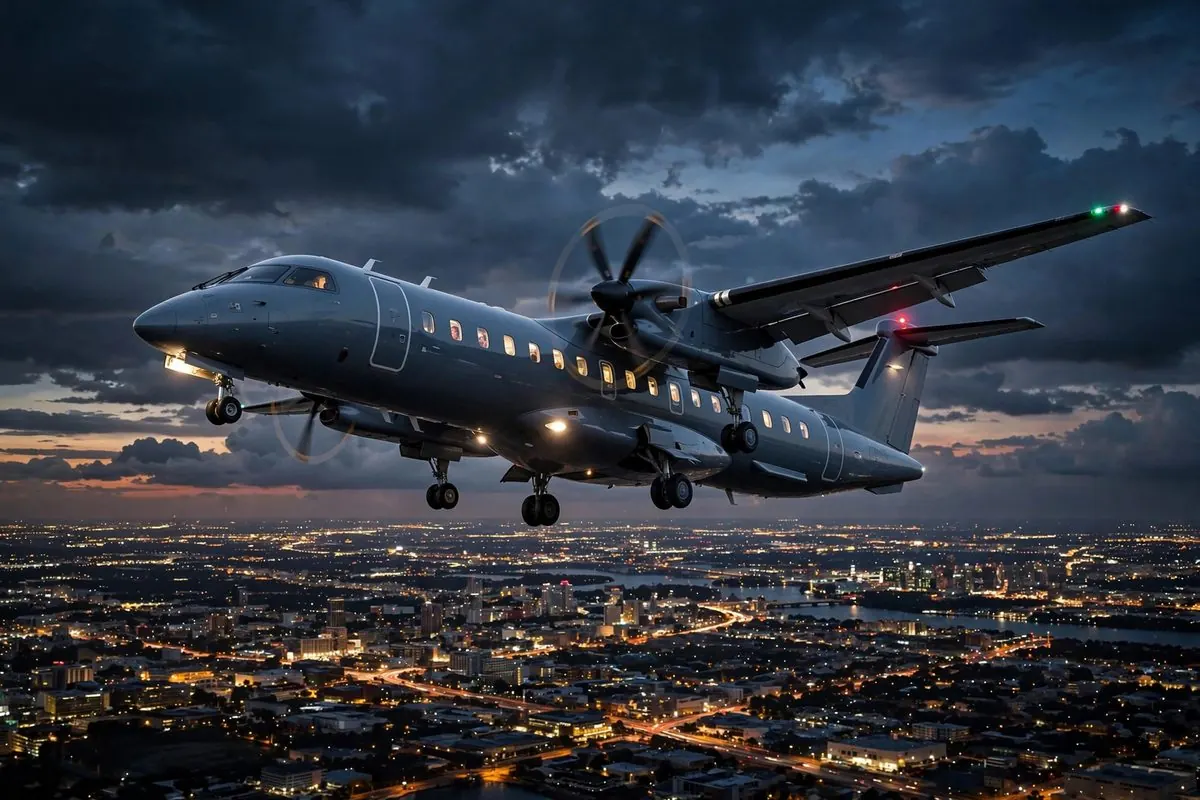
The aircraft's design reads like a careful compromise between physics and business. Two electric nacelles sit on a V-tail empennage, with propellers powered by a battery bank that is itself fed by an onboard internal combustion engine running as a generator. On short legs, the aircraft can fly purely on battery power. On longer sectors, the generator keeps the batteries charged in flight.
The headline numbers, from the company's design targets: a 59-foot wingspan, a 12,500-pound maximum takeoff weight, cruise speed of 162 knots at 7,000 feet, and a range of about 1,034 nautical miles carrying a one-tonne payload with up to 13 passengers aboard. The composite fuselage, foldable wingtip floats for lower drag, and retractable gear are designed to fight corrosion, the chronic cost driver of saltwater operations. In the near term the generator burns jet fuel or sustainable aviation fuel; the company says later versions could move to hydrogen or full battery power.
This is the right architecture for a realistic reason. Batteries are nowhere near the energy density of kerosene, and on an amphibian that must haul floats, landing gear, and boat-hull structure, the weight penalty bites twice. The series-hybrid approach lets the aircraft fly its most profitable short routes with zero local emissions while keeping the fuel fallback for longer sectors.
The economics of the second aircraft market
What makes this story different from the typical electric-aircraft announcement is who is buying and why. EVIA AERO, Mehair, and Tropic Ocean Airways are not speculative startups; they are operators with existing routes, customers, and cost structures. The company claims operating costs will fall roughly 40 percent and fuel consumption 85 percent versus traditional seaplanes, company targets rather than audited results, but the pitch is a cheaper aircraft to run, not merely a greener one.
That distinction matters because the history of aviation is a graveyard of technically brilliant aircraft that were too expensive to operate. Seaplane operators have survived on thin margins for decades, flying tourist runs in the Maldives, island hops in Greece, and commuter routes in British Columbia and the Pacific Northwest. They will adopt new propulsion if the numbers work, and a 20-aircraft European order, even as an MOU, is the market saying the numbers are plausible.
What still has to go right
The caveats are real and the companies do not hide them. Final routes depend on certification, on ground and water infrastructure, and on demand. A 1/6th-scale model has flown; the company has said a full-scale prototype would fly in 2027, with passenger service possible around 2030. EASA validation of the type is still ahead, and certifying a hybrid-electric amphibian is a first-of-kind task for regulators who have spent a century writing rules around piston engines and turbines.
Infrastructure is the quieter risk. Water landings need docks, passenger facilities, fuel or charging, and regulatory frameworks that in many jurisdictions barely exist. building waterports in Helsinki, Amsterdam, and Zurich means negotiating with port authorities that have never hosted commercial aircraft. The technology may be ready before the bureaucracy is.
The bigger bet
Step back and the strategic picture is striking. Electric aviation has a range problem, and everyone knows it. The industry's answer so far has been to start small: short routes, small aircraft, high-value passengers. The seaplane operators were already there. They have been flying 100-to-500-mile routes for a century to places roads do not reach. The Polaris does not invent a new market; it electrifies an old one that already proved its economics.
That is also the article's tension. A 1,034-nautical-mile range in a hybrid aircraft is not the zero-emission future of flight; it is a transitional machine that still burns fuel on longer sectors. Whether the Polaris counts as a climate breakthrough depends on whether the hybrid phases out as batteries improve, or becomes a comfortable excuse to keep burning jet fuel on the profitable legs.
But watch the harbors. If EVIA AERO's operational study turns into EASA validation, definitive orders, and actual waterports in Valletta and Gozo, the first scheduled electric passenger flights in Europe may not take off from an airport at all. They will lift off from the sea, in an aircraft type the industry had written off decades ago. The future of flight might look exactly like the past, with better batteries.
0 Comments