
On October 16, 2026, QuEra Computing announced that its scientists will serve as co-principal investigators on three of the nine teams selected for the U.S. Department of Energy's Quantum Computing for Computational Chemistry (QC3) program. Run by the Advanced Research Projects Agency for Energy (ARPA-E), the three-year program directs $37 million across its performers. The targets are high-temperature superconductors, ultra-strong lightweight magnets, and cleaner hydrogen production, all attacked with neutral-atom quantum hardware and a design philosophy the agency calls full-stack co-design.
This is not a grant for vague futurism. ARPA-E's premise is unusually specific: vendor roadmaps are racing toward expanded logical qubit counts by the end of the decade, but nobody has mapped those roadmaps cleanly onto the resources that published quantum algorithms for chemistry actually require. QC3 exists to close that gap, and it asks each team to identify an application worth a quadrillion BTU of energy or a gigaton of CO2 equivalent, then pursue a scalable hundredfold improvement over the classical state of the art, validated at approximately 100 logical qubits.
What the program demands, in plain numbers
The "quadrillion BTU or a gigaton" criterion is ARPA-E's way of filtering out toy problems. A quadrillion BTU (a "quad") is roughly one percent of total U.S. annual energy use, and a gigaton of CO2 equivalent is on the order of one-sixth of annual U.S. emissions. The program wants chemistry problems whose solutions move those needles: superconductors that could reshape the power grid, magnets that could shrink electric motors, and hydrogen production that escapes its dependence on iridium, one of the rarest metals on Earth.
The hundredfold improvement target matters as much as the energy metric. ARPA-E is not asking for a laboratory curiosity that beats a laptop on a cherry-picked molecule. It wants a scalable path to doing computational chemistry one hundred times better than the best classical methods, demonstrated at the scale of about 100 logical qubits. A logical qubit is an error-corrected unit of quantum computation built from many physical qubits, so 100 logical qubits is the scale where quantum error correction stops being a science experiment and starts being an architecture.
"We have a growing body of evidence that the earliest examples of quantum advantage will be the result of co-design across the entire application stack, from the algorithm design to the QEC architecture, to the hardware itself."
The quote is from Stefan Ostermann, QuEra's Director of Quantum Applications, and it captures the program's central bet. ARPA-E's thesis is that improvements of two to three times at each layer of the stack, hardware, error correction, algorithms, compound into an order of magnitude overall. No single breakthrough is expected to carry the day; the stack is.
The three projects QuEra is joining
Enjoying this story?
Get the five most important stories in tech, every morning. Free.
SuperKIQ, led by Lawrence Berkeley National Laboratory, is a superconductor search built on Krylov-inspired quantum algorithms, methods that extract information about a material's lowest-energy states without simulating every electron in full. The goal is to deepen understanding of high-temperature superconductors and accelerate the discovery of new ones, by co-designing algorithms and error-correction protocols for hardware with reconfigurable connectivity. The team also includes NASA Ames, the University of Southern California, Michigan State University, Citrine Informatics, and Azulene Labs.
MAGNETIQC, led by Lawrence Livermore National Laboratory, combines quantum computing with machine learning to build software tools for discovering ultra-strong, lightweight magnets, the components inside electric motors, generators, and high-performance information technology. Team members include Columbia University, the National Energy Research Scientific Computing Center Application Technology Group, and Citrine Informatics.
The third project, led by the quantum software firm Phasecraft, targets hydrogen fuel production. The objective is optimized quantum algorithms for simulating electrolysis, the process of splitting water into hydrogen and oxygen, with the specific aim of reducing reliance on iridium, a critical mineral used in current electrolyzer designs. Phasecraft Ltd, Johnson Matthey, and Harvard University round out the team.
Why neutral atoms got the call
QC3: the DOE's quantum chemistry bet
ARPA-E's three-year program, in announced figures.
Note: Figures as announced; bar widths are illustrative.
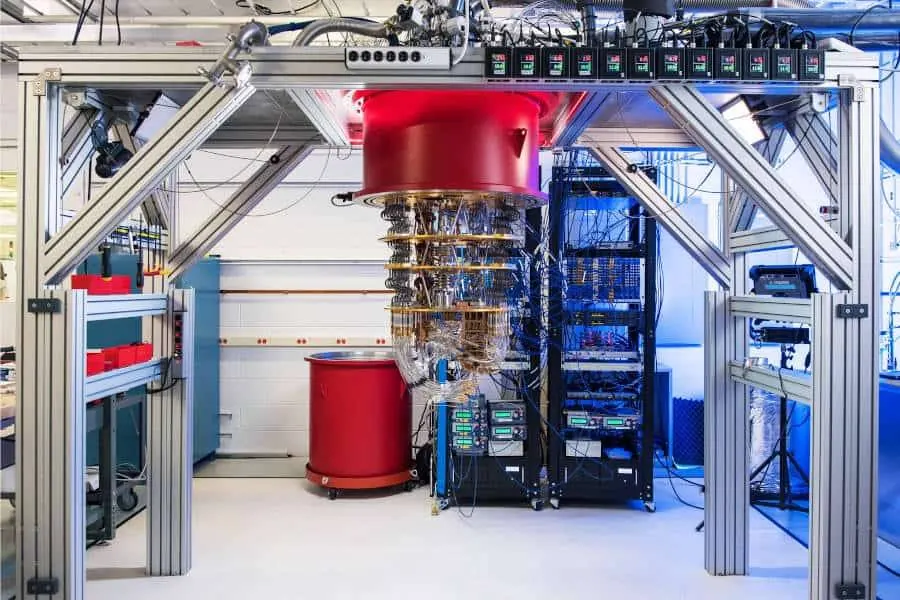
QC3's solicitation made hardware choice a gating requirement: every applicant had to submit a letter of intent from a quantum hardware provider as part of its application. Five of the nine selected teams are led by hardware companies running their own machines. QuEra is the external hardware partner for three of the remaining four, and its scientists are co-PIs on all three.
The attraction is the architecture. Neutral atoms are identical by nature, controlled wirelessly by lasers rather than by on-chip wiring, and reconfigurable: the atoms can be rearranged into different connectivity patterns. That reconfigurability is a genuine lever for both algorithm design and error correction, because it lets researchers reshape the machine to fit the problem instead of the other way around.
QuEra has published receipts for this approach. With Los Alamos National Laboratory, the company published a transversal STAR architecture in PRX Quantum in June 2026 that delivered up to 250 times faster execution with roughly half the physical qubits of conventional fault-tolerant approaches for structured quantum simulation, achieved by co-designing error correction around neutral-atom reconfigurable connectivity. Separately, algorithmic fault tolerance published in Nature in 2025 reduced runtime overhead by 10 to 100 times for reconfigurable architectures. "QuEra's architecture and software stack give researchers exceptional flexibility to co-design quantum error correction and fault-tolerant applications with the hardware itself," said Shengtao Wang, QuEra's VP of Algorithms and Applications.
QuEra's updated roadmap targets 1,000 logical qubits by 2029, which the company says provides ample headroom for a program that will validate at roughly 100 logical qubits.
The honest accounting
None of this is a promise that quantum chemistry is solved. One hundred logical qubits is a validation milestone, not a production machine, and the hundredfold classical improvement is a target, not a result. The program runs three years precisely because the work, demonstrating that co-designed quantum simulations of real materials beat classical supercomputers at scales that matter for industry, has not been done yet.
But the framing is the point. As federal funding has moved quantum chemistry from theory toward targeted programs, the field's value is increasingly being argued in terms of specific energy applications rather than abstract supremacy. QC3's structure, concrete energy targets, hardware locked in from day one, and compounding improvements across the full stack, is the most disciplined version of that argument the DOE has made. If the co-design thesis holds, the payoff will not be a single headline machine. It will be quieter: better batteries, better magnets, better catalysts, computed atom by atom.
0 Comments