
For most of quantum computing's commercial history, using a quantum processor meant submitting a job to a remote machine and waiting. On October 13, French photonic quantum company Quandela outlined a different vision: a quantum processing unit (QPU) sitting inside the same rack as your GPUs, exchanging data with them in real time. At NVIDIA GTC Berlin (October 20 to 22), it will showcase a hybrid AI-to-quantum demonstrator in which an AI workflow on an NVIDIA DGX Spark passes data directly to Quandela's FPGA-based Quantum System Controller through NVIDIA's NVQLink interconnect.
Why the wiring matters more than the qubit count
Most near-term quantum workloads are hybrid. Variational algorithms, quantum machine learning, and error mitigation alternate rapidly between classical optimization and quantum execution, sometimes thousands of times per run. Every round trip between the classical machine and the QPU adds latency, and the bill compounds. For photonic systems, which can run at very high repetition rates, a slow control link becomes the throughput bottleneck regardless of how fast the quantum hardware itself is.
NVQLink is NVIDIA's answer: an open reference architecture for low-latency, real-time integration between quantum hardware and NVIDIA accelerated computing, built on the CUDA-Q platform for hybrid quantum-classical workloads. The CPU orchestrates the application, the GPU handles the intensive classical and AI computation, and the photonic QPU is called for selected workloads where quantum processing may provide an advantage, with data moving between them over NVQLink instead of through a network queue.
Quandela validated the low-latency path with a physical photonic QPU earlier in 2026 at ISC High Performance in Hamburg. The GTC Berlin demonstrator extends that into a full workflow: a reservoir-computing use case with a dashboard tracing the pipeline from classical data preparation to quantum processing to the result.
The next challenge for quantum computing is not simply to make QPUs available. It is to make them work naturally inside the computing infrastructures that researchers and companies already use. (Jean Senellart, Chief Technology and Product Officer, Quandela)
What reservoir computing has to do with it
Enjoying this story?
Get the five most important stories in tech, every morning. Free.
Reservoir computing uses a fixed, randomly connected network driven by an input signal, with only a simple readout layer trained to produce the desired output. Because the reservoir itself is never trained, the method is computationally cheap and well suited to time-series prediction and signal processing. Researchers have explored quantum reservoirs, physical quantum systems whose dynamics stand in for the random network, as a way to process data in higher-dimensional spaces than a classical reservoir can reach.
Using reservoir computing as the demo workload is deliberate. It is a concrete hybrid task where the classical side does the heavy lifting (data preparation, training the readout) and the quantum side handles a well-defined transformation, exactly the division of labor the GPU-QPU architecture is designed for. It also sidesteps the hardest question in quantum machine learning, whether any of this beats classical methods, by framing the demo around integration.
The fine print, stated plainly
Honesty about what is and is not being shown matters. For the GTC Berlin exhibition, the QPU itself is simulated. Quandela says the setup reproduces the system architecture and interaction model already validated with a physical photonic QPU, and that the simulation exists to make the GPU-to-QPU workflow visible on an exhibition floor. The demonstration proves the integration model, not a new quantum benchmark.
That is consistent with the industry's broader shift. Quandela is not alone in the accelerator argument: around 20 quantum hardware companies, including London-based ORCA Computing, have engaged with NVQLink since October 2025, and the hybrid model now dominates commercial quantum strategy. The open question is not whether QPUs will join classical infrastructure, but how much latency the integration layer can eliminate and which workloads benefit.
Photonic computing's practical pitch
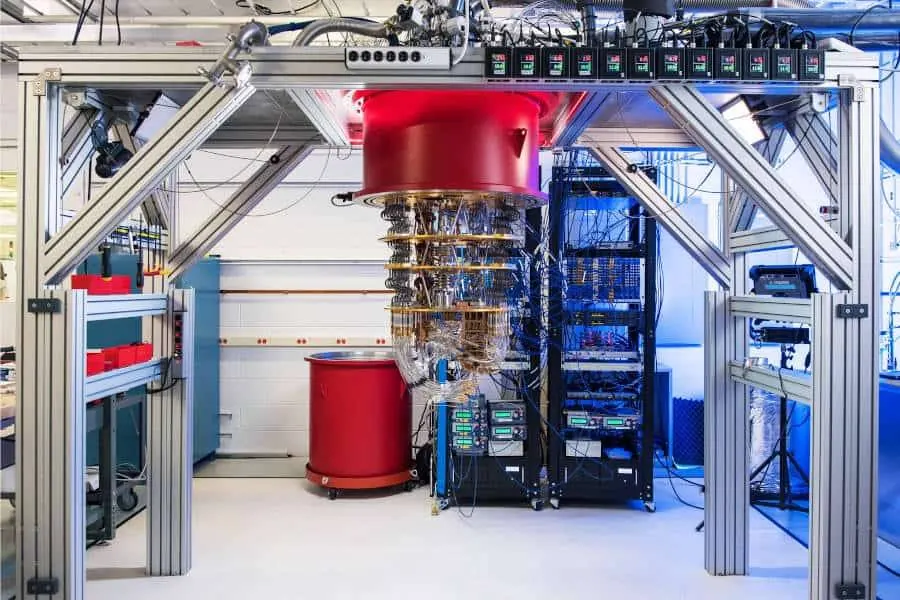
Quandela's bet rests on photons. Unlike superconducting systems, photonic quantum computers do not require dilution refrigerators or near-absolute-zero operating temperatures, which simplifies data center integration. Founded in 2017 as a spinout of the Institut d'Optique Graduate School, the company builds gate-based photonic machines around semiconductor quantum-dot single-photon sources and has been deploying industrial-grade systems since 2023.
The track record behind the pitch: in October 2025, Quandela delivered its 12-qubit Lucy photonic system to the CEA, installed at the TGCC supercomputing center in France under the EuroHPC Joint Undertaking, where it runs alongside the Joliot-Curie supercomputer as part of France's Hybrid Quantum Infrastructure program. In November 2025 it partnered with OVHcloud to offer its Belenos (12-qubit) and Canopus (24-qubit) processors on a sovereign European cloud. The company has raised above 100 million euros in total funding.
Quandela's GTC Berlin showing will not settle who wins photonic quantum computing. But it signals where the company thinks the fight is moving: not to the qubit with the best specs, but to the processor that fits most naturally into the machine room that already exists.
0 Comments