
This week, the most consequential electric aviation deal in India did not involve a single aircraft changing hands. Ubifly Technologies, the Chennai-based deep-tech startup behind The ePlane Company, signed a memorandum of understanding with Noida International Airport to build the ground side of the air taxi business: vertiports, charging stations, standard operating procedures, and a vertiport management system built specifically for electric aircraft. No aircraft were ordered. No launch date was promised. The modesty is the point. India is trying to make air taxis work by preparing the airport before the aircraft ever shows up.
The agreement, reported by Construction Business News Middle East and Urban Acres this week, sets up a joint framework rather than a purchase contract. Yamuna International Airport Private Limited, the airport operator, will allocate space inside the airport for proof-of-concept trials, vertiport facilities, and charging infrastructure, and will align its own standard operating procedures to accommodate eVTOL services. The ePlane Company handles the aircraft side: clearances from the Directorate General of Civil Aviation and the Bureau of Civil Aviation Security, prototyping, and flight testing of its flagship e200X. Together, the two will engage regulators, air traffic control, and state governments to establish safety frameworks, a vertiport management system, and AI-assisted fleet scheduling integrated with smart-city systems.
Infrastructure first, passengers later
The sequencing here is deliberately staged, and it is the most interesting thing about the deal. The ePlane Company's founder, Dr. Satyanarayanan Chakravarthy, has said that deploying electric air taxis requires the parallel development of ground infrastructure, regulatory frameworks, and operational procedures, not just a working aircraft. The initial trials will use drones to validate operational models before the company transitions to piloted e200X flights. The approach is designed so that the airport ecosystem, its pads, its chargers, its air traffic protocols, is ready by the time the aircraft earns its certification.
This is a contrast with how air taxi announcements usually go. Most eVTOL news is aircraft news: a first flight, a range claim, a certification milestone. Joby Aviation, for example, has logged more than 40,000 miles of flight testing and entered the FAA's final type-inspection phase with its first conforming aircraft. That hardware progress is real, but it keeps leaving the same question unanswered everywhere it happens: where does the aircraft land, who charges it, who schedules it, and whose rules does it follow on the ground? Noida is answering those questions in advance, in writing, with an airport operator.
Why an airport, and why this one
Enjoying this story?
Get the five most important stories in tech, every morning. Free.
Noida International Airport is an unusual partner precisely because it is still young. The greenfield airport in Uttar Pradesh is building its long-term master plan with a stated ambition of serving more than 70 million passengers a year, and it is folding advanced air mobility into that framework now rather than bolting it on later. The airport's chairman, Daniel Bircher, has tied the partnership to the airport's long-term vision of future-ready infrastructure and multi-modal connectivity, describing the goal as safe, zero-emission air transit plus vital emergency services for the Delhi-NCR region.
The air taxi industry has spent a decade perfecting aircraft. Noida is betting the missing piece was never the aircraft at all.
The intended services tell you where the commercial logic starts. The partnership is aimed at airport-to-airport transit, intra-city commuting, and emergency air ambulance services across the Delhi-NCR region. The air ambulance use case matters more than it might appear: Delhi's road congestion is notorious, and medical transport is the one air taxi mission that does not need a mass market to justify its economics. A few high-value, time-critical routes can sustain early operations while the commuter market figures itself out. That is a pragmatic reading of Indian traffic, and it is probably correct.
The aircraft and the factory behind it
The Noida Air Taxi Deal, in Numbers
Ubifly Technologies (The ePlane Company) and Noida International Airport
Note: figures from company and airport statements reported by Construction Business News Middle East and Urban Acres, October 2026.
The e200X is The ePlane Company's flagship program, and the hardware side of the story is advancing in parallel with the airport deal. The company recently unveiled the full-scale e200X PT-01 prototype, and ground testing is underway. The ePlane Company, an IIT-Madras incubated startup, has already secured Design Organisation Approval from the DGCA and is in the type certification pipeline, which puts it inside the regulator's formal process rather than outside it. Its manufacturing facility at Thaiyur, on the outskirts of Chennai, is targeting an initial production scale of 80 aircraft by 2028.
The money behind that ramp-up is also government money, of a sort. The company has received approximately Rs 285 crore as optionally convertible debt under India's Research, Development and Innovation programme, a public financing channel designed to back deep-tech industrialization. That funding, plus the prototype and the factory, gives the Noida partnership its industrial base. The airport deal covers the part that no factory can build: the operating system on the ground.
A global pattern, with an Indian accent
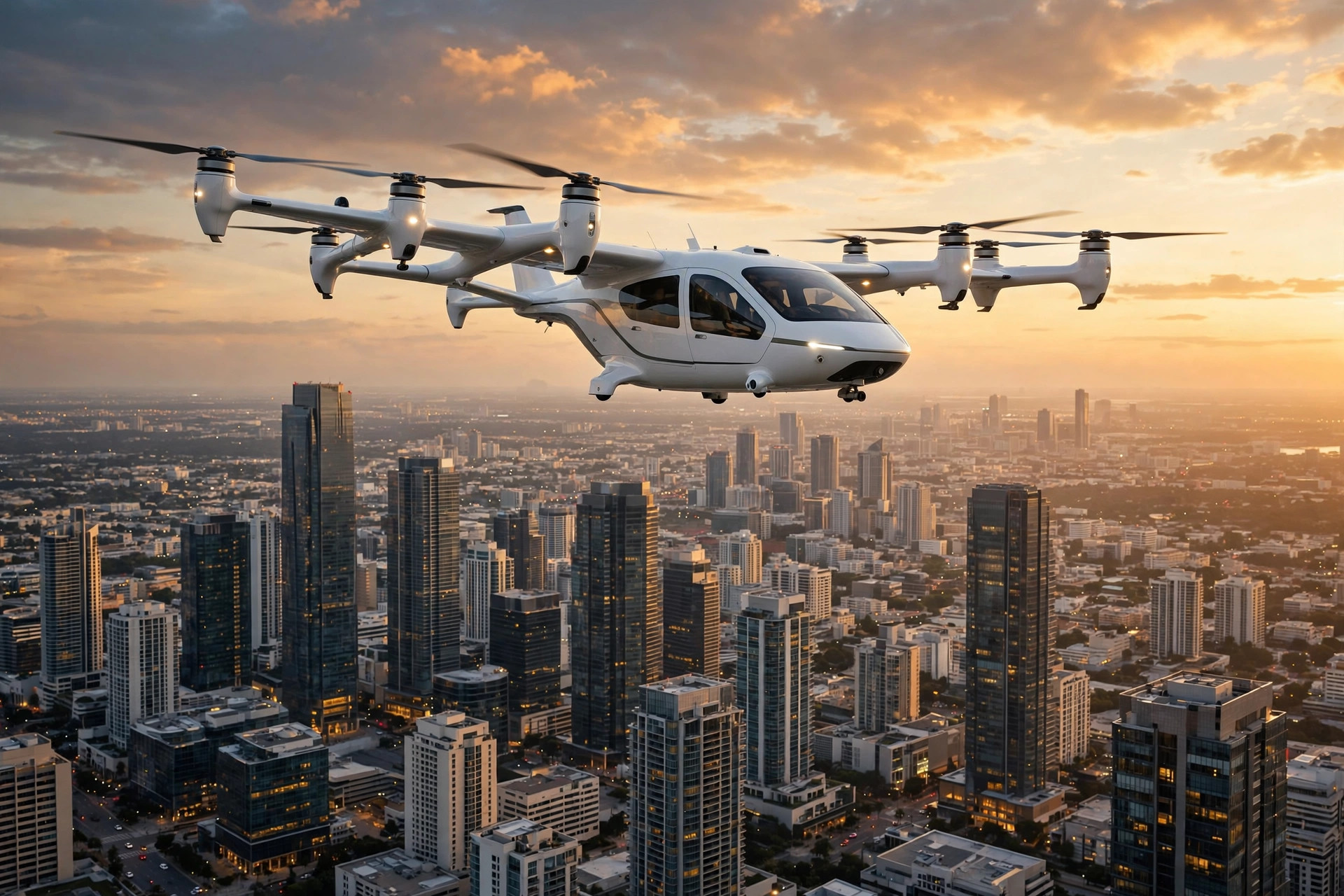
This is not happening in isolation. Dubai's first commercial vertiport, developed by Skyports Infrastructure with the Roads and Transport Authority near Dubai International Airport, has reached technical completion ahead of initial operations targeted before the end of 2026, with Joby's aircraft as the launch vehicle. North Carolina has begun flying eVTOL demonstration flights under the FAA's Integration Pilot Program, with Joby and BETA Technologies running routes between regional airports. The global shape of advanced air mobility is converging: the aircraft makers fly, the infrastructure builders build, and the regulators watch both.
What makes the Noida deal distinct is the direction of the relationship. In Dubai, the vertiport exists to serve an aircraft that is already nearly certified. In Noida, the vertiport, the charging stations, and the management software are being developed alongside an aircraft that is still working through its certification pipeline, with drone trials filling the gap in the meantime. It is a bet that the binding constraint on air taxis was never vertical lift. Batteries got good enough, motors got efficient enough, and the aircraft started flying. The hard part turned out to be everything around them: the pad, the plug, the procedure, and the permission. Noida is trying to solve that part first.
0 Comments