
At Kennedy Space Center in Florida, the rocket that will carry astronauts back to the surface of the Moon is starting to look like a rocket. NASA announced on October 13 that teams have completed the integration of the final solid rocket booster motor segments for the Artemis III Space Launch System, and that all four RS-25 engines are now installed on the SLS core stage.
The milestone brings the agency one step closer to a mission more than fifty years in the making: the first crewed lunar landing since Apollo 17 left the Moon in 1972. Artemis III is designed to send four astronauts to lunar orbit and put two of them down near the lunar south pole, a region no human has ever set foot on. Before that can happen, the 322-foot rocket has to be assembled, tested, and proven flight-ready, and this week's stacking work is the visible part of that grind.
The first crewed lunar landing since 1972 is now a matter of assembly, testing, and rehearsal.
The short stack takes shape
The hardware currently going together in the Vehicle Assembly Building is known as the "short stack": the two solid rocket boosters plus the core stage, without the upper stage and Orion spacecraft that will ride on top. The boosters are the muscle of the vehicle. Each is a five-segment solid rocket booster, and together the pair generates 7.2 million of the rocket's 8.8 million pounds of thrust at liftoff, with each booster burning through its propellant in about two minutes.
With the final booster segments now sitting on top of the mobile launcher, attention turns to the core stage. The four RS-25 engines are installed, and next comes the systems tunnel, a structure that runs the length of the 212-foot stage and routes the pyrotechnic cabling that allows the rocket's single-use quick disconnects to function during liftoff. In the coming weeks, NASA says, the core stage will be mated with the boosters to complete the short stack configuration.
Next comes a tanking test: NASA plans to roll the short stack from the Vehicle Assembly Building out to Launch Pad 39B in the coming months, where the Artemis launch team will practice the procedures and timelines for loading propellant. It is an unglamorous but critical step, the point where teams learn whether months of assembly work actually behave the way the paperwork says it will.
A launch day rehearsal with the crew
Enjoying this story?
Get the five most important stories in tech, every morning. Free.
The tanking test will not be a crew-only or hardware-only exercise. While the rocket is at the pad, the Artemis III crew (NASA astronauts Randy Bresnick, Frank Rubio, and Andre Douglas, plus ESA astronaut Luca Parmitano) will conduct a launch day rehearsal and an emergency exit walkdown. That means suiting up in the crew quarters, riding out to the pad, climbing the mobile launcher, and walking through the exact route they would take if an emergency forced them off the rocket during the countdown.
Pad 39B itself has been getting work too. Teams are refurbishing the flame deflector, which saw only minimal damage after the Artemis II launch, and the flame trench bricks were unaffected thanks to ground support improvements made after Artemis I in 2022. Each flight teaches the ground systems something, and the pad gets a little more resilient each time.
Orion and the adapters are catching up
Artemis III SLS: By the Numbers
Hardware status at Kennedy Space Center as of October 13, 2026.
While the rocket's lower stages come together in Florida, the Orion spacecraft is advancing on a parallel track. Engineers from ESA and Airbus recently inspected Orion's solar array wings, the four panels that deliver power to the European Service Module, which provides propulsion, thermal control, electrical power, and air and water for the crew.
At NASA's Marshall Space Flight Center in Huntsville, Alabama, the forward and aft rings have been welded on the Artemis III spacer, completing its primary structure. The spacer stands in for the upper stage's dimensions during the mission, and dimensional checks are now underway. Engineers are also converting two existing structural test articles, the Orion stage adapter and the launch vehicle stage adapter, into flight-ready hardware. The Orion stage adapter has been repainted and is awaiting cables and brackets; the launch vehicle stage adapter has undergone inspection and corrosion removal, with nondestructive evaluation beginning this fall followed by coating, painting, and thermal protection foam. The spacer and both adapters remain on track to ship to Kennedy early next year.
Training for a landing nobody has ever attempted
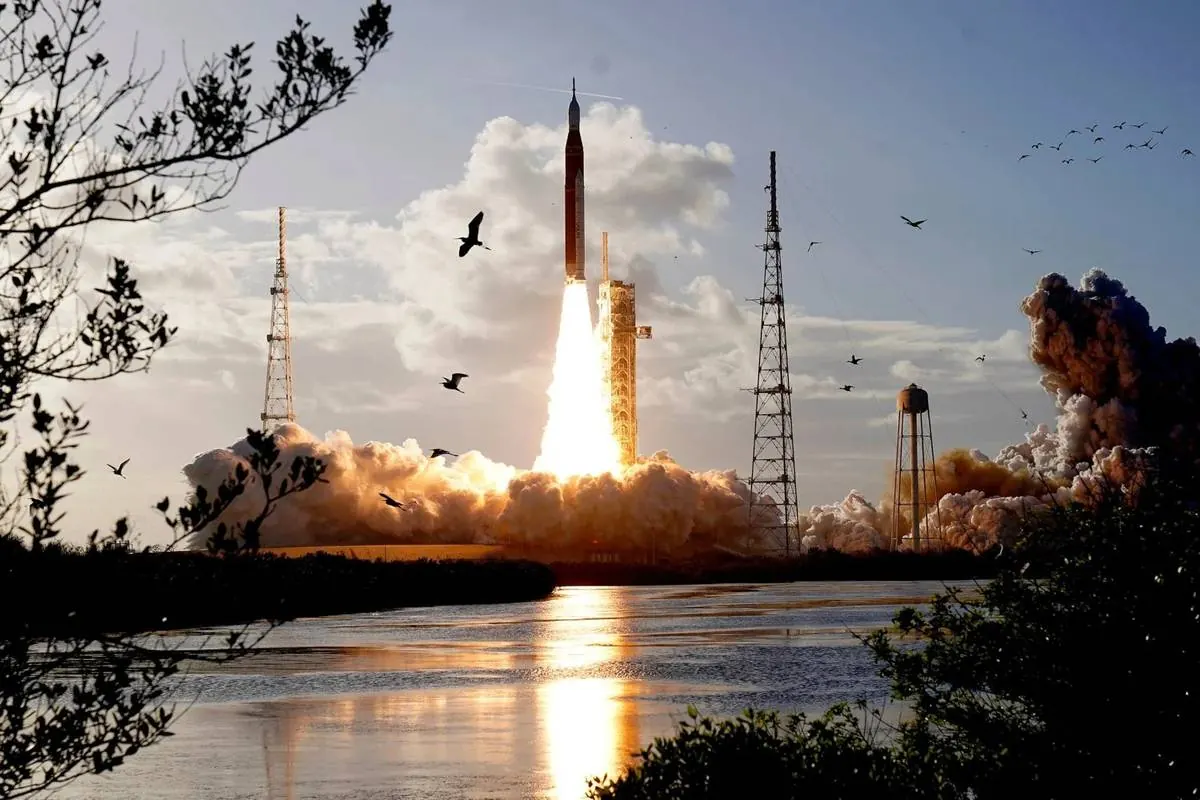
The four-person crew has been in training well beyond the pad rehearsal. Recently they worked with a flywheel exercise device, a compact machine about the size of an extra-large shoe box that uses pulleys and a torque limiter to mimic a rowing machine, providing aerobic, resistive, and rowing workouts with straps attached to a bar or harness. Astronauts need countermeasures against bone and muscle loss on long missions, and compact equipment like this is designed for the confined quarters of a spacecraft.
Nutrition has gotten serious attention too. At NASA's Space Food Systems Laboratory in Houston, the crew sampled nearly 200 menu items to pick their favorites for the mission. They have completed helicopter underwater egress training, escaping from a submerged, upside-down mock helicopter cabin in a pool to prepare for off-nominal water landings. Last week, some crew members traveled to San Diego for recovery training with NASA and military partners, practicing water lifts by U.S. Navy helicopters. This week they ran suited training in the Orion Crew Survival System Suits, covering communication system checks, emergency equipment handling, contingency drills, and cabin configuration.
In September, the full crew and backup astronauts visited Florida together for the first time since the crew announcement earlier this year. They saw their Orion spacecraft, the integrated boosters on the mobile launcher, and the core stage in final processing. They also visited commercial partners SpaceX and Blue Origin to get oriented with the lunar lander providers' progress, since the landing itself depends on a commercially built vehicle to ferry two astronauts from lunar orbit to the surface and back.
What this milestone actually signals
Booster stacking is not the kind of event that draws headlines the way a launch does, but within NASA's Artemis program it is one of the most reliable schedule indicators. The SLS stack is a serial process: boosters, then core stage, then adapters and Orion, then integrated testing. Each completed step locks in the ones behind it. The agency is targeting a 2027 launch for Artemis III, and the steady drumbeat of hardware milestones like this one is how NASA demonstrates the date is real rather than aspirational.
Artemis III is not a repeat of Apollo. The mission profile sends crew to the lunar south pole, a region of permanent shadow and rugged terrain that holds water ice deposits scientists want to study, and the lander, descent profile, and modern spacesuits are all new development. A stacked booster does not solve any of that. But it does mean the rocket, the oldest and best-understood part of the architecture, is coming together on something resembling a schedule.
0 Comments