
This week, Maryland made its clearest statement yet about where it intends to sit in the quantum computing race. Governor Wes Moore joined University of Maryland president Darryll J. Pines and IonQ CEO Peter Chapman to announce that IonQ, the trapped-ion quantum computing company, will build a 100,000-square-foot facility in UMD's Discovery District: a combined headquarters, data center, laboratories, and office space. IonQ also committed to doubling its Maryland workforce to at least 250 people over the next five years.
The announcement is the anchor move in what the state calls its "Capital of Quantum" initiative, a public-private partnership that aims to catalyze $1 billion in total investment. The state's own starting commitment is comparatively modest: $27.5 million in Moore's FY 2026 budget submission. The strategy is that a relatively small public seed unlocks far larger federal and private capital. Moore signed an executive order in early 2025 designating quantum computing a priority industry for state investment, and the facility announcement, made this week subject to budget approval, is the first flagship corporate commitment to land inside that framework.
Eighteen months of groundwork
The IonQ facility is not a standalone bet. It caps a year and a half of deliberate infrastructure building. In April 2025, DARPA and the state signed a memorandum of agreement establishing the Capital of Quantum Benchmarking Hub at UMD's Applied Research Laboratory for Intelligence and Security. Each side committed up to $100 million over four years, contingent on progress, with an explicit mandate: independently evaluate whether commercial quantum approaches can reach utility-scale performance, the point where a quantum computer's useful output exceeds its cost.
Other arrivals followed. Microsoft announced a 15,000-square-foot Quantum Research Center in the Discovery District in September 2025, including classified research zones and direct DARPA access for its Majorana-based topological qubit program. IQM opened its first U.S. quantum technology center in April 2026, focused on integrating superconducting processors with high-performance computing providers. Maryland's FY27 budget added $20 million toward IonQ's global headquarters, $22 million for UMD's Quantum Startup Foundry and national testbeds, $20 million for a dedicated Deep Tech Facility, and $12 million for the Applied Research Laboratory for Intelligence and Security and quantum faculty recruitment. Quantum Motion established a silicon-CMOS hardware base in June 2026, and in September 2026 Riverlane planted its U.S. headquarters in College Park while QuEra added neutral-atom systems to the mix.
Maryland is not recruiting quantum companies with tax breaks and hoping a cluster forms. It is building the shared infrastructure first and letting companies plug into it.
Five ways to build a qubit, one corridor
Enjoying this story?
Get the five most important stories in tech, every morning. Free.
What makes the College Park corridor unusual is not the number of companies but the spread of physics. Five distinct qubit approaches are now co-located: trapped ions at IonQ, topological qubits at Microsoft, superconducting circuits at IQM, silicon-spin CMOS at Quantum Motion, and neutral atoms at QuEra. Riverlane, an error-correction specialist, adds the software layer that every one of these approaches needs to turn noisy physical qubits into reliable logical ones.
That concentration matters because of the benchmarking hub. A single facility evaluating multiple architectures against the same federal criteria can produce comparative performance data that the industry currently lacks. In a field where every architecture carries its own scaling tradeoffs, credible third-party measurement is scarce. It is also, as industry analysts have noted, a double-edged sword for the companies involved: strong results bring credibility, weak ones bring exposure. That is arguably the point. A hub designed to separate viable approaches from marketing claims is more valuable than one designed to flatter everyone.
The honest caveats
Maryland's Quantum Capital, in Numbers
The state's quantum investment stack as of October 2026 (bars scaled to the $1 billion target).
Note: The $1 billion is a five-year target, not committed funding. DARPA and Maryland hub commitments are each up to $100M over four years, contingent on progress.
A sober reading of this week's news is in order. A 100,000-square-foot building is real estate, not a quantum computer, and IonQ has not disclosed the data center's scope or which systems it will house. The $1 billion figure is a target, not a committed sum; the money confirmed so far, from state seed funds, the DARPA agreement, Zupnik Hall, and the FY27 budget lines, is a fraction of it. Workforce pledges, even from a public company, stretch over five years and depend on the business growing into the space.
The deeper question is the one the Quantum Computing Report flagged in its September analysis of the cluster: research centers are not the same as commercial deployment. Maryland has assembled benchmarking capacity, a talent pipeline (UMD's quantum faculty exceeds 200 researchers, one of the largest concentrations anywhere), a university-industry testbed in the National Quantum Laboratory that UMD runs with IonQ, and a startup accelerator in the Quantum Startup Foundry. The test of all of it is whether companies in the corridor win contracts and ship systems because of their Maryland position, not whether they cut ribbons there.
A busy week for quantum, beyond Maryland
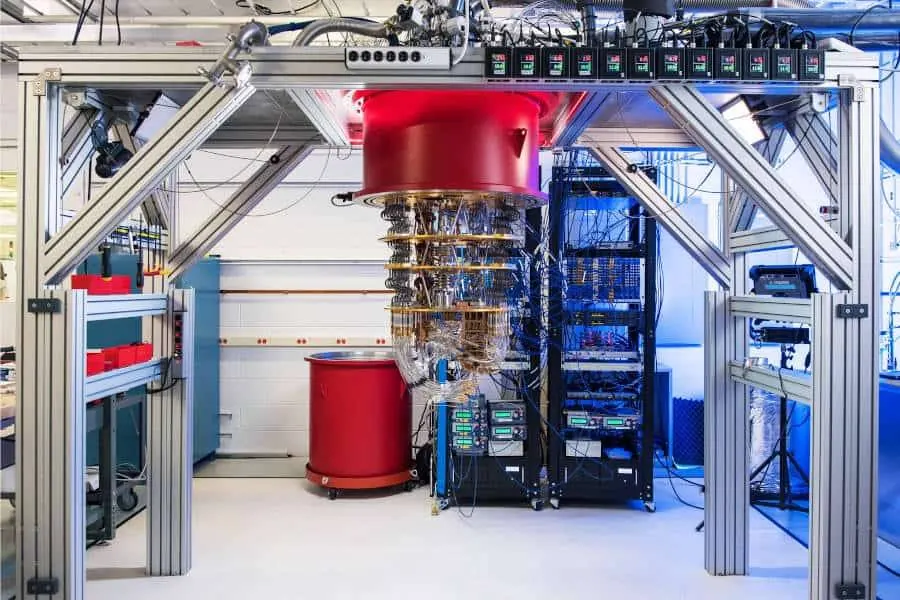
Maryland's announcement was not the only quantum news this week. IonQ also disclosed a $21.1 million project with the U.S. Air Force Research Laboratory to install quantum networking infrastructure at the Innovare Advancement Center in Rome, New York, a reminder that quantum networks, the plumbing for linking quantum processors across distances, are attracting defense dollars alongside the computers themselves. On the funding side, SEEQC, a New York startup building a "quantum computing system on a chip" based on superconducting circuits, raised $30 million from investors including Booz Allen Ventures and NordicNinja. And Australian startup Quantum Brilliance, which builds room-temperature quantum computers using diamond-based qubits, closed a $20 million Series A led by Main Sequence, In-Q-Tel, and Intervalley Ventures, with part of the money earmarked for a quantum diamond foundry.
The pattern across these stories is consistent: capital is flowing not just to bigger qubit counts but to the unglamorous scaffolding around them, control systems, error correction, foundries, networking, and independent testing. That is a sign of a maturing industry. Nobody is promising that a quantum computer will crack public-key cryptography next year. But states, defense agencies, and investors are now paying for the infrastructure that would make the next decade of the technology measurable, testable, and eventually deployable. Maryland is simply the furthest along in treating that scaffolding as the strategy itself.
0 Comments