

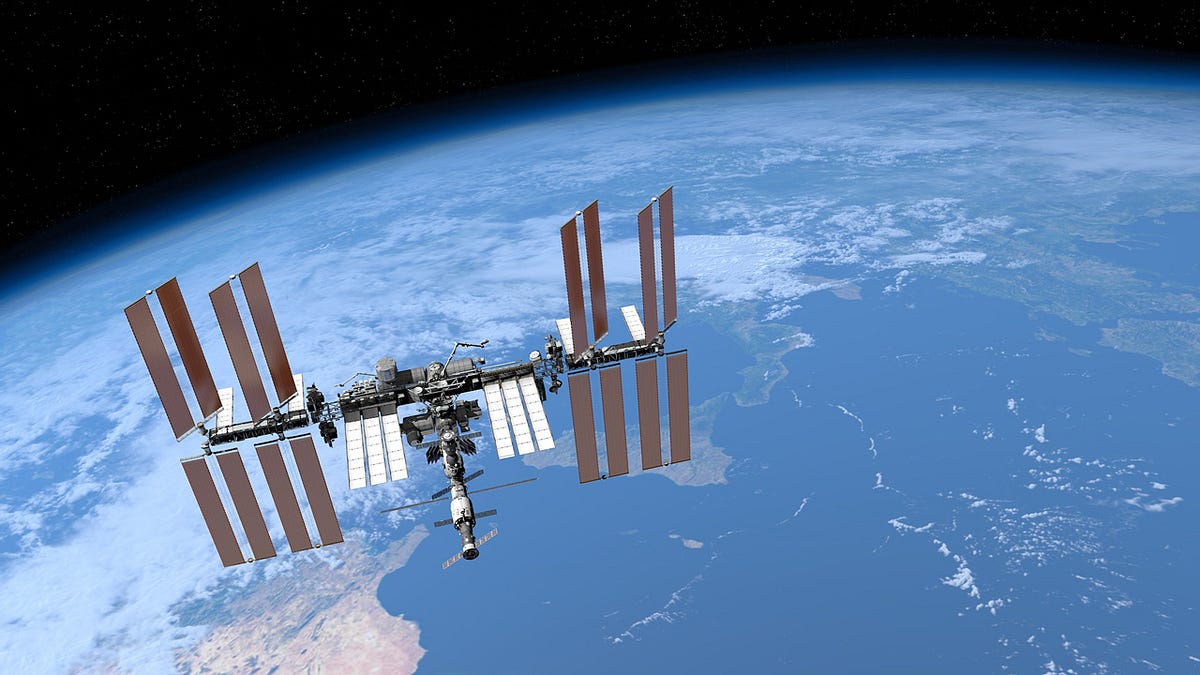
For nearly three decades, there has not been a single day without humans living in space. That streak is about to end. The International Space Station, humanity's longest-running orbital outpost, is entering its final years, with a controlled deorbit planned before the decade closes. When it goes, it will take an era with it.
What comes next isn't a single replacement. It's a fragmentation: commercial stations, national programs, lunar infrastructure, and eventually Mars, all competing and cooperating in a space economy the ISS era only hinted at.
Why the ISS has to go
The station is old. Modules designed for 15-year lifespans are pushing 30. Maintenance costs run into the billions annually, consuming a share of NASA's budget that the agency increasingly wants to redirect toward the moon and Mars. Micro-meteorite strikes, aging seals, and the slow accumulation of structural fatigue make continued operation a growing risk.
There's also a geopolitical reality. The ISS was built on a US-Russia partnership that made sense in the 1990s and makes progressively less sense now. The partnership has held through remarkable strain, a testament to the engineers on both sides, but nobody is designing the next station around it.
For nearly three decades, there has not been a single day without humans living in space. That streak is about to end.
The commercial handoff
Enjoying this story?
Get the five most important stories in tech, every morning. Free.
NASA's plan is deliberately different this time: instead of building the next station, it's buying rides on commercial ones. Several companies are building ISS successors with NASA as an anchor tenant rather than owner. The model mirrors what SpaceX did for launch: the government sets requirements and guarantees demand, private companies build and operate.
The economics are compelling. A commercial station can host government astronauts, private researchers, and eventually tourists, spreading costs across customers. Early designs emphasize manufacturing: fiber optics, pharmaceuticals, and semiconductors that benefit from microgravity, products valuable enough to justify the orbital overhead.
Meanwhile, the moon
From ISS to What Comes Next
The changing landscape of crewed spaceflight.
Note: For illustrative purposes only.
Orbital stations are only half the story. The Artemis program is building toward a sustained lunar presence, and the pieces are falling into place: the heavy-lift rockets, the landers, the spacesuits, the surface habitats. The moon is where the long-term action is, water ice for fuel, a launchpad for Mars, and the scientific prize of the solar system's best-preserved history.
The ISS deorbit and the lunar buildup are connected. NASA can't afford both at full funding, and the agency has made its choice: the future is the moon, then Mars. Low Earth orbit becomes a commercial zone. Deep space stays a government-led frontier, at least for now.
The gap nobody wants to talk about
Here's the risk: the ISS deorbits before its replacements are ready. Schedules in spaceflight slip, always, and a gap of even a year or two without continuous human presence in orbit would break a streak that has defined the space age. China, notably, will have no such gap; its Tiangong station is operational and expanding.
The transition from ISS to whatever comes next is the most consequential handoff in spaceflight history. Get it right, and humanity steps into a multi-player, commercial space economy. Get it wrong, and we spend the 2030s watching from the ground, wondering what happened to the future.
What the ISS taught us
It's worth pausing to appreciate what the station accomplished. Beyond the science, thousands of experiments in materials, medicine, and fundamental physics, the ISS proved that sustained international cooperation in space is possible even when terrestrial relations collapse. It trained a generation of engineers, inspired millions of students, and gave humanity its first permanent foothold off Earth.
The less visible legacy is operational knowledge: how to keep humans alive in space for a year at a time, how to maintain complex systems with limited resupply, how to coordinate multinational crews across languages and cultures. That knowledge doesn't deorbit with the station. It transfers to every program that follows.
The Mars question
Every conversation about the post-ISS era eventually reaches Mars. The red planet remains the horizon goal, the thing that justifies the infrastructure. Current timelines suggest the first crewed Mars missions in the late 2030s, using the moon as a proving ground for the life support, propulsion, and surface operations the longer journey demands.
Skeptics note that Mars timelines have slipped for fifty years and will slip again. Optimists counter that the commercial space industry has a habit of doing the "impossible" a decade after experts declare it so. Both have been right before. The honest position: Mars is coming, but the date is a guess dressed as a plan.
What isn't a guess is that the ISS era is ending. The only question is what we build on its foundations, and whether we build it in time.
The view from the ground
For most people, the ISS was a bright dot crossing the night sky, a reminder that humans live above us. Its end marks something emotional as well as technical: the close of the chapter when spaceflight meant governments cooperating on a single shared outpost. What replaces it will be messier, more commercial, more competitive, and probably more dynamic.
The optimists see a Cambrian explosion: dozens of stations, lunar bases, orbital factories, a space economy measured in trillions. The pessimists see fragmentation and a lost commons. Both futures are visible from here. Which one arrives depends on decisions being made right now, in budget hearings and boardrooms, about what humanity's presence in space is actually for.
156 Comments