
A quantum particle is tunneling between two sites on a tiny lattice built from trapped ions, with no magnetic field anywhere it can touch. But when the researchers threaded a loop of magnetic flux through the space around its path, the particle stopped dead: its two possible routes canceled each other out, perfectly. That is the Aharonov-Bohm effect, one of quantum mechanics' oldest and strangest predictions, observed here for the first time with both the matter and the magnetic flux itself as fully dynamical quantum objects.
Published in Nature Physics in October 2026 by a University of Oxford team led by Sebastian Saner, with theorist Alejandro Bermudez of the Instituto de Fisica Teorica in Madrid, the experiment also demonstrates a new kind of quantum simulator: a hybrid machine in which qubits and quantum oscillators play different physical roles, modeling matter and force fields together in real time.
The effect that never touches
In 1959, physicists Yakir Aharonov and David Bohm predicted that a charged particle traveling around a region containing a magnetic field would pick up a measurable phase shift, even though it never passes through the field itself. Confirmed decades later with real electrons, but always with the magnetic field supplied as a fixed background, like scenery in a play.
The Oxford team asked what happens when the scenery becomes a character. In their experiment, the "magnetic flux" was no magnet in the lab: it was encoded in the quantum state of the gauge fields themselves, dynamical participants in the same quantum evolution as the matter particle. Nothing was held fixed, and that had never been done before.
Two kinds of quantum objects, one machine
Enjoying this story?
Get the five most important stories in tech, every morning. Free.
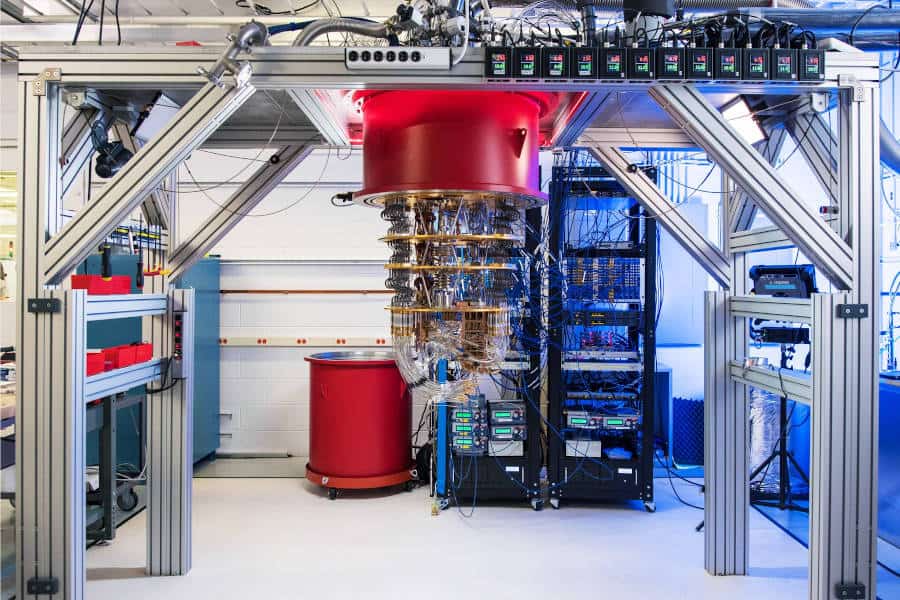
The machine is a trapped-ion quantum computer, but a hybrid one. Qubits, encoded in the electronic states of strontium ions, represent the gauge fields, the force-carrying side of the theory. The matter is represented by the collective vibrational modes of the ion crystal, quantum harmonic oscillators that naturally encode bosonic matter. Mixing discrete qubits with continuous oscillators lets the bosonic character of matter emerge without the truncations of purely qubit-based encodings.
The control is hybrid too. Digital gates prepare the initial states, suppress errors, and read out the results, while the time evolution runs as an analog process under an engineered Hamiltonian with the right symmetry. A pair of qubit-state-dependent forces, each detuned from a different vibrational mode, produces exactly the correlated hop that Gauss's law demands: a matter particle tunnels, and the gauge field flips in lockstep.
First the link, then the loop
The Experiment at a Glance
Oxford's hybrid quantum simulation of the Aharonov-Bohm effect, by the numbers.
Sources: Saner et al., Nature Physics (2026), DOI 10.1038/s41567-026-03400-6; arXiv:2507.19588. Bar widths illustrative. For illustrative purposes only.
The team started with the simplest building block: a single link, one ion carrying both a gauge qubit and two motional modes as matter sites. Initialized with a single matter excitation, the system performed the predicted choreography: as the charge tunneled between sites, its attached electric field line stretched and compressed in lockstep. Raising the electric field energy, making it costly to stretch the field line, slowed tunneling and shrank it: a direct precursor of confinement, the mechanism that binds quarks inside protons, in its simplest possible form.
The particle never crossed the magnetic field. The field was never even a magnet, just a pattern of quantum entanglement. And the particle stopped anyway.
A vison walks in, tunneling walks out
Then came the loop. A second ion created the minimal geometry in which magnetic flux can exist: two gauge qubits and two matter oscillators, arranged in a square. The researchers encoded the flux in entangled Bell states of the two gauge qubits. That began as a practical workaround, the hardware could not generate flux the conventional way, and turned out to be the scientifically interesting route, because it made the gauge field itself dynamical.
With the gauge fields in the Bell state for zero flux, the matter excitation tunneled freely around the loop, its two possible paths interfering constructively at an enhanced rate. With the fields in the orthogonal Bell state, a flux of pi corresponding to a flux excitation called a vison, the two paths acquired a relative phase of pi and interfered destructively. Tunneling was suppressed completely. The charge stayed put, frozen by an interference effect it could never directly see, only feel.
The team checked that the flux itself survived the process: the flux observable, measured through the correlation between the two gauge qubits, stayed constant throughout, confirming the Aharonov-Bohm phase was conserved even as matter and gauge became entangled. Simulations built from independently calibrated error sources, including motional heating of hundreds of quanta per second on the most fragile mode and qubit dephasing, reproduced the data closely, with echo sequences refocusing the dominant dephasing noise.
What it is, and what it is not
Time for precision, because quantum results get oversold reflexively. The system was tiny: two ions, two qubits, two oscillators, all easily simulated by a classical computer; nobody claims otherwise. The gauge group, Z2, is the simplest non-trivial choice, a group of just two elements, while the Standard Model runs on the continuous groups U(1), SU(2), and SU(3). This is a prototype, not a machine that can do anything useful yet.
But prototypes are the point. Previous Z2 simulations were confined to one-dimensional chains, where visons and topological effects do not exist, or they enforced Gauss's law to eliminate the matter degrees of freedom entirely, so the interplay between dynamical matter and dynamical gauge fields could never be observed. The Oxford machine keeps both. And because the matter sites are genuine oscillators, the platform can host squeezed states whose Hilbert spaces grow with the squeezing magnitude, hinting at classically intractable dynamics on surprisingly small lattices.
Z2 theories are not arbitrary toys, either. They describe frustrated magnets, superconductors, and quantum spin liquids, and are closely connected to topological quantum error correction, the schemes many researchers expect will eventually make quantum computers fault-tolerant. A simulator for this class of theories is a tool for two frontiers at once.
The Maryland twin
The Oxford paper arrived with a sibling. A University of Maryland group led by Norbert Linke, with first author Anton T. Than, published alongside it in the same Nature Physics issue, reporting quantum field theory dynamics on a spin-phonon quantum computer, including a simulation of the Yukawa potential relevant to nuclear and particle physics. The two groups worked independently and coordinated their submissions.
Where it goes from here
Synthetic dimensions, selectively addressing qubit-oscillator subsystems along a longer ion chain, could assemble chains of connected loops, triangular geometries, and even tetrahedral lattices, the simplest fully three-dimensional gauge theory, with only modest increases in hardware. The authors also sketch a three-way competition between tunneling, electric field energy, and Aharonov-Bohm interference to probe interference-driven localization in a gauge-invariant setting.
None of this will break encryption or design a room-temperature superconductor next year. What it does is narrower and more honest: it shows that a hybrid quantum machine can keep matter and force fields in the same dynamical picture and reproduce one of quantum physics' most counterintuitive effects in a regime where classical methods begin to break. Richard Feynman proposed in the 1980s that only quantum machines could efficiently simulate quantum physics. Four decades later, the machines are still small. They are also, steadily, getting real.
0 Comments